where is the thermal conductivity of the wall (constant at any point) and .
Considering as a function of the distance within the wall, we obtain a new expression for the conductive heat flow:
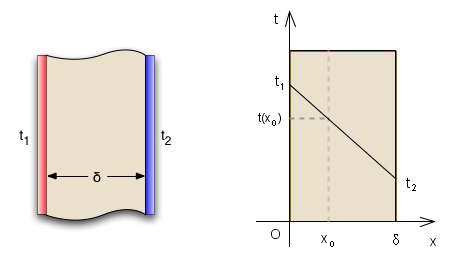
In the left figure of the following diagram you may notice that the distance x is considered starting from the hotter side of the wall, marked in red. Also in the right figure the value of is shown for a particular value of .
The example code below computes the value of for some particular input data.
Example 1
#include <codecogs/engineering/heat_transfer/conduction/hm_plane.h>#include <stdio.h>int main(){// the distance within the walldouble x = 0.165;
// the the thickness of the walldouble delta = 0.213;
// the temperature of the entry surface for the heat fluxdouble t1 = 32.257;
// the temperature of the exit surface for the heat fluxdouble t2 = 22.421;
// display the various input valuesprintf(" t1 = %.3lf\n t2 = %.3lf\ndelta = %.3lf\n", t1, t2, delta);
printf(" x = %.3lf\n\n", x);
printf("The temperature at distance %.3lf within the wall is %.5lf\n",
x, Engineering::Heat_Transfer::Conduction::hm_plane(x, delta, t1, t2));
return0;
}
Output
t1 = 32.257
t2 = 22.421
delta = 0.213
x = 0.165
The temperature at distance 0.165 within the wall is 24.63756
Note
The distance within the wall x must be a real positive number less than or equal to the thickness of the wall and it must be true that .
References
Dan Stefanescu, Mircea Marinescu - "Termotehnica"
Parameters
x
the distance within the planar wall (<i>meters</i>)
delta
the thickness of the planar wall (<i>meters</i>)
t1
the temperature of the heat flow at the entry surface (degrees Celsius)
t2
the temperature of the heat flow at the exit surface (degrees Celsius)
Returns
The temperature at distance x within the wall (<i>degrees Celsius</i>)