
I have forgotten
my Password

Or login with:

  • Facebookhttp://facebook.com/
  • Googlehttps://www.google.com/accounts/o8/id
  • Yahoohttps://me.yahoo.com

Thick Walled cylinders and Spheres

Analysis of the Strees and Strain in thhick walled cylinders Palstic Yielding and compound Tubes
+ View other versions (5)

Thick Walled Cylinders

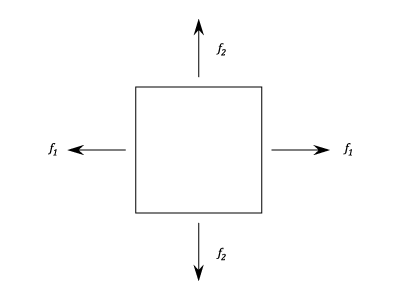
Under the action of radial Pressures at the surfaces, the three Principal Stresses will be \displaystyle p\;\;(Compressive)\;\;radially : \displaystyle f_1\;\;(Normally\;Tensile)\;\;Circumferentially and \displaystyle f_2\;\;(Normally\;tensile)\;longitudinally. These Stresses may be expected to vary over any cross-section and equations will be found which give their variation with the radius r.

It is assumed that the longitudinal Strain e is constant. This implies that the cross-section remains plain after straining and that this will be true for sections remote from any end fixing.

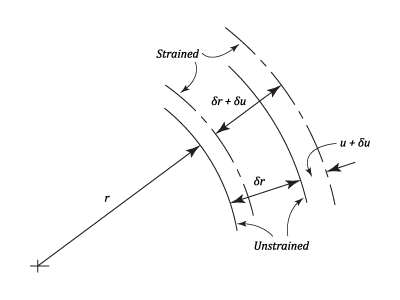
Let u be the radial shift at a radius r. i.e. After Straining the radius r becomes (r + u). and it should be noted that u is small compared to r.

13108/img_cyl11_0001.jpg
+

The increase in Hoop Strain ( Circumferential) is given by:-

Thus the Radial Shift at an unrestrained radius of \displaystyle r\;+\z\;\delta r will be

\displaystyle u\;+\z\;\delta u . The Radial Strain \displaystyle =\;\frac{Increase\;in\;\delta r}{\delta r}\;=\;\frac{du}{dr}\;in\;the\;limit

The derivation of the Strain Equations appears in " Engineering Materials; Compound Stress and Strain". Using the equations given:-

It is necessary to eliminate u from equations (4) and (5).

Multiplying Equation (4) by r gives:-

This equation can now be differentiated w.r.t. r

From Equation (5) the above equals:-

Collecting Terms:-

Differentiating equation (3) and since e is constant.

Substituting this into equation (9)

This can be reduced to :-

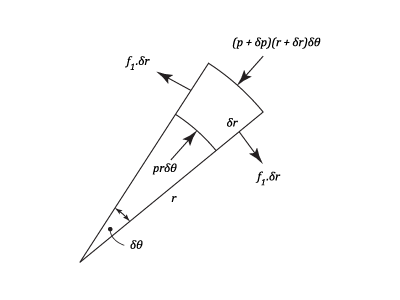
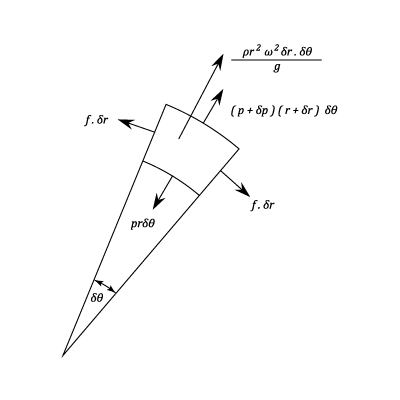
Equilibrium Equation (Radially)

13108/img_cyl11_0002.jpg
+

In the limit \displaystyle \sin\frac{1}{2}\delta \theta \rightarrow \frac{1}{2}\delta \theta and neglecting the products of small quantities the above equation reduces to:-

Subtracting Equation (14) from (12)

Integrating:-

Subtracting equation (17) from (14)

Integrating

Where d = 2r and b = 4B

Putting equation (22) in (17)

It follows from equations (3) and (17) that since e is constant \displaystyle \mathbf{f_2} is constant( i.e.it is independent of r) The above analysis could have been considerably shortened is this had been assumed initially. This would have meant that equation (3) would have been reduced to :-

This result coupled with the equilibrium equation (14) allows all the other equations to be obtained.

The majority of numerical problems can be solved by the application of equations (22) and (23). However some examples may require the use of a general formula for \displaystyle f_1\;\;and\;\;p in terms of the dimensions and the external pressures.

Given an internal pressure of \displaystyle p_1 (Internal diameter \displaystyle d_1 and external pressure and diameter of \displaystyle p_2\;\;and\;\;d_2 then it follows that the radial stresses at these surfaces must be equal to the applied pressures and equation (22)can be written as:-

Subtracting and re-arranging:-

Similarly

Thus from equation (23)

And from equation (22)

The maximum Shear Stress(i.e. half the stress difference):-

It will be found that the maximum Principal Stress and maximum Shear Stress occur at the inside surface

Internal Pressure Only

Pressure Vessels are found in all sorts of engineering applications. If it assumed that the Internal Pressure is \displaystyle p_1 at a diameter of \displaystyle d_1 and that the external pressure is zero ( Atmospheric) at a diameter \displaystyle d_2 then using equation (22)

And

Solving these equations for a and b

The Stresses at any Diameter d are:-

And:-

13108/img_cyl11_0003.jpg
+

The Stress variations with diameter are shown in the diagram. The two curves are in effect "parallel" since ( See equation (17)):-

It can be seen that the maximum Hoop Stress occurs when \displaystyle d\;=\;d_1

The Maximum Shear Stress is given by:-

The longitudinal Stress \displaystyle f_2 has been shown to be Constant and for a cylinder with closed ends can be obtained, for any transverse section, from the Equilibrium Equation.

The Error In The "thin Cylinder" Formula

If the thickness of the cylinder walls is t then \displaystyle d_2\;=\;d_1\;+\;2t and this can be substituted into equation (43)

If the ratio of \displaystyle d_1\;to\;t\;=\;10 then:-

Which is 11% higher than the mean value given by \displaystyle \frac{p_1\;d_1}{2t}

And if the ratio is 20 then \displaystyle \hat{f_1}\;=\;\frac{884}{84}\times p_1 which is 5% higher than \displaystyle \frac{p_1\;d_1}{2t}

It can be seen that if the mean diameter is used in the thin cylinder formula, then the error is minimal.

Example 1

The cylinder of a Hydraulic Ram has a 6 in. internal diameter. Find the thickness required to withstand an internal pressure of 4 tons/sq.in. The maximum Tensile Stress is limited to 6 tons/sq.in. and the maximum Shear Stress to 5 tons/sq.in.

If D is the external diameter, then the maximum tensile Stress is the hoop Stress at the inside.

Using equation (43)

The maximum Shear Stress is half the "Stress difference" at the inside. Thus using equation (45)

From which as before, D = 13.43 in.

Example 2

Find the ratio of thickness to internal diameter for a tube subjected to internal pressure when the ratio of Pressure to Maximum circumferential Stress is 0.5.

Find also the alteration of thickness of metal in such a tube 8 in internal diameter when the pressure is 5 tons/sq.in.

Using equation (43)

From which:-

Also if \displaystyle d_1\;=\;8\;in.\;\;then\;\;d_2\;=\;8\sqrt{3}\;=\;13.86\;in.

On the outside of the tube:-

Using equation (47)

Using Equation (4)

At the Outside:-

Note. For those of you unfamiliar with the Imperial System the 2240 converts E into tons/sq.in

Example 3

The maximum permitted Stress permitted in a thick Cylinder of radii 8 in. and 12 in. is 2000 lb./sq.in. If the external pressure is 600 lbs/sq.in. what Internal pressure can be applied?

Plot curves showing the variation of hoop and radial stresses throughout the material.

Using Equations (22) and (23)

The Maximum Stress = The Hoop Stress at the inside

Solving these two equations for a and b gives:-

and

The Internal Pressure is given by \displaystyle -a\;+\;\frac{b}{256}

The Constant difference between the Hoop and the radial Stress is 400 lb/sq.in

At a 10 in. radius

13108/img_cyl11_0004.jpg
+

Example 4

Two thick steel cylinders A and B , closed at the ends have the same dimensions, the inside being 1.6 times the inside. A is subjected to internal pressure only and B to external pressure only. Find the ratio of these two pressures:-

  • When the greatest Circumferential Stress has the same numerical value.
  • When the greatest circumferential Strain has the same numerical value.

Poisson's ratio = 0.304 (U.L.)

Cylinder A

The Internal pressure is \displaystyle p_1

The greatest circumferential Stress is given by equation (43) :-

Substituting values:-

The longitudinal Stress can be found from Equation (47)

The Greatest Circumferential Strain is:-

Cylinder B

Using equation (22) the External Pressure \displaystyle p_1\;=\;-\;a\;+\;\frac{b}{d_2^2}

Likewise as the Internal Pressure is zero. \displaystyle 0\;=\;-a\;+\;\frac{b}{d_2^2}

Solving these equations for a and b:-

From Equation (23)

This reaches its maximum value when \displaystyle d\;=\;d_1

Then Longitudinal Stress \displaystyle f_2 is given by the equilibrium Equation

The Greatest (numerically) Circumferential Strain will occur at the inside and:-

Case(1)

Case (2)

The Plastic Yielding Of Thick Tubes.

If the internal pressure of a thick cylinder is increased sufficiently, yielding will occur starting at the Internal surface and spreading outwards until the whole cross-section becomes plastic. The Strains generated will not initially be excessive since there will be a ring of elastic material around the plastic zone. Collapse will only happen once the final stage is reached. If the Pressure for complete plasticity can be estimated and used as the "collapse" pressure then a design pressure can be derived by dividing by a suitable "Load Factor". This system was used in the pages on "The Plastic Theory of Bending".

A useful application of partial plasticity can be used in the manufacture of gun barrels and pressure vessels. The process involves deliberately overstraining the component with a high internal pressure during manufacture. The result is to impart compressive stresses into the inner layers and this has the effect of reducing the Hoop Stress which occur under normal working conditions. Note the same effect can be achieved by shrinking one tube over another.

Assumptions made in the Theory of Plastic Yielding.

  • Yield takes place when the maximum Stress difference ( or Shear Stress) reaches the value corresponding the yield in simple tension. This assumption has been found to be in good agreement with experimental results for ductile material.
  • The Material exhibits a constant yield Stress \displaystyle f_y in tension and there is NO Strain hardening. i.e. it is an ideal elastic material.
  • The longitudinal Stress in the tube is either zero or lies algebraically between the Hoop and Radial Stresses. From this it follows that the maximum Stress difference is determined by the Hoop and Radial Stresses only.

Hoop and Radial Stresses in the Plastic Zone

The equilibrium equation (14) must apply and the yield criterion based on the assumptions stated above, provided that \displaystyle f_1\;\;and\;\;p are stresses of the opposite type, is:-

Combining this with equation (14)\displaystyle \left(f_1\;+\;p\;+\;r\frac{dp}{dr}\[=\[0 \right) and integrating gives :-

If the radial Stress is p_2 at the outer radius of the plastic zone \displaystyle r_2.

And using equation (98), the Hoop Stress is given by:-

Partially Plastic Wall

Consider a thick tube of internal radius \displaystyle r_1 and external radius \displaystyle r_3 subjected to an internal pressure only of such a magnitude, that the material below a radius of \displaystyle r_2 is in the plastic state. (i.e. \displaystyle r_2 is the boundary between the inner plastic region and the outer elastic region)

If \displaystyle p_2 is the radial Stress at \displaystyle r_2 , it is stated by the elastic theory for internal pressure only (Equation (45))that the maximum Stress difference is \displaystyle f_y (i.e.) just reaching the yield conditions at \displaystyle r_2

Substituting this value in equations (101) and (102) gives the variations in Stresses in the Plastic Zone. i.e.:-

The relationship between the internal Pressure \displaystyle p_1 and the radius of yield \displaystyle r_2 is given by equation (106) when \displaystyle r\;=\;r_1.

The Pressure at the Initial Yielding is found by putting \displaystyle r_2\;=\;r_1

The Pressure required for complete yielding through the Wall is given when \displaystyle r_2\;=\;r_3

Since \displaystyle f_1\;+\;p\;=\;f_y in the Plastic Zone, the Hoop stress at the inside in the plastic state is:-

If the Longitudinal Stress is zero, equations (110) and (1111) can only be applied for\displaystyle \frac{r_3}{r_1}< 2.718 \displaystyle p_1\;=\;f_1\;\;and\;\;f_1\;=\;0 and the maximum Stress difference becomes . If the the tube is thicker than this and the Internal Pressure is raised to the value of . there will be an inner Zone in which the radial stress is constant and equal to and the Hoop Stress is ( to satisfy the equilibrium equation (14)), an intermediate zone in which equations (110) and (111) apply and an outer zone. This argument can be modified to take account of any uniform longitudinal Stress.

Example 5

A gun barrel of 4 in. bore and with a wall thickness of 3 in, is subjected to an internal pressure sufficient to cause yielding in two thirds of the metal. Calculate this pressure and show the variation of Stresses across the wall.

What are the pressures required for initial ield and complete yield? Assume that yield occurs due to maximum shear stress and neglect Strain Hardening. In simple Tension \displaystyle f_y equals 25 tons/sq.in.

Using Equation (108) which gives the pressure required to produce a given depth of yielding where \displaystyle r_1\;=\;2\;in.\;\;and\;\;r_3\;=\;5\;in.

And using equation (105)

Using Equation (107), at \displaystyle r_1 the Hoop Stress is given by:-

At \displaystyle r_2 using the plastic relationship \displaystyle f_1\;+\;p\;=\;f_y

In the elastic zone, using the conditions that \displaystyle p_2\;=\;4.5\;\;\;and\;\;\;p_3\;=\;0 for a tube of inner and outer radii of 4 in. and 5 in., it follows from Equation (41)that the Hoop Stress is given by:-

At r = 4 in.

At r = 5 in.

The variation of these Stresses in the two zones is shown on the following Diagram.

13108/img_cyl11_0005.jpg
+

The pressure for the initial yield can be found from equation (109)

And the pressure for a complete yield is found from equation (110)

Compound Tubes.

13108/img_cyl11_0003.jpg
+

It can be seen from the figure that the Hoop falls off appreciably as the material near the outside of the tube is not being stressed to the limit.

In order to even out the stresses the tube may be made in two parts.one part being shrunk on to the other on to the other (after heating). By this means the inner tube is put into compression and the pouter tube in tension. When an internal pressure is then applied it causes a tensile Hoop Stress to be superimposed on the "Shrinkage" Stresses and the resultant Stress is the algebraic sum of the two sets.

In general, the procedure is to use the knowledge of the radial pressure at the common surface, to calculate the stresses due to shrinkage in each component. The Stresses due the application of internal pressure are calculated in the usual way. Provided that the tubes are made of the same material, the two tubes may be treated as one.

The radial pressure at the common surface due to shrinkage is related to the diametral "interference" before the tubes are fitted together. If \displaystyle f_1 is the Compressive Hoop stress at the outside of the inner tube and \displaystyle f_1' is the tensile Hoop Stress at the inside of the outer tube then due to shrinkage the inner tube diameter is decreased by:-

And the outer tube diameter is increased by:-

Where d is the common diameter. The difference of these diameters before shrinkage is the sum of the changes and equals:-

Example 6

A tube that is 4 in. inside and 4 in. outside diameter is strengthened by shrinking on a second tube of 8 in. outside diameter. The compound tube is to withstand an internal pressure of 5000 lb./sq.in. and the shrinkage allowance is to be such that the final maximum stress in each tube is to be the same. Calculate this stress and show in a diagram the variations of Hoop Stress in the two tubes. What is the initial difference of diameters prior to assembly ?

Let \displaystyle p_0 be the common radial pressure due to shrinkage.

substituting in equation (23)

For the inner tube:-

Solving these two equations for a and b:-

Now using equation (23)

Similarly for the outer tube:-

Solving these two equations for a' and b';-

The lines marked"Shrinkage Stress" on the diagram are sketched from the results of equations (133) and(140). The numerical value of \displaystyle p_0 is found latter.

Stresses due to Internal Pressure:-

Using Equation (22) again:-

Solving these two equations for a'' and b'' gives:-

The Hoop Stresses are:-

From the results of equations (146) (147) and (148) the lines of "pressure" stressed can be drawn onto the diagram. The final resultant Hoop Stress in each tube is obtained by the algebraic sum of pressure and shrinkage Stresses. It has already been pointed out that the maximum Stress occurs at the inside surface.

Equating values obtained for the two tubes:-

(133) + (146) = (139) + (147)

13108/img_cyl11_0006.jpg
+

The Numerical value of the Maximum Hoop Stress = (139) + (147) = 6470 lb./sq.in.

The initial difference of diameters at the common surface

= The difference of Hoop Strains X Diameter.

=(1/E)(The difference in Hoop shrinkage Stresses) X Diameter.

A Hub Shrunk Onto A Solid Shaft

The Shaft will be subjected to an external pressure \displaystyle p_1 and if \displaystyle f_1\;and\;p are the Hoop and Radial Stresses at a radius r, the equilibrium equation (14) will be obtained as for a "Thick Cylinder".

The longitudinal Stress is zero and assuming that the longitudinal strain is constant, it follows from equation (1) that:-

These two equations can be solved as before to yield:-

But since the Stresses cannot be infinite at the centre of the shaft b must be zero.

Thus the Hoop Stress is compressive and equal to the radial Stress. Both Stresses are constant throughout. The Hub or Slieve is subjected to an internal pressure \displaystyle p_1 and is treated as a thick tube under internal pressure.

Example 7

A Steel shaft 2 in. in diameter is to be pressed into a cast iron hub of 6 in. diameter and 4 in. lomng, so that no slip occurs under a torque of 20 ton-in. Find the necessary force fit allowance and the maximum circumferential Stress in the hub. \displaystyle E_s\;=\;2\times E_{ci}\;\;\;and\;\;\;Poisson'd\;Ratio\;=\;0.25 for both. The coefficient of friction between th the surfaces is 0.3

If after assembly the shaft is subjected to an axial compressive Stress of 5 tons /sq.in., what is the resulting increase in the maximum circumferential Hub Stress

Let \displaystyle p_1 be the radial pressure at the common surface.

For the shaft

And the decrease in the outside diameter = Hoop Strain X diameter

For the Hub

Substituting into equation (43)

force fit

If \displaystyle f_1 is the increase in the maximum Hoop Stress in the hub whne a axial stress of 5 tons/sq.in. is applied to the shaft, then the corresponding increase in Radail Pressure at the inside surface is determined by the dimensions of the hub.

The radial and Hoop Stresses in the Shaft must also increase by thwe same amount since they are both equal and compressive.

Increase in the Hoop Strain at the outside of the shaft

= The increase in ther Hoop Strain at the inside of the Hub.

Thick Spherical Shells

At any radius r let the circumferential or Hoop Stress be f Tensile and the Radial Stress p Compressive. If u is the radial shift then it was shown earlier that the Hoop Strain is given by u/r and the radial Strain by du/dr. The Strain equations are:-

Multiply Equation (104) by r and differentiate the result and equate it to equation (175)

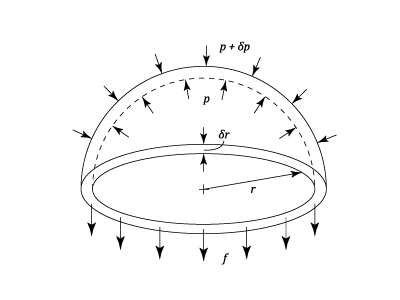
Consider the equilibrium of a Hemisphere:-

13108/img_cyl11_0007.jpg
+

Substituting \displaystyle (f\;+\;p) from equation (179) into equation (177)

Which reduces to :-

Integrating

Substituting for f from equation (182) in equation (179)

This can be re-arranged as:-

Integrating gives:-

By putting \displaystyle a\;=\;\frac{2A}{3}\;\;\;and\;\;\;b\;=\;8B

By combuining this result with equation (182)

If the inside and outside diameters are \displaystyle d_1\;\;\;and\;\;\;d_2 and the pressures on these surfaces are \displaystyle p_1\;\;\;and\;\;\;p_2 respectively.

Solving these equations gives:-

From Equations (187) and (188)

If there is internal pressure only:-

The Maximum Stress is the value of f at the inside i.e.

And the maximum Shear Stress