
CodeCogs - An iteractive open source Numerical library Welcome... Login
CodeCogs
shopping cart
OSXWindowsLinux
Search CodeCogs
Numerical Pages

Valid RSS

EngineeringMaterials

Compound Stress and Strain Part 2

About | FAQ | Contact
About FAQ Contact

A description of Mohr's Stress and Strain Circles ; two and three dimensional Stress and Strain systems and Strain Energy

viewed 3598 times


+View version details
Contents -

Mohr's Stress Circle

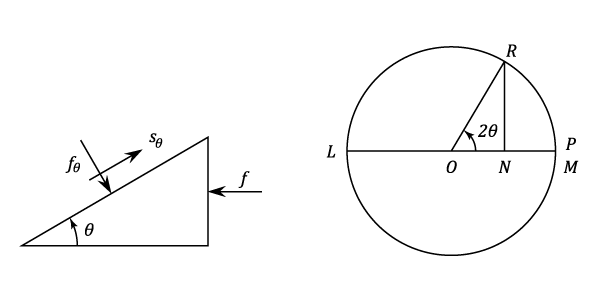
Mohr's Stress Circle allows the Stress on any plane which makes an angle \displaystyle \theta with the Principle Planes.

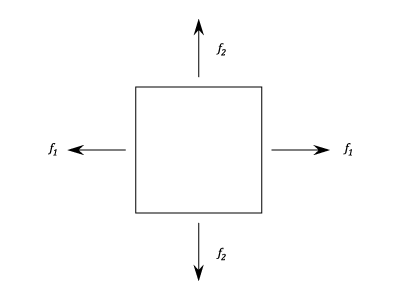
In the figure \displaystyle f_1\;\;and\;\;f_2 are the Principle Stress on the Principle Planes BC and AB.

13108/img__ss6_0017.jpg
+

To draw the circle:-
13108/img__ss6_0018.jpg
+

Then \displaystyle f_\theta is the normal Stress Component on AC. (See equation (9) in Part 1 of Compound Stress and Strain. where \displaystyle s_\theta is the Shear Stress Component on AC

Also the Resultant Stress is given by:-

The inclination of the resultant Stress to the Normal of the plane is given by:-

\displaystyle f_\theta is a Tensile Stress in this case and \displaystyle s_\theta is considered positive if R is above PM. A positive Shear Force is one which tends to give a clockwise rotation to a rectangular element ( Sown dotted in the first Diagram)

the latter being of the same magnitude as \displaystyle s_{\theta } but of the opposite type which tends to give an anticlockwise rotation to the dotted element.

Two particular cases which were considered analytically in Part 1 are now dealt with using this method.

Pure Compression.

If f is a Compressive Stress then the other Principle Stress is zero.

13108/img__ss6_0019.jpg
+

If \displaystyle \theta is the angle measured from the Plane of zero Stress then in the above diagram PL = f numerically. It will be measured to the left for Compression. PM = 0

Hence:-

And the Maximum Shear Stress, q occurs when \displaystyle \theta \;=\;45^{0} and is given by:-

Principal Stresses Equal Tension And Compression.

Let \displaystyle \theta be the angle measured anticlockwise from the Plane of f Tensile.

13108/img__ss6_0020.jpg
+
PM = f to the right. PL = f to the left.

Hence O coincides with P.

\displaystyle f_\theta \;=\;PN and is Tensile for \displaystyle \theta between \displaystyle \pm 45^{0} and Compressive for \displaystyle \theta between \displaystyle 45^{0}\;\;and\;\;135^{0}.

\displaystyle s_\theta \;=\;RN.\;\;When\;\;\theta \;=\;45^{0},\;\;s_\theta reaches its maximum value (Numerically equal to f) on those Planes where the Normal Stress is Zero (i.e. Pure Shear)
Example 1:
A piece of material is subjected to two compressive Stresses at right angles, their values being 4 tons/sq.in. and 6 tons/sq.in.. Find the position of the Plane across which the resultant Stress is most inclined to the Normal and determine the value of this resultant Stress.

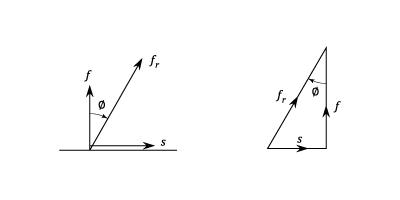
In the left hand diagram the angle \displaystyle \theta is inclined to the plane of 4 tons/sq.in. compression. In the right hand diagram Pl = 6 and PM = 4. The maximum angle \displaystyle \phi is found when PR is a tangent to the Stress Circle. OR = 1 and PO = 5.

13108/img__ss_2_0021.jpg
+

From the right hand diagram:- which gives the position of the plane required.

It is also possible to use Mohr's Stress Circle in in the reverse sense to find the magnitude and direction of the |Principal Stresses in a given Stress system. An example of this is shown below.
Example 2:
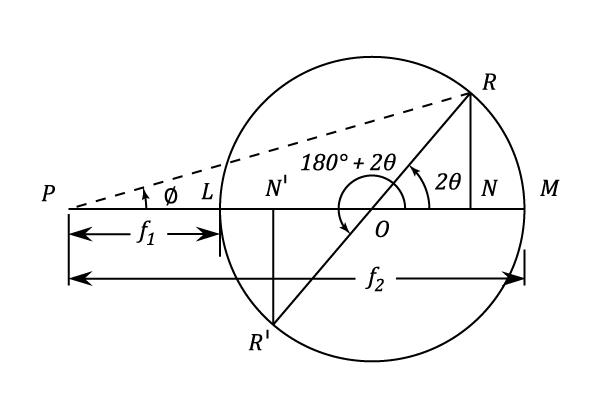
At a point in a piece of elastic material there are three mutually perpendicular planes on which the Stresses are as follows: Tensile Stress 5 tons/sq.in. and Shear Stress 4 tons/sq.in.on one plane, Compressive Stress 3.5 tons/sq.in. and Complementary Shear Stress 4 tons/sq.in. on the second plane and no Stress on the third plane.

13108/img__ss_2_0022.jpg
+

Find (a) The principal Stresses and the positions of the planes on which they act. (b) The position of the planes on which there is no Normal Stress (U.L.)

Construction.
  • Mark off PN = 5, NR = 4, PN' = 3.5, N'R' = -4
  • Join RR' cutting NN' at O
  • Draw circle Centre O and radius OR

(a) The Principal Stresses are:-

This means that the Plane of the Tensile Principal Stress must be rotated through \displaystyle 21^{0}\;40' in an anti clockwise direction in order to coincide with the plane of 5 tons/sq.in. tensile Stress .
13108/img__ss6_0014.jpg
+
The relative position of the Planes is shown in the above diagram.

(b)If there is no Normal Stress then the plane N and P coincide and :- (The dotted radius on the previous diagram)

The following example gives a method of constructing Mohr's circle and hence finding the Principal Planes and Stresses when the Direct Stresses in any three directions is known.
Example 3:
Figure (a) shows the Direct Stresses in three directions which occur at a particular Point. It is required ti find the Magnitude and Directions of the Principal Stresses.

13108/img__ss6_0015.jpg
+

  • Draw a vertical line (i.e. thje one through P) and measure off distances proportional to the given stresses. Note:-( Positive to the right, negative to the left.)
  • At these distances draw three vertical lines, one for each Stress.
  • Choose an arbitrary point on the central line and draw lines at \displaystyle 60^{0}\;\;and\;\;120^{0} to the vertical cutting the other two verticals at Q and S.
  • The angles should be drawn so that they produce a similar figure to that produced by the Stress directions . i.e. It must be possible to rotate figure (a) and place it over R with the 2000 lb/sq.in. Stress in the vertical position. The \displaystyle 60^{0} line from R is produced to cut the 10,000lb./sq.in. vertical at S and the \displaystyle 120^{0} is produced (backwards in this case) to cut the -5000 lb./sq.in.vertical at Q
  • The circle which passes through QRS is constructed by using the perpendicular bisectors of the lines QR and RS. This Circle is Mohr's Stress Circle.
  • The Stress conditions on the three given planes are related to the points Q, R' and S where R' in on the vertical through R.

The justification for this construction lies in the fact that the angle at the centre of a circle is twice that the circumference and it can be seen that the angles between the radii OQ, OR' and OS are \displaystyle 120^{0} which is twice the angle between each pair of given Direct Stresses.

The Principal Stresses are given by :-

A Two-dimensional Stress System.

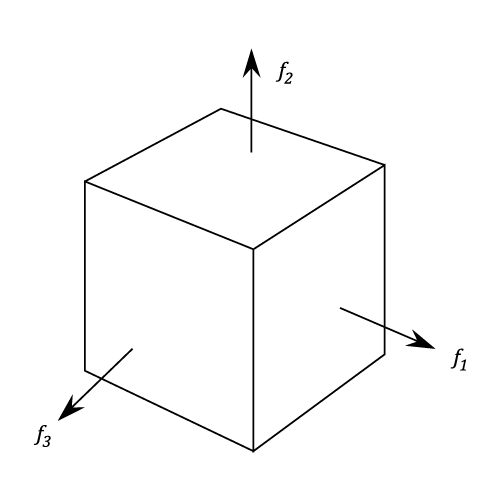
It has been shown that every system can be reduced to the action of pure normal Stresses on the Principal Planes.

13108/img__ss_2_0023.jpg
+

Consider the Strains produced by each Stress separately:-

\displaystyle f_1 will cause:-

\displaystyle f_2 will cause:-

Since the Strains are all small, the resultant strains are given by the algebraic sum of those due to each Stress separately. i.e.

The normal conventions apply and Tensile Stress is positive and Compressive Stress negative. A positive Stress represents an increase in dimensions in that direction.

Principal Strains In Three Dimensions.

Using a similar argument to that used in the previous paragraph,it can be shown that the Principal Strains in the direction \displaystyle f_1.\;\;f_2,\;and\;\;f_3 are given by :-

13108/img__ss6_0025.jpg
+

It must be remembered that Stress and Strain in any given direction are not proportional when Stress exists in more than one dimension. Strain can exist without Stress in the same direction. (e.g. \displaystyle If\;\;\;f_3\;=\;0,\;\;Then\;e_3\;=\;-\;\frac{f_1}{m\;E}\;-\;\frac{f_2}{m\;E} )
Example 4:
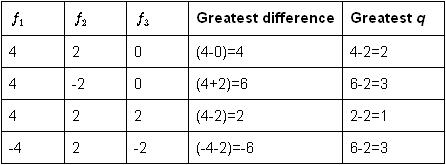
A piece of material is subjected to three perpendicular Tensile Stresses and the Strains in the three directions are in the ratio of 3:4:5. If Poisson's Ratio is 0.286 find the ratio of the Stresses and their value if the greatest is 6 tons/sq.in. (U.L.)

Let the Stresses be and the corresponding Strains 3k, 4k, and 5k. Then :-

Subtracting Equation (36) from (38)

Re-writing equations (38) and (37)

From Equations (41)and(42)

From this and the other equations above :-

Hence the Ratios of the stresses are:-

If the greatest Stress is 6 tons/sq.in.

Principal Stresses Determined From Principal Strains.

Rearranging equations (32)(33)and(34) as:-

Subtracting Equation (50) from (49)

From (49) and (51)

Subtracting (52) from (53)

Similarly

And

(b) A Two Dimensional Stress System where \displaystyle f_3\;=\;0

Solving these two equations for

Analysis Of Strain.

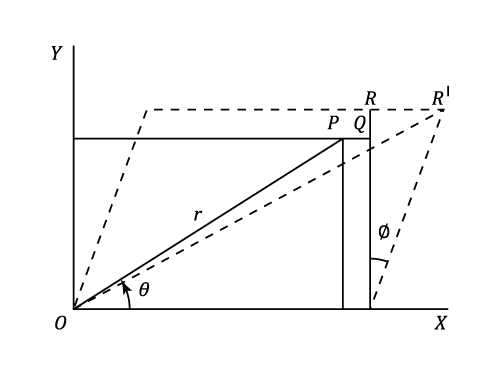
If e_x\;,\;e_y\;and\;\phi are the linear and Shear Strains in the plane XOY Then we require an expression for _\theta, the linear Strain in a direction inclined at an angle \theta to OX in terms of e_y\;,\;\phi \;\;and\;\;\theta.

13108/img__ss6_0026.jpg
+

In the diagram the line OP, of length r , is the diagonal of a rectangle which under the given Strains distorts into the dotted parallelogram. P moves to P'. It must be remembered that the actual Strains are small.

But by definition \displaystyle e_\theta \;=\;\frac{PP'}{r}

This can be compared with equation (18) in "Compound Stress and Strain Part 1. The Principal Strains \displaystyle e_1\;\;and\;\;e_2 are the maximum and Minimum values of Strain. These occur at values of \displaystyle \theta obtained by equating \displaystyle \frac{de_\theta }{d\theta } to Zero.

i.e.

Then as for the Principal Stresses \displaystyle e_1\;\;and\;\;e_2 are given by :-

In order to evaluate \displaystyle e_x,\;\;e_y\;\;and\;\;\phi ( and hence the Principal Strains) it is necessary to know the linear Strains in any three directions at a particular point( Note. If the principal directios are known then only two Strains are required since \displaystyle \phi \;=\;0\;\;and\;\;e_x\;=\;e_1\;\;,\;\;e_y\;=\;e_2 )

Finally if the Strains are caused by Stresses in two dimensions only, then the Principal Stresses can be determined by equations (62) and (63)
Example 5:

The measured Strains in three directions inclined at 60 degrees to one another are \displaystyle 550\times 10^{-6}\;,\;\;-\;100\times 10^{-6}\;\;and\;\;150\times 10^{-6}.. Calculate the magnitude and direction of the Principal Strains in this plane. If there is no Stress perpendicular to the given Plane, determine the Principal Stresses at the point.

13108/img__ss_2_0027.jpg
+

Taking the X-axis in the direction of the \displaystyle 550\times 10^{-6} Strain, \displaystyle e_x,\;\;e_y\;\;and\;\;\phi are determined from equation (68) with \displaystyle \theta \;=\;0,\;\;60^{0}\;\;and\;\;120^{0} fro the three measured Strains;

Adding equations (74) and (77)

Using equation (72}

From equations (74)(77) and ( )

The Direction of the Principal Strains \displaystyle e_1\;\;and\;\;e_2(To the X-axis) are found using equation (69)

The Principal Strains are found using equation (70) and are:-

For a two dimensional Stress system and using equations (62) and(63)

Mohr's Strain Circle.

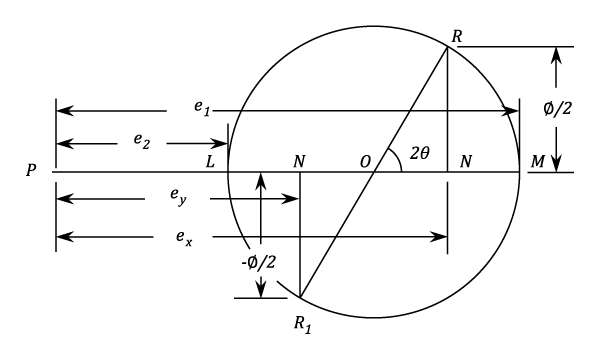
It is now apparent that Mohr's Circle can also be used to represent Strains. The horizontal axis represents linear Strain and the vertical axis half the Shear Strain.

13108/img_ss8_0028.jpg
+

The diagram shows the relationship between \displaystyle e_x,\;e_y,\;\phi \;\;and\;\;\theta and the Principal Strains \displaystyle e_1\;\;and\;\;e_2 as given by equations (69) and (70). Note that \displaystyle PO\;=\;\frac{1}{2}(e_x\;+\;e_y)\;\;\;and\;\;\;OR\;=\;\frac{1}{2}\sqrt{(e_x\;-\;e_y)^2\;+\;\phi ^2}

The Strain Circle can be constructed if the linear Strains in three directions at a point and in the same plane , are known. The problem of the last exercise will now be solved using this method.

The given Strains are \displaystyle e_0\;,\;\;e_{60}\;,\;\;e_{120}. The Construction of the circle is similar to the Stress Circle. Vertical lines are drawn in relative positions to a datum through P and at distances on either side proportional to the given Strains. From R on the central line ( i.e. \displaystyle e_{120} in this case)lines are set off at \displaystyle 60^{0}\;\;and\;\;120^{0} to the vertical, to cut the corresponding Strain Verticals in Q and S. The Strain Circle then passes through QRS and the Principal Strains are :-

The radius OS gives the Strain condition in the X direction and the angle SOM = 22^{0}. The direction of \displaystyle e_1 is then at \displaystyle \frac{1}{2}\times 22\;=\;11^{0} clockwise from the X-axis and \displaystyle e_2 is at right angles to \displaystyle e_1

The Principal Stresses can best be obtained from the Principal Strains by using the same calculations as were used in the last Example.

Volumetric Strain.

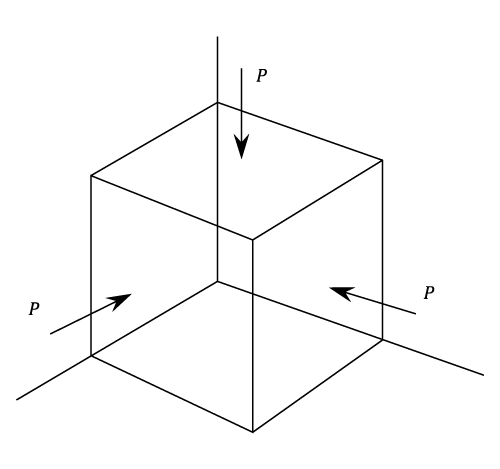
A rectangular solid of sides x, y, z. is under the action of three principal Stresses \displaystyle f_1,\;f_2,\;\;and\;\;f_3

13108/img_ss_101_2.jpg
+

Then if \displaystyle e_1,\;e_2,\;\;and\;\;e_3 are the corresponding linear Strains, the dimensions become :- The Volumetric Strain = Increase in volume / Original volume

Sine the actual Strains are small this may be written as equal to:-

Thus it can be stated that the Volumetric Strain is the Algebraic sum of the three Principal Strains

The Volumetric Strain can also be found using the Principal Stresses in which case:-

Strain Energy

The Strain Energy U is the Work done by the Stresses in Straining material It is sufficiently general to consider a unit cube acted upon by the three Principal Stresses \displaystyle f_1,\;f_2,\;and\;f_3 . If the corresponding Strains are \displaystyle e_1,\;e_2,\;and\;e_3 then, since the Stresses are applied gradually from zero, the Total work done = \displaystyle =\;\sum{\frac{1}{2} f\;e}.

Using equations (32)(33)(34)

For a two dimensional Strain system \displaystyle f_3\;=\;0

Example 6:
The Principal Stresses at a point in an elastic material are 6 tons/sq.in.tensile 2 tons/sq.in. tensile 5 tons/sq.in. compressive. Calculate the volumetric Strain and the resilience. E = 6000 tons/sq.in. and 1/m = 0.35.

Using equation (99)

Shear Strain Energy.

Writing

Then under the action of the mean stress \displaystyle \frac{1}{3}(f_1\;+\;f_2\;+\;f_3) there will be volumetric Strain with no distortion of shape (i.e.no shear Stress anywhere). The Strain energy under this mean Stress acting in each direction can be derived from equation (102) and may be called volumetric Strain Energy

The other terms in the arrangement of \displaystyle f_1,\;f_2,\;\;and\;\;f_3 are proportional to the maximum Shear Stress values in the three planes and will cause a distortion of the shape.

Shear strain Energy \displaystyle \mathbf{U_s} is defined as the Total Strain Energy and the Volumetric Strain Energy.

Thus

The quantities in the brackets are each twice the maximum Shear Stress in their respective planes.

In a pure Shear Stress system the Principal Stresses are \displaystyle \pm \;s,\;0 and by substitution:-

Shear Straing Energy

Note: The relationship between E and C will be discussed in "Elastic Constants"
Last Modified: 2008-11-27 17:46:56     Page Rendered: 2010-03-11 18:32:31

Page Comments

Format Excel Equations

  You must login to leave a messge


Valid CSS!   Valid XHTML 1.0 Transitional