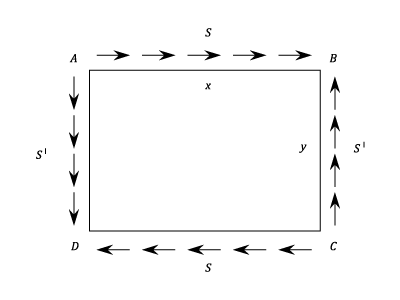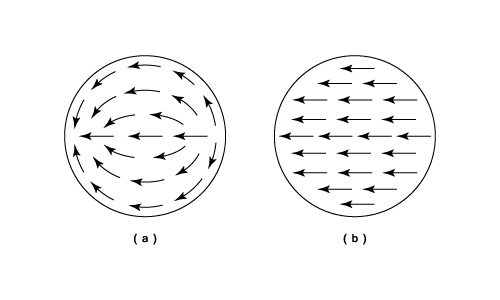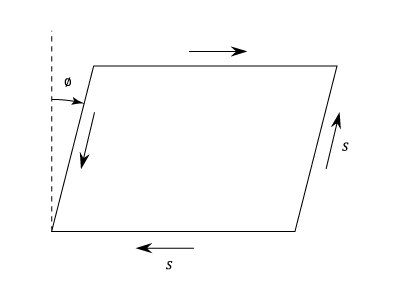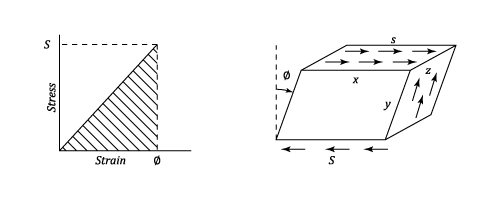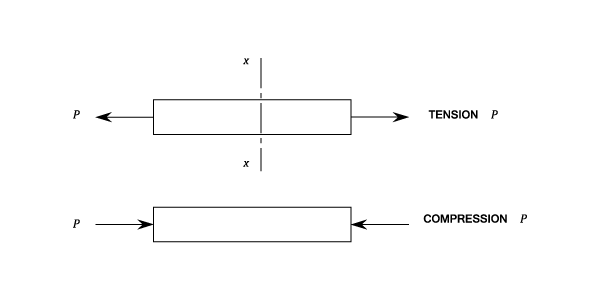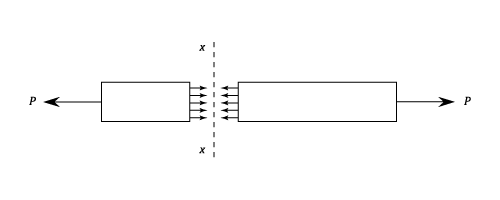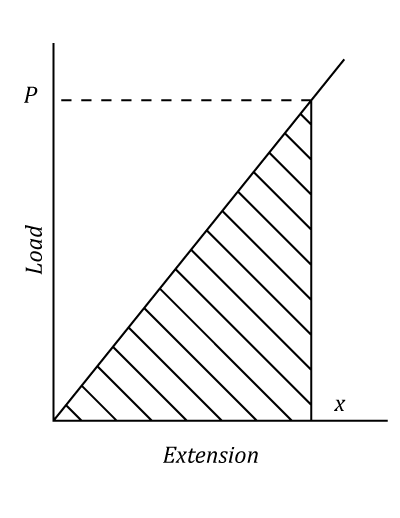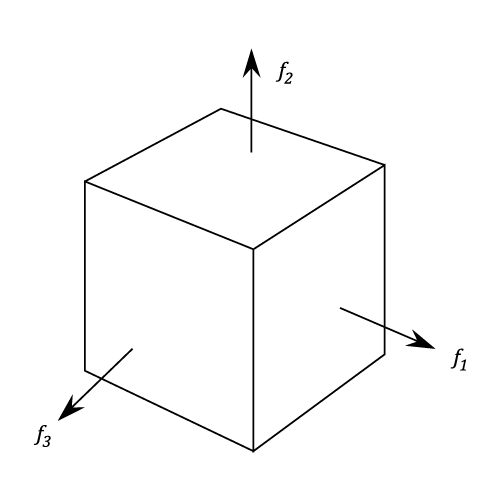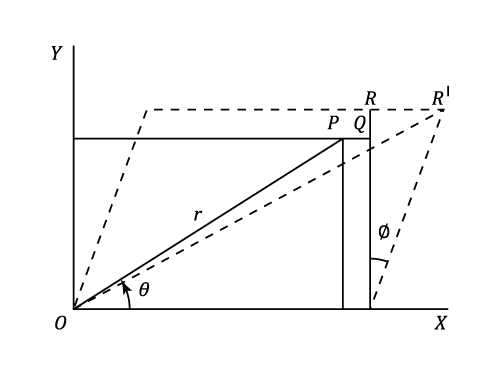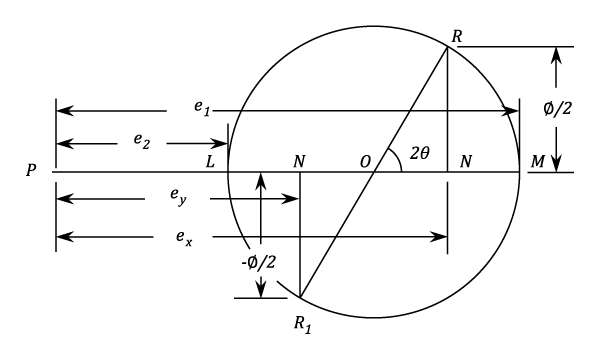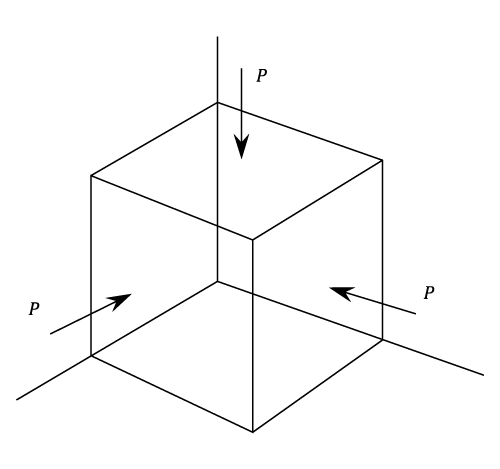

The results of both tensile and shear stress acting together
View version details
Contents  |
|
Oblique Stress.
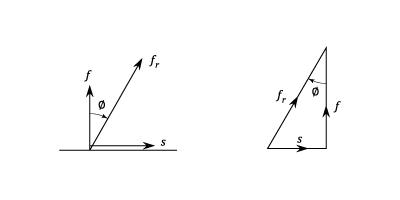
It is very common to find that both Direct Stress and Shear Stress occur at the same time and as a result the Stress across any section will be neither normal or tangential to the plane of that section. If

is the resultant stress at angle

with the normal to the plane on which it acts.
To find the normal and tangential components f and s then by inspection:-
Several important particular cases can now be considered./
Simple Tension
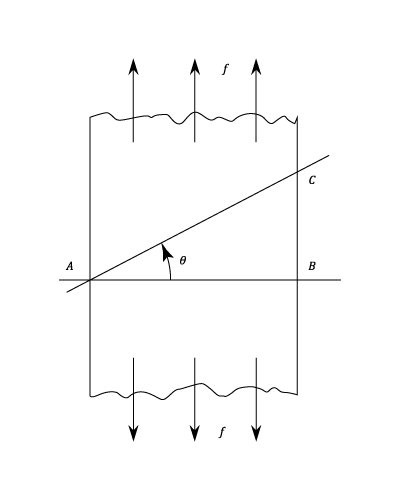
The bar in the diagram is under the action of pure Tensile Stress

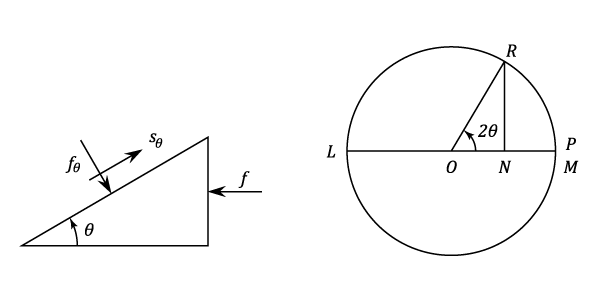
along ts length. Any transverse section such as AB will have pure normal Stress acting on it. The problem is to find the Stress acting on any plane AC at an angle

to Ab. This Stress will not be normal to the plane and can be resolved into two components
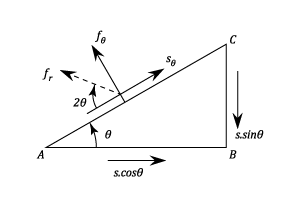
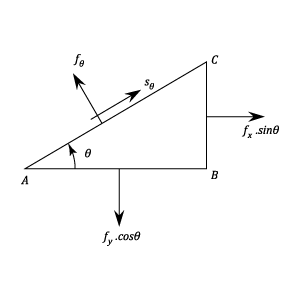
The diagrams show the Stresses acting along the three planes of the triangular prism ABC. There can be no stress on the plane BC which is a longitudinal plane of the bar. The Stress component

must act up the plane for equilibrium. The thickness of the prism is t.
The equations of equilibrium can be used to solve for

Resolving in the Direction of
Resolving in the Direction
The Resultant Stress
It can be seen from the above equations that the maximum normal Stress occurs at

and is of course equal to the applied stress f. The maximum Shear Stress occurs at

and has a magnitude of

. On these planes there is also a normal component equal to

. The variation of Stress components with

is given by equations (4),(7) and (8).
Note

The resultant Stress is at a maximum when
The important Result is that:-
in simple Tension (or Compression) the maximum Shear Stress is equal to half of the applied Stress
Notes on the diagrams.
- In most problems the Stress is varying from point to point in the member and it is necessary to consider the equilibrium of an element which is sufficiently small to give a value at a particular point.
- It can be seen that the results are independent of the thickness t of the element being considered and for convenience it may be assumed to be unity.
- As all the figures will always be right angle triangles, there will be no loss in generality by assuming that the Hypotenuse are of unit length
By making use of the above it can be seen that the areas on which the Stresses act are proportional to 1 (AC); sin

and cos

and future figures will show the forces acting on the element.
Pure Shear
If the Stress on a [plane AB is pure Shear s then there will be an equal complementary Shear Stress on the plane BC. It is necessary that we should be able to find the Stress components

acting on any plane AC which is at an angle of

to AB
Following normal convention the Applied Shear Stresses will be shown acting towards B and

acting up thee plane AC. In accordance with the note at the end of the last paragraph, the area of the plane AC is unity. The Forces acting on the plane are shown on the diagram.
Resolving in the direction of
Note
In the above system the Normal component
has maximum and minimum values of + s (tension) and - s (compression) on planes which are at
to the applied Shear and on these planes the tangential component
is zero. This shows that at a point where there is pure Shear Stress on any two given planes at right angles, the action across the planes of an element taken at
to the given planes is one of equal tension and compression.
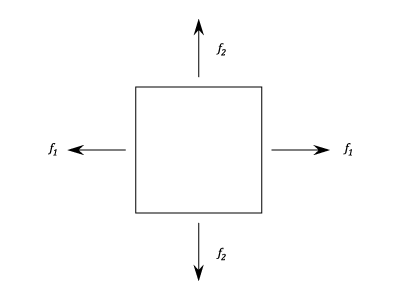
Pure Normal Stresses On Given Planes.
If the Stresses on BC are

and on AB

then the forces on the element are proportional to those shown on the diagram.
Resolving in the direction of
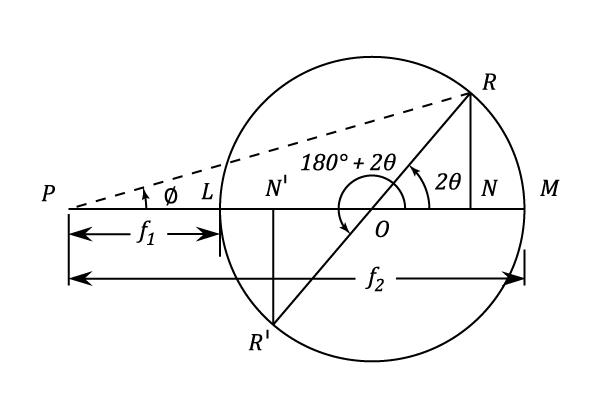
It can be shown that

varies between the limits of

and

which are its maximum and minimum values. However

has a maximum value equal numerically to half the difference between the given normal Stresses and occurring on a plane at

to the given planes. This is of some significance when calculating the maximum Shear Stress in any complex system and it will be found that

correspond to the Principle Stresses.
A General Two-dimension Stress System.
If the Stresses acting on the planes AB and BC are

then the Forces are as shown.
Resolving in the direction of
Example 1:
- If the Stresses on two perpendicular planes which pass through a point P are 6 tons/sq.in. tension; 4 tons/sq.in. compression and 3 tons/sq.in. in Shear, find the Stress components and resultant Stress on a plane at 60 degrees to that of the tensile Stress.
The above diagram shows the forces on the element.
Resolving
And
occurs at an angle of
Principal Planes
It can be seen from equation (20) that there are values of
for which

are zero and the Planes on which there are no Shear component are called
{Principal Planes)
From equation (20)
This will give two values of

which differ by 180degrees and hence there are two values of

which differ by 90 degrees. i.e. The Principal Planes are at Right Angles.
From the diagram it can be seen that:-
And
where the signs are to be taken as both positive or both negative ( giving the Values for
Principal Stresses.
The Stresses on the Principal Planes will be pure Normal ( Tension or Compression) and their values are called the
Principal Stresses
From Equation (18) and using equations (28) and (29)
The Importance of
Command [\b(] not found.
Principle Stresses} is that they are the
Maximum and Minimum values of Normal Stress in the two dimensions under consideration. When they are of opposite type then they give the numerical values of the maximum tensile and compressive Stresses.
A Shorter Method For Principal Stresses.
On the assumption that Principal Planes (i.e. planes on which the shear stress is zero) exist, then it is possible to use a shorter analysis to determine their position and the value of the associated Principle Stresses.
Let AC be a principle plane, and let

be the Principal Stress acting upon it. Then

are the Stresses on the planes BC and AB (See diagram)
Resolving in the direction of
Similarly resolving in the direction of
It is now possible to eliminate

from equations (34) and(36) to give:-
In any numerical problem it is advisable to substitute the values at this stage and then solve the quadratic for the two values of the Principal Stresses. However mulitplying out the equation becomes:-
Solving the quadratic.
The values of

for the Principal Planes are of course found by substituting in equations (34) and (36)
Maximum Shear Stresses.
If AB and BC are the principal planes and

are the Principal Stresses, then resolving:-
Hence the
maximum Shear Stress q occurs when
i.e. on planes at 
{to the Principal Planes}
Note. This can be compared to the paragraph on Pure Normal Stress.
The maximum value of q is given by:-
Thus the
{maximum Shear Stress is half the algebraic difference between the Principal Stresses
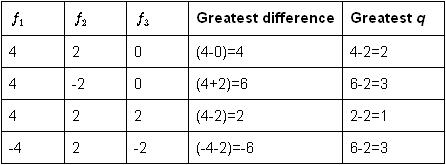
As all solids have in fact three dimensions, there must be three Principal Stresses although in many cases the third stress is zero. In calculating the
maximum Shear Stress by taking one-half the algebraic difference between the Principal Stresses the zero Stress will be of importance if the other two are of the same type (Tensile or Compressive) The following figure illustrates this where

are the three Principal Stresses. ( Compression is shown as being negative.) Note that to find the maximum q it is necessary to find the greatest difference in the stresses.
Example 2:
- At a Section in a beam the tensile stress due to bending is 500 lb./sq.in. and there is a shear stress of 2000lb./sq.in. Determine from first principles the magnitude and direction of the Principal Stresses and calculate the maximum Shear Stress.
Let AC be a principal Plane and BC the plane on which the Bending Stress acts. There is no Normal Stress on AB since it is is a longitudinal plane of the Beam. The forces are shown on the diagram.
Resolving in the direction of AB
Resolving in the direction of BC
Eliminating
Solving the quadratic.
i.e. The Principal Stresses are 5700 lb./sq.in. in tension and 700 lb./sq.in. in compression. The third stress is zero.
Using these values the directions of the Principal Planes are given by:-
The Maximum Shear Stress
and the Planes of Maximum Shear are at
to the Principal Planes i.e.
Poisson's Ratio
If a bar is subjected to a longitudinal Stress there will be a Strain in the direction of the Stress. The value of this Strain is f/E. There will also be a Strain in all directions perpendicular to f and the final shape of the bar will be as shown by the dotted lines on the diagram
For an elastic material it has been found that the Lateral Strain is proportional to the Longitudinal Stain and is of the opposite type.
when it is produced by a single Stress is called
{ Poisson's Ratio} and the symbol used is
If the Stress is beyond the Elastic Limit and the Total Longitudinal Strain is e then the "elastic" portion is approximately f/E and the "plastic" portion is e - f/E. For plastic deformation Poisson's Ratio may be taken as 0.5 i.e. there is no change in either density or volume and hence:-
Example 3:
- A steel bar 10 ins. long and with a rectangular cross section of 1 in. by 2 ins. is subjected to a uniform Tensile Stress of 12 tons/sq.in. along its length. Find the changes in dimension.
E = 13,200 tons/sq.in. and Poisson's ratio = 0.3
Last Modified: 2009-03-19 14:07:32 Page Rendered: 2010-03-11 18:31:37