
CodeCogs - An iteractive open source Numerical library Welcome... Login
CodeCogs
shopping cart
OSXWindowsLinux
Search CodeCogs
Numerical Pages

Valid RSS

EngineeringMaterials

Direct Stress

About | FAQ | Contact
About FAQ Contact

Resiliance and Direct Stress in bars, both composite and of varying cross section

viewed 4255 times


+View version details
Contents -

Strain Energy, Resilience

13108/img_shr1_0002.jpg
+
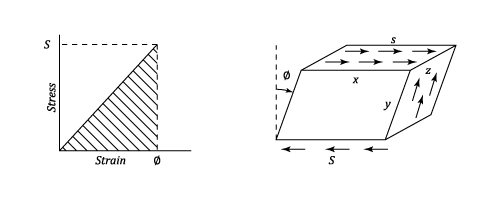
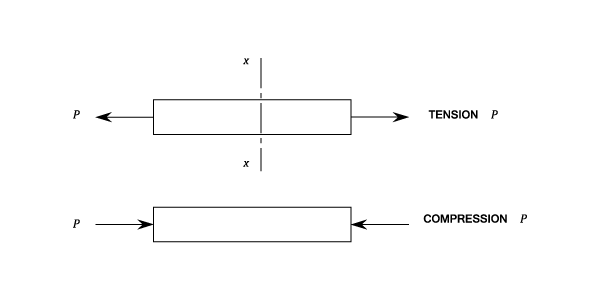
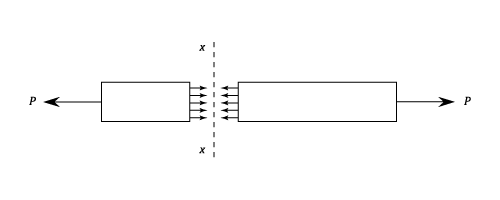
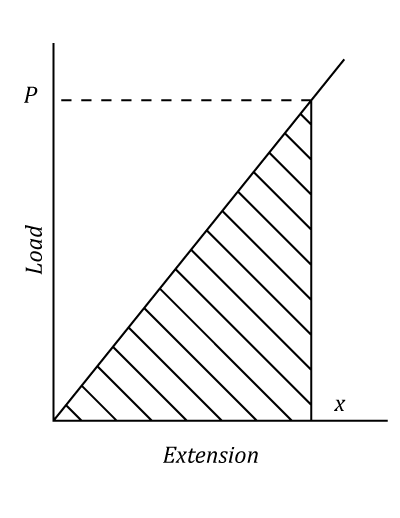
When either a Tensile or Compressive Load is applied to a bar, there will be a change in length x which for a material which obeys Hooke's law, is proportional to the load. The Strain Energy (U) of the bar is defined as the work done by the load in altering the length (i.e. Producing Strain). For a gradually applied or "Static" load the work done is represented by the shaded area on the diagram.

The Strain Energy can be expressed in terms of the Stress and dimensions. For a bar of uniform cross section and length l. (See Engineering Materials Direct Stress Introduction equations (1) and (5))

But A l is the volume of the bar can be expressed in words as:-

The Strain Energy per unit volume ( Usually called Resilience) in either simple Tension or Compression is :-

Example 1:
Calculate the Strain Energy of the following Bolt which is under a Tensile Load of 1 ton.
13108/img_ds14_0004.jpg
+
Show That the Strain Energy is increased when the bolt is under maximum Stress, if the shank of the Bolt is turned down to the root diameter of the thread.

It is normal practice to assume that the load is distributed evenly over the core of the screwed portion ( i.e. In this case the core diameter is 0.622 in. and the Area of the core is 0.304 sq. in. The Cross sectional Area of the shank is 0.442 sq.in.

The Stress in the screwed portion is given by:=

The Stress in the Shank is given by:-

Thus using Equation ( 0 ) the Total Strain Energy is given by:-

If the shank is now reduced in diameter to 0.662 in. the Stress in the bolt will be constant and have a value of 7380 lb./sq.in. and the Strain Energy will be given by:-

Impact Loads.

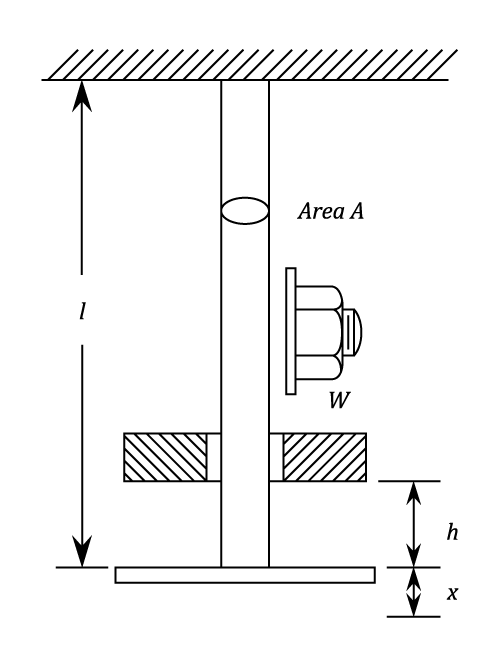
If a weight W falls through a height h onto a collar attached at one end of a uniform bar ( See Diagram),
13108/img_shr_3_0002.jpg
+

the bar will extend. The extent of this extension will be greater than if the load had been gradually applied. This must be so since the weight will have Kinetic Energy at the point of impact and this energy is absorbed by an increase in the strain energy of the bar. Assuming that the bar does not fail the weight will oscillate about and finally come to rest at the Normal equilibrium position.

In the diagram the maximum extension of the bar is shown as x. P is the equivalent static or gradually applied load which would produce an extension of x.

The Strain Energy in the bar at the point of maximum extension is \displaystyle \frac{1}{2}\;P\;x

If the loss of energy at Imact is neglected then the following equation can be written:-

Loss of Potential Energy by the Weight = Increase in Strain Energy in the Bar

i.e. (see equations(1) and (5))

Hence

Rearranging and multiplying through by \displaystyle \frac{A\;E}{l} a quadratic in P is produced. i.e.

Solving and discarding the negative root:-

Using the resulting value for P it is now possible to calculate both the value of the maximum extension x and the resulting Direct Stress.

The particular case where h = 0(i.e. the Load is suddenly applied gives the value P = 2W i.e.The Stress produced by a suddenly applied load is twice the Static Stress

The above simple analysis assumes that the whole of the rod attains the same value of maximum Stress at the same moment. This is however not strictly true. A wave of stress is set up by the Impact which is propogated along the rod. The actual maximum Stress set up will then depend upon the dimensions of the rod, its density and the velocity of the load at impact. Usually this approximate analysis gives results that err on the "Safe side" but this is not always the case.
Example 2:
Referring to the diagram shown above, let a weight of 200 lbs. fall a distance 2 ins. onto a collar at the end of a 1 in. diameter steel rod. If the rod is 10 ft. long what is the maximum Stress set up.

Using the results of equation (15)

Note the length of the bar is 10 ft. = 10 X 12 ins.

i.e. Although the Load only dropped 2 inches ( Approx 5 cms.) the maximum Stress was nearly 64 times the "Static" Stress.
Example 3:
If in the previous problem the bar was turned down to 1/2 in. diameter over half its length what would be the maximum Stress and extension caused by the 200 lb. load falling 2 inches.

Let P be the equivalent gradually applied load to cause the same maximum Stress. The corresponding extension is made up of two parts.

Substituting given values (Note. The lengths of each part of the bar have been converted to inches)

Applying the Energy Equation

Using the values for x from above:-

Multiplying through by \displaystyle \frac{\pi \times10^5}{4} and rearranging:-

Solving this quadratic and ignoring the negative root:-

The Maximum Stress will occur in the smaller section giving:-

The Maximum extension is given by:-

If the bar is already stressed before Impact e.g. If th collar in the previous examples had been given a weight, it would be correct to allow for the loss of Potential Energy of the the collar after the impact and equate the total loss of Potential Energy to the difference between the initial and final Strain Energies.
13108/img_shr_4_0003.jpg
+

If W' is the weight of the collar and LM represents the further extension after impact, then the area ALMB represents the increase in Strain Energy. But the area ALMC being W' times the added extension represents the loss of Potential Energy of the collar after impact. This leaves ABC to be equated to the loss of energy of the weight alone.

Consequently the Stress due to impact may be calculated without any consideration of the initial Stress and the final Total Stress is then found by adding the initial Stress.

i.e.

Where P' is calculated on the assumption of no initial Stress.
Example 4:
The loads carried by a lift may be dropped 4 in. onto the floor. The cage itself weighs 2 Cwt. and is supported by 80ft. of wire rope weighing 0.6 lb./ft. and consisting of 49 wires each 0f 1/16 in. diameter. The Maximum Stress in the wire is limited to 13000 lb/sq.in. and E for the rope is \displaystyle 10.5\times .10^6\;lb.in.^{-2} . Find the maximum Load which can be carried. (U.L.)

Note 1 Cwt. = 112 lbs.

The maximum Stress will occur at the top of the rope and the Initial Stress will be found from the weight of the cage and wire rope.

13108/img_shr_4_0007.jpg
+

The Initial Stress \displaystyle =\frac{2\times 112\;+\;80\times0,6}{49\times (\pi /4)(1/16)^2}=1810\;lb.in^{-2}

Subtracting this from the Permissible Stress of 13000 lb/sq.in., the increased Stress due to impact is 11190 lb./sq.in. This would be caused by an equivalent Static load of :-

This would produce an extension of:-

If W is the load dropped , then applying the Energy Equation gives

Substituting in Values:-

Varying Cross-section And Load

It is usual to assume that the load is uniformly distributed over the cross-section and that therefore the Stress is inversely proportional to the area.

The load may also vary as in the case of a column where its own weight needs to be taken into account and of course the case of inertia loadings on members in motion.
Example 5:
A rod of length l tapers uniformly from a diameter D at one end to a diameter d at the other. Find the extension caused by an axial load P.

At a distance x from the small end the diameter is given by:-

13108/img_shr_4_0008.jpg
+

At x the load P will extend a short length dx by:-

And for the whole rod the extension is given by:-
Example 6:
What is the condition that a column will have uniform strength (i.e. a constant maximum stress) when under the action of its own weight and a longitudinal Stress f which is applied to the top?

13108/img_shr_4_0009.jpg
+

Let the cross-section at the top be a and at a distance x from the top be A. The diagram shows the forces acting on a slice of thickness dx where w is the density and f the uniform Stress.

Equating Forces:-

Separating the variables

Integrating

When x = 0 A = a Thus or
Example 7:
A steel rod of uniform section 30 inches long is rotated about a vertical axis through one end at right angles to its length, at 1000 r.p.m. If the density of the material is 0.28 lb./cu.in. Find the maximum Stress

Let the Stress at a distance x from the axis be f and a distance x + dx ,f + df. If the area is A, the density of the rod w and the angular velocity \displaystyle \alpha

13108/img_shr_7_0007.jpg
+

Then the forces acting on the element are as shown. The Centrifugal Force is \displaystyle \left(\frac{w\;A\;dx}{g} \right)\;x\;\omega ^2

13108/img_ds14_0003.jpg
+

For equilibrium

Integrating

When x = l f = 0

The maximum Stress will occur at the axis where x = 0

Notes.
  • \displaystyle \omega is measured in radians per second and \displaystyle 1000\;r.p.m.\equiv 1000\times2\pi \div 60
  • g is usually taken as 32.2 ft/sec.sq. but in this example must be multiplied by 12 to bring it inches/sec. sq.

Compound Bars

Any Tensile or Compressive member which consists of two or more bars or tubes in parallel is called a Compound Bar. The bars are usually of different materials. The method of analysis is shown in the following examples.
Example 8:
A compound bar is made up of a rod of area \displaystyle A_1\;\;and\;\;modulus\;E_1 and a tube of equal length of area \displaystyle A_2\;\;and\;\;modulus\;E_2. If a compressive load is applied to the Compound Bar find how the Load is shared.

Since the rod and tube are of the same length and must remain so, the strain in each must be the same. The total load carried is P and we can assume that it is shared as \displaystyle W_1\;\;and\;\;W_2

From the Strain equation (See Direct Stress introduction equation (5)

And by equilibrium

Combing equations (54) and (55)

Re-arranging.

Example 9:
A central steel rod \displaystyle \frac{3}{4} in. in diameter passes through a copper sleeve 1 in.internal and \displaystyle 1\;\frac{5}{8} in external diameter. It is provided with nuts and washers at each end and the nuts ae tightened until a Stress of 10,000 lb/sq.in. is set up in the steel. The whole assembly is then placed in a lathe and a cut is taken along half the length of the tube removing the copper to a depth of \displaystyle \frac{1}{16}\;in.

13108/img_ds13_0001.jpg
+

a) Calculate the Stress now existing in the Steel. b) If an additional end thrust of 500 lbs. is applied to the ends of the steel bar calculate the final Stress in the steel. (L.U.)

When the nuts are tightened on the tube the effect is to put the steel into tension (Stress\displaystyle f_{s1}) and the copper tube into compression (Stress\displaystyle f_{c1})

Pull on rod = Push on tube

The tube is reduced in cross sectional area for half its length let. Let the Compressive Stress in the reduced section be\displaystyle f_{c2} and \displaystyle f_{c2'} in the remainder. Let the Stress in the Steel rod be\displaystyle f_{s2}

The load on the tube = The load on the rod.

From Which:-

The Strain Equation:-

Reduction in length of the rod = Reduction in length of the tube

Note. The reduction in length is caused by the decrease of tension in the rod and an increase in compression in the tube.

Substituting the known values and using equations (65) and (66) to solve for \displaystyle f_{s2}

b) An additional end thrust of 500 lbs, will cause a further reduction in the tension in tje rod and an increase in the compression in the tube.
13108/img_shr_11_0009.jpg
+

Let the corresponding Stresses be \displaystyle f_{s3}\;\;and\;\;f_{c3} in the reduced section and \displaystyle f_{c3'} in the remainder.

The equilibrium equation gives:-

The load must be constant along the length of the tube giving:-

Substituting from equation (72)

Using the Stain energy equation reffered to initial conditions:-

Substituting from equations (72) and (75) and solving for \displaystyle f_{s3}

Temperature Stresses

If a Compound bar is made of several different materials with different coefficients of thermal expansion, then if it is subjected to a change in temperature, then the different parts will tend to expand by different amounts. If the parts are constrained to remain together, then the actual change in length must be the same for each. This change will be the result ( taking into account positive and negative Strains) of the effects due to both temperature and Stress conditions.
Example 10:
A steel tube of 1 in. external diameter and \displaystyle \frac{3}{4}\;in. internal diameter encloses a copper rod of \displaystyle \frac{5}{8}\;in. diameyter to which it is rigidly joined at each end. If at a temperature of \displaystyle 60^0\;F. there is no longitudinal Stress, calculate the Stresses in the rod and tube when the temperature is raised to \displaystyle 400^0\;F.

\displaystyle E_s\;=\;30\times10^6\;lb.in.^{-2} \displaystyle E_c\;=\;14\times10^6\;lb.in.^{-2}

The coefficients of linear expansion:- \displaystyle \alpha _s\;=\;6\times10^{-6}\;/^{\circ} F \displaystyle \alpha _c\;=\;10\times10^{-6}\;/^{\circ} F

From the constants given it can be seen that the copper rod would expand more than the steel tube if it were free to do so.

13108/img_shr_12_0009.jpg
+

Since the two are joined together the copper will be prevented from expanding by as much as it would like and is therefore put into compression. The steel is tube is stretched and the compound bar takes up an intermediate position.

Let \displaystyle f_s be the tensile Stress in the steel tube.

\displaystyle f_c be the compressive Stress in the copper rod.

Using the Equilibrium Equation.

The Strain Equation:-

It is assume that the original lengths of the rods were the same.

Hence the temperature Strain of the rod - the compressive Strain = The temperature strain of the tube + the tensile Strain.

Substituting values

Substituting from equation (82)


Last Modified: 2008-11-16 23:46:47     Page Rendered: 2010-03-09 01:45:51

Page Comments

Format Excel Equations

  You must login to leave a messge


Valid CSS!   Valid XHTML 1.0 Transitional