
CodeCogs - An iteractive open source Numerical library Welcome... Login
CodeCogs
shopping cart
OSXWindowsLinux
Search CodeCogs
Numerical Pages

Valid RSS

EngineeringMaterials

Direct Stress Introduction

About | FAQ | Contact
About FAQ Contact

An intoduction to some of the teerms used in "Materials" and the concepts of Direct Stress and Strain
viewed 3953 times


+View version details
Contents -

Introduction

The following page introduces some of the terms associated with the study of "The Strength of Materials" and in particular those associated with Direct Stress.

Load

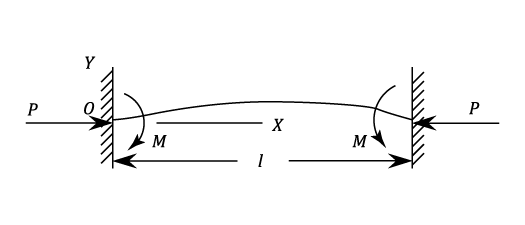
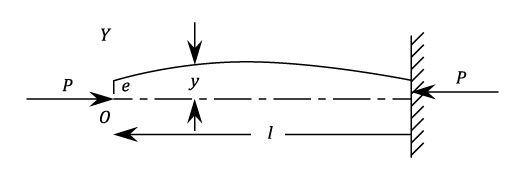
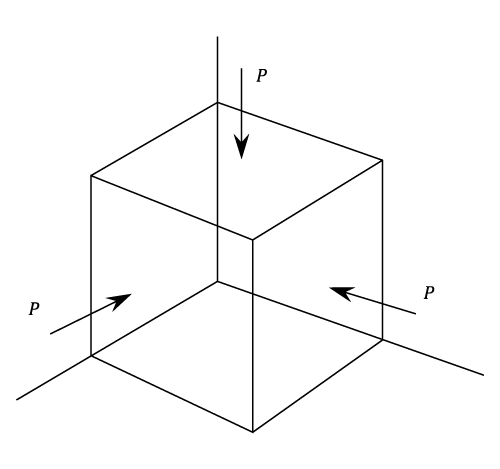
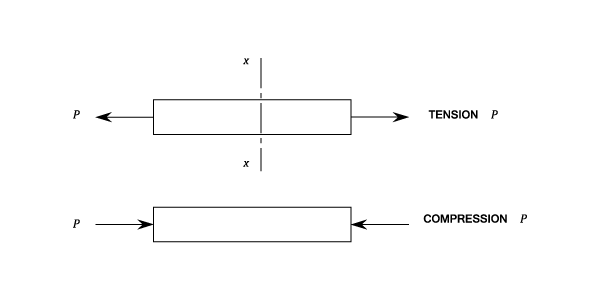
The simplest type of load (F) is a direct pull or push, known technically as Tension and Compression

13108/img_smx.jpg
+

Examples of these types of load are:-

In pin-jointed structural framework some members will be in Compression and some in Tension depending upon the loads through the joints at the ends of the member.

If a member is in motion the loading may be cause partly or in whole by dynamic or inertia forces. For instance the connecting rod of a reciprocating engine is subjected to inertia forces due to piston acceleration and due to its own acceleration as well as gas pressures on the piston and gravity effects.

Stress

13108/img_sh_y_0002.jpg
+

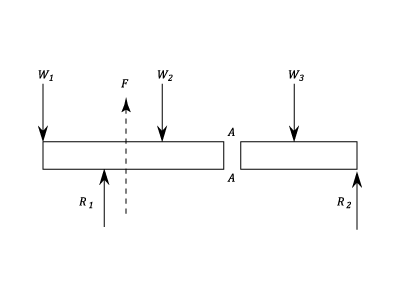
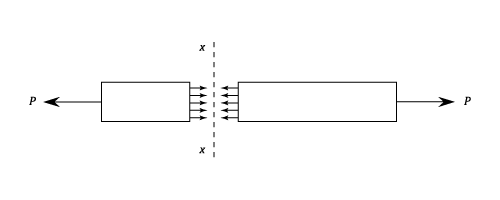
Across any section of a member, the Total Force carried must equal the Load P. This is distributed amongst the internal Forces of cohesion, which we call {Stresses} Imagine that the member is cut through at XX. Then each Portion must be in equilibrium under the action of the external load P and the Stresses across XX.

Stress which are Normal to the plane on which they act are called Direct Stressesand they are either tensile or compressive.

The Load transmitted across any Section divided by the cross sectional area is called the {Stress (f)}. Where the Load is uniformly distributed across the Section:-

In some instances the Stress varies throughout the member and the Stress at any point is defined as the limiting ratio of \displaystyle \frac{\delta P}{\delta A} fro a small area enclosing the point.

Stress is measured in Load per unit Area and is therefore lb./sq.in. tons/sq.in or Newtons/sq.mm.

Principle Of St. Venant

This principle states that the actual distribution of the Load over the surface of its application will not affect the distribution of Stress or Strain on sections of the body which are at an appreciable distance ( relative to the dimensions) away from the Load. Any statically equivalent loading may therefore be substituted for the actual Load distribution, provided that the Stress analysis in the region of the Load are not required.

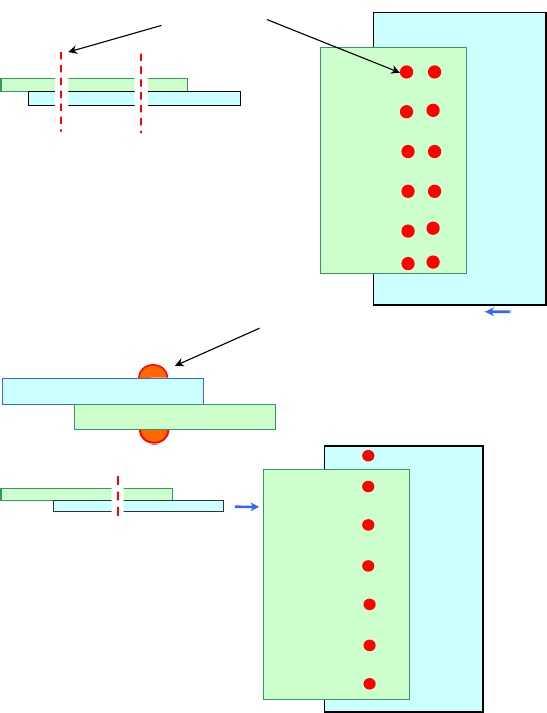
For example. A rod in simple Tension may have the end Load applied either:-

These are all statically equivalent but the last is the easiest to deal with analytically and the Principle of St. Venant justifies the choice of the distribution. For points in the rod distant more than three times its greatest width from the area of loading no appreciable error will be introduced.

Strain

Strain (e) is the measure of the deformation produced in a member by the applied Load. Direct Stress produces a change in length in the direction of the Stress. If a rod is in tension and the stretch or elongation produced is x then the Direct Stress is defined as the ratio:-

Normally Tensile Strain is considered Positive and Compressive Strain (i.e. a reduction in length) negative.

Note that as Strain is a Ratio it is Dimensionless.

Hooke's Law. The Principle Of Superposition.

This states that Strain is Proportional to the Stress which Produced it. This law is obeyed within certain limits by most ferrous alloys and can usualy be assumed to apply with sufficient accuracy to other Engineering Materials such as timber; concrete and non-ferrous alloys.

In general a material is said to be {Elastic} if it obeys Hooke's Law.

Where a number of Loads are acting together on an Elastic Material, the principle of {Superposition} states that the resultant Strain will be the sum of the individual Strains caused by each Load seperately.

Young's Modulus Or (modulus Of Elasticity)

Within the limits for which Hooke's Law is obeyed t, the ratio of direct stress to the strain it produces is called the { Young's Modulus (E) or Modulus of Elasticity}

For a bar of uniform cross-section this can be written as:-

Thus E is a Constant for a given Material and is usually assumed to be the same for Tension and Compression. For Materials which do not obey Hooke's Law exactly it is often possible to apply an average value for E over a given range of Stress.

Provided that Hooke's Law is obeyed Young's Modulus represents the Strain required to produce Unit Strain. A Stress numerically equal to the Modulus , when applied to a uniform bar, would cause the length to double. For Engineering Materials the Strain will, in fact, rarely exceed 1/1000 so that the change in length will always be small compared to the original length. E.G. Mild Steel has a value for E of 13,400tons/sq.in and will rarely be stressed above 10 tons/sq.in. At this value the Strain is

So a Bar of 10 inch length under a load of !0 tons/sq.in. will only suffer a change of length of 0.0075 inches
Last Modified: 2008-11-16 23:47:17     Page Rendered: 2010-03-14 06:02:27

Page Comments

Format Excel Equations

  You must login to leave a messge


Valid CSS!   Valid XHTML 1.0 Transitional