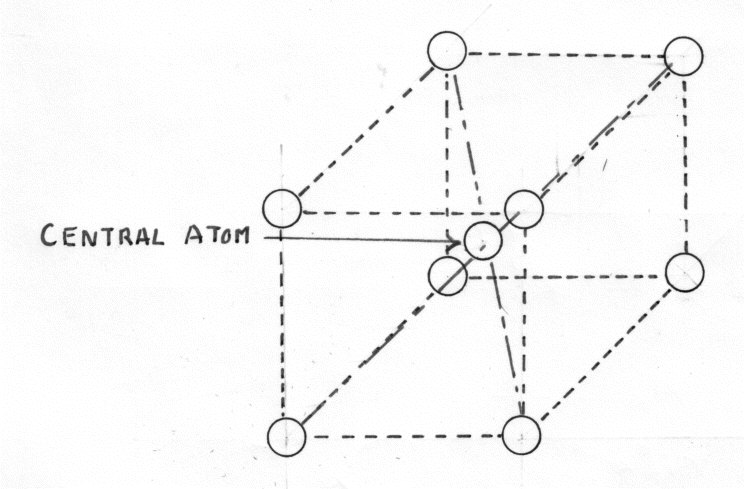
Cleavage Planes - Crystal Boundaries
1) In Crystals the regular Cubic arrangement of the Atoms results in the formation of planes either parallel with the three axis of the cube or diametrically along those atoms that can most easily slide over one another. These planes are known as "Cleavage Planes" and are a source of weakness.
2) At the Crystal boundaries there are always spare atoms which do not fit into the regular arrangement of the space lattice. This is because there are not always the exact number of atoms available to complete the Cubic arrangement. These spare atoms actually form the Crystal boundaries. i.e. The arrangement of the atoms along the Crystal boundaries are irregular.
FOR PURE METALS AND UNIFORM SOLID SOLUTIONS
3) The above means that there are no cleavage planes along the Crystal boundaries and therefore the boundaries do not split so easily. They are in fact stronger than the Crystals themselves. This explains why fractures take place most easily along cleavage planes. i.e. Through the Crystals and not along the boundaries. Thus the SMALLER the Crystals the stronger the material since there are more boundaries to be broken through.
4) If impurities are present the pure metal will reject them and any other foreign atoms during the cooling process. They then may form a layer or film separating one crystal of the parent material from another.
Conclusion
For a pure metal or alloy the strength is largely the strength of the Crystal boundaries. For a pure metal or uniform solid solution these boundaries are stronger than the Crystals, If however these boundaries contain impurities or other brittle constituents, the fracture may occur along them.