Typical values include:
<table border="1">
<tr><td><b>Material</b></td><td>E (GPa)</td></tr>
<tr><td>Wood</td><td>11</td></tr>
<tr><td>Aluminium</td><td>69</td></tr>
<tr><td>Brass</td><td>103-124</td></tr>
<tr><td>Titanium</td><td>105-120</td></tr>
<tr><td>Iron</td><td>190-210</td></tr>
<tr><td>Tungsten</td><td>400-410</td></tr>
<tr><td>Silicon Carbide</td><td>450</td></tr>
<tr><td>Diamond</td><td>1050-1200</td></tr>
</table>
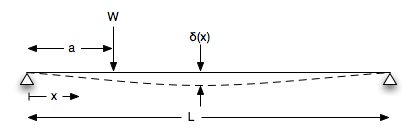
In structures the Young's modulus has importance in calculated the deflection or extension of beams due to applied loads, enabling an induced stress to be converted into a strain. As strain is defined as the (change of length)/(original length), then the movement of the structural member can be calculated.