
The expansion and compression of ideal gases are regularly considered to be polytropic processes. Therefore, they satisfy the equation:
where

is called the polytropic index.
However, we also know that ideal gases follow the so-called combined gas law (for a more detailed discussion also see
Thermodynamics of Ideal Gases ), which states that:
Therefore, when dividing equation (
1) by

we will also get a constant:
or, written in a different form:
from which we obtain that, during an expansion or compression, ideal gases satisfy:
Also, we can rewrite equation (
2) as:
By using the expression form of the volume from (
6) in equation (
1), we get that:
which leads to another equation which is satisfied during the expansion or compression of ideal gases:
Let us now consider the work done during a polytropic expansion or compression. We know that the work done by a gas which is expanding from state

to state

is given by:
As this is a polytropic expansion, we also have that:
or, furthermore, that:
where

is a constant, and

the polytropic index. By using the expression of pressure from (
11) in equation (
9), we get the work done by the gas as:
which, integrated, leads to:
By using identity (
10) again, we can rewrite (
13) as:
or, furthermore, as:
Thus, we obtain the work done by the gas during a polytropic expansion as:
However, from the ideal gas law we also have that:
where

is the mass, and

the universal gas constant (for additional information also see
Thermodynamics of Ideal Gases ). Therefore, we have that:
and:
By using (
18) and (
19), the work done from equation (
16) becomes:
from which we obtain the work done by the gas during a polytropic expansion also as:
In order to calculate the work done on a gas undergoing a polytropic compression from state

to state

, we follow a similar reasoning, but this time starting from:
Therefore, equations (
16) and (
21) can be rewritten in order to express the work done during a polytropic compression as:
and:
respectively. Hence, we obtain that the work done during a polytropic compression can be expressed as:
or as:
Let us now consider the heat supplied during a polytropic expansion. From the first law of thermodynamics we know that the heat added to the system

equals the change in internal energy

plus the work done by the system

:
As the change in internal energy is given by:
where

is the mass, and

the heat capacity at constant volume (for a more detailed discussion also see
Thermodynamics of Ideal Gases ), and also taking into account the expression of the work done during a polytropic expansion from (
20), the heat supplied during a polytropic expansion becomes:
which can also be written as:
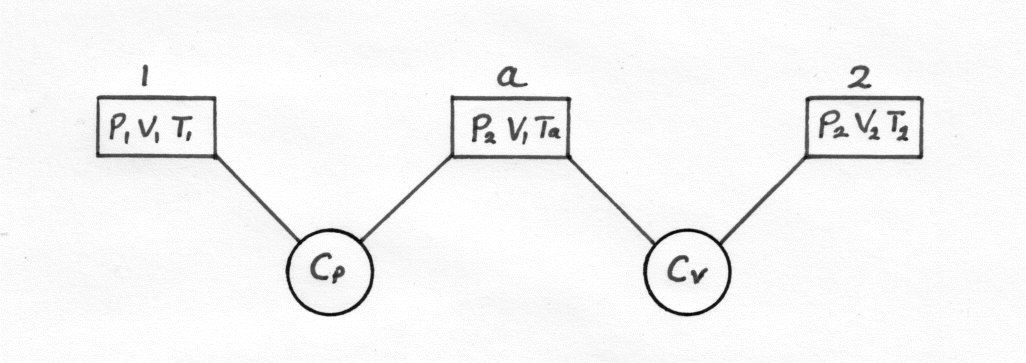
We know that the universal gas constant

relates the heat capacity at constant volume

to the heat capacity at constant pressure

by:
(for a more detailed discussion also see
Thermodynamics of Ideal Gases ). However, from the definition of the heat capacity ratio

:
we also have that:
By using the expression of

from (
33) in equation (
31), we get that:
or, furthermore, that:
from which we obtain

as:
By using the expression of

from (
36) in equation (
30), we get the heat supplied during a polytropic expansion as:
or, furthermore, as:
Equation (
38) leads to:
or, furthermore, to:
Taking into account that

(see equation
21), we obtain the heat supplied during a polytropic expansion as:
where

is the heat capacity ratio,

the polytropic index, and

the work done during the expansion.