Definitions
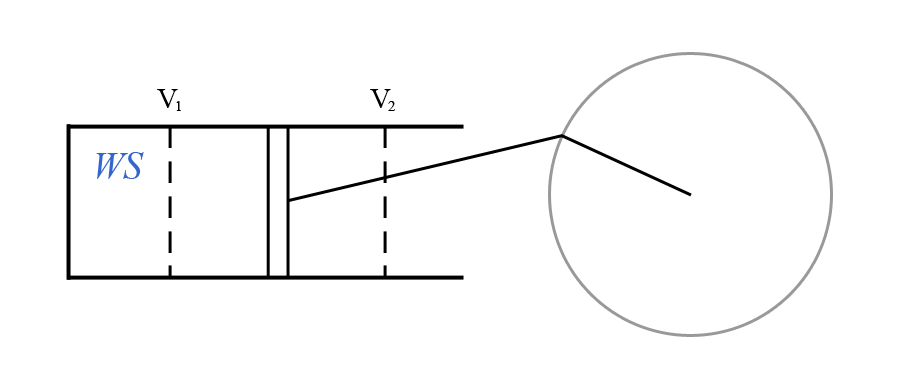
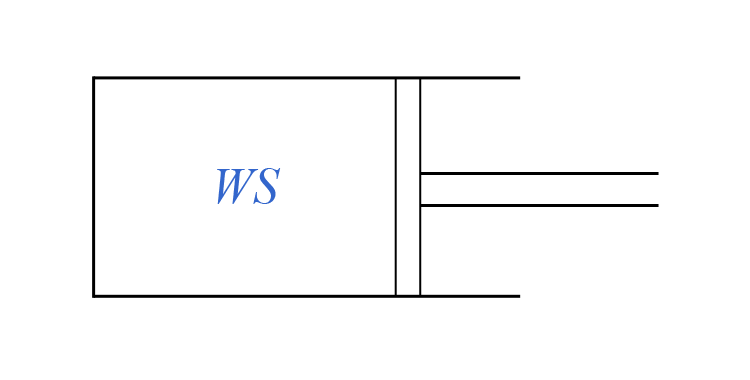
Working substance (WS) = the
WS is used as the carrier for heat energy. The state of the
WS is defined by the values of its properties, e.g. pressure, volume, temperature, internal energy, enthalpy. These properties are also sometimes called functions of state.
Key facts
An ideal gas is a
WS which obeys Boyle's law, Charles' law, Amontons' law, Avogadro's law, Joule's law of internal energy, Dalton's law of partial pressures, and has a constant specific heat.
Boyle's law states that if

, then:
Charles' law states that if

, then:
Amontons' law states that if

, then:
The combined gas law affirms that:
The ideal gas law can be written for

moles of gas as:
where

is the universal gas constant.
Avogadro's law states that equal volumes of gas contain, at the same temperature and pressure, the same number of molecules.
Joule's law of internal energy states that the internal energy of an ideal gas is independent of its pressure and volume, and depends only on its temperature.
Dalton's law of partial pressures affirms that the total pressure exerted by a gaseous mixture is equal to the sum of the partial pressures of each individual component of that mixture.
The heat capacity at constant pressure

is related to the heat capacity at constant volume

by:
where

is the universal gas constant.
The heat capacity ratio

is defined as:
The change in internal energy of

moles of an ideal gas undergoing a change in temperature of

is given by:
The change in enthalpy of

moles of an ideal gas undergoing a change in temperature of

is given by:
Constants
An ideal gas is a
working substance (WS) which obeys Boyle's law, Charles' law, Amontons' law, Avogadro's law, Joule's law of internal energy, Dalton's law of partial pressures, and has a constant specific heat. In order to obey all these laws, the
WS would not be able to change its state even at absolute zero. Therefore, the molecules of the
WS would need to be so far apart that there are no intermolecular forces and no collisions.
At normal temperatures and pressures, the permanent gases (e.g. hydrogen, oxygen, nitrogen) closely obey these laws. Therefore, these gases are called semi-perfect gases.
Ideal Gas Laws
Boyle's law (also sometimes called Boyle-Mariotte's law) states that if the temperature of a fixed mass of gas is kept constant, then its pressure is inversely proportional to its volume. Expressed in mathematical terms, Boyle's law affirms that if

is constant, then:
Boyle's law is illustrated in Figure 1 (to see the animation click on the thumbnail), which shows the inverse proportionality between pressure and volume when mass and temperature are kept constant.
Charles' law (also sometimes called Charles and Gay-Lussac's law) states that if the pressure of a fixed mass of gas is kept constant, then its volume is directly proportional to its temperature. Translated into mathematical terms, this means that if

is constant, then:
Charles' law is depicted in Figure 2 (to see the animation click on the thumbnail), which highlights the direct proportionality between volume and temperature when mass and pressure are kept constant.
Amontons' law (also known as the pressure-temperature law) states that if the volume of a fixed mass of gas is kept constant, then its pressure is directly proportional to its temperature. Expressed in mathematical terms, this law affirms that if

is constant, then:
Boyle's law, Charles' law, and Amontons' law can be associated to devise the so-called
combined gas law, which states that the ratio between the pressure-volume product and the temperature of a fixed mass of gas remains constant, or, in mathematical terms, that:
The combined gas law can be expressed more generally for

moles of gas as:
or, furthermore, as:
where

is a constant called the universal gas constant. Equation (
6) is named the
ideal gas law, and represents the equation of state of an ideal gas. The value of

in imperial is:
while in metric it is:
We can also define the specific gas constant

of a gas as the ratio between the universal gas constant

and the molar mass

of that gas:
For example, the specific gas constant of dry air is:
or, expressed in alternative units:
Another characteristic law of ideal gases is
Avogadro's law, which states that equal volumes of gas contain, at the same temperature and pressure, the same number of molecules. Avogadro's law can be expressed in mathematical terms as:
where

is the volume of the gas, and

the number of moles of the gas.
Joule's law of internal energy states that the internal energy of an ideal gas is independent of its pressure and volume, and depends only on its temperature. In mathematical terms this means that the internal energy

is a function of the absolute temperature

:
Yet another law characteristic of ideal gases is
Dalton's law of partial pressures, which states that the total pressure exerted by a gaseous mixture is equal to the sum of the partial pressure of each individual component of that mixture. This can be written in mathematical terms as:
where

is the total pressure,

is the partial pressure of component

, and

is the total number of components of the gaseous mixture.
Specific Heat Of Ideal Gases
The (molar) specific heat is the quantity of heat required to raise the temperature of one mole of substance by one degree.
In the case of gases, the specific heat depends on the way in which the gas is heated. For example, if it is allowed to do work, then the specific heat must be greater. We can imagine therefore an infinite number of specific heats. However, we will consider only two of them: the specific heat at constant volume, and the specific heat at constant pressure.
Imagine a heating process at constant volume. The first law of thermodynamics states that the change in internal energy of a system is equal to the heat added to the system minus the work done by the system:
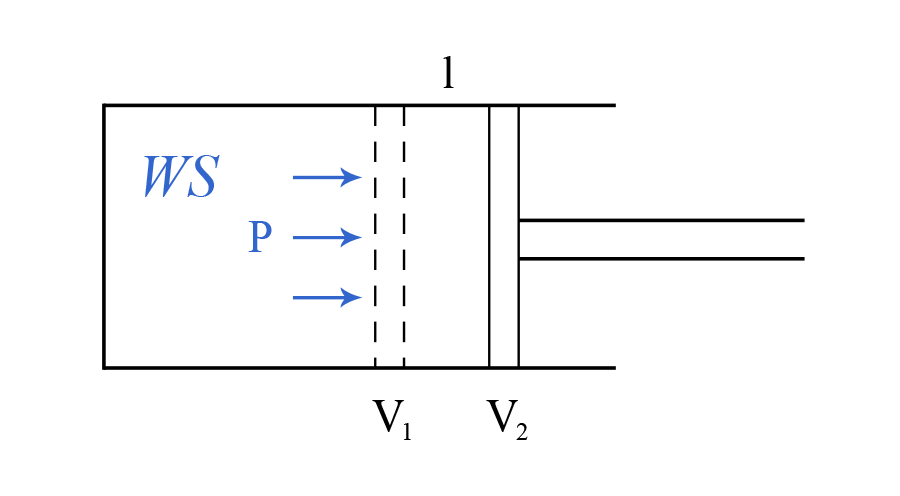
In our case, the work done by the system is given by:
while the heat added to the
WS during a process at constant volume (the specific heat at constant volume) can be written as:
where

is the number of moles of the
WS,

the heat capacity at constant volume, and

the change in temperature.
By using (
18) and (
19) in equation (
17), we obtain that:
However, we previously saw that the internal energy of an ideal gas is independent of its pressure and volume, and depends only on its temperature (see Joule's law of internal energy, equation
15). Therefore, equation (
20) becomes:
or, by considering the datum as absolute zero:
Now imagine a heating process at constant pressure. The heat added to the
WS in this case (the specific heat at constant pressure) is given by:
where

is the heat capacity at constant pressure.
Taking into account that the ideal gas law (
6) can also be written as:
and also considering equations (
21) and (
23), the first law of thermodynamics (
17) becomes:
from which we obtain that:
or, furthermore, that:
Hence, the universal gas constant

relates the heat capacity at constant volume

to the heat capacity at constant pressure

.
Also, let the ratio between

and

be denoted by

:
where

is called the heat capacity ratio.
The value of

varies depending on the degrees of freedom of the gas, which in turn is related to its atomic composition. For example, monoatomic gases can rotate only about their own axis, while diatomic gases can rotate about their own axis, as well as the two atoms of the molecule about each other. Hence, for monoatomic gases (which have only one degree of rotational freedom)

is approximately

, for diatomic gases (which have two degrees of rotational freedom)

is

, while for polyatomic gases

is approximately

.
Enthalpy Of Ideal Gases
We know that the change in enthalpy

of a system can be written as:
Taking into account equations (
21) and (
24), the change in enthalpy of an ideal gas becomes:
or, furthermore:
As

(see equation
27), equation (
31) becomes:
By considering the datum as absolute zero, we obtain the enthalpy of an ideal gas as: