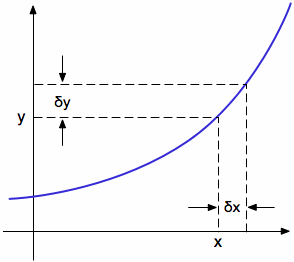
As the value is reduced and tends towards dx i.e. until it is infinitesimally small, the value of tends towards zero and can be neglected. is now written as .
It can be seen from the diagram that the value of the tangent at x,y is and at the limit this is written as
Referring to Equation (1) the value of the tangent is given by:
The Differential Coefficient (gradient Function)
is known as the Gradient function and represents the Derivative of y with respect of x. It is also known as the b{Differential Coefficient}.
In the simplest case, if
then
Example:
Example - Differentiation
Problem
Find the differentiation of
Workings
Bringing the power of each x variable down, and subtracting 1 from each power of x yields:
which is simplified further to
Solution
The Differentiation 0f A Product Of Two Functions Of X
It is obvious, that by taking two simple factors such as 5 X 8 that the total increase in the product is Not obtained by multiplying together the increases of the separate factors and therefore the Differential Coefficient is not equal to the product of the d.c's of its factors.
If
then
To Prove the Product Rule let where u and v are both functions of x. Thus when x increases to u and v will also change to and .
Their product y will therefore become
Therefore , the increase in
Thus
In the limit as , and tend to zero, so the above equation becomes:
Example:
Example - Differentiation - Product Rule
Problem
Differentiate
using the Product Rule
Workings
if
then the differential is
So for
Thus
Solution
The Differentiation Of A Product Of Any Number Of Functions Of X
The rule for finding the differential coefficient of a product of two functions of x can be extended to apply to the product of any finite numbers of functions of x
If
Where u, v, w are all functions of x, then regarding this as the product of the two factors u and w:
And similarly for any finite number of factors.
Note An important result follows from the above rules. The differential coefficient of with respect to x can be considered to be the product of two factors each of x and hence is given by:
Similarly, if n is any interger, by taking the product of n factors each of y
The differential coefficient of With respect to
The Differentiation Of A Quotient Of Two Functions Of X
Let
Then
The proof from first principles of the Quotient Rule.
As with previous proofs from first principles x becomes , u becomes and v becomes
Therefore y becomes
Thus
Therefore
In the limit when tends to zero the so will and
Then