Theorem A
A straight line drawn from the centre of a circle to bisect a chord which is not a diameter, is at right angles to the chord.
A chord is a line segment joining two points on a circle.
Theorem B
There is only one circle which passes through three given points which are not in a straight line.
Theorem C
Equal chords of a circle are equidistant from the centre and visa versa.
A tangent is a line intersecting the circle at only one point.
Theorem D
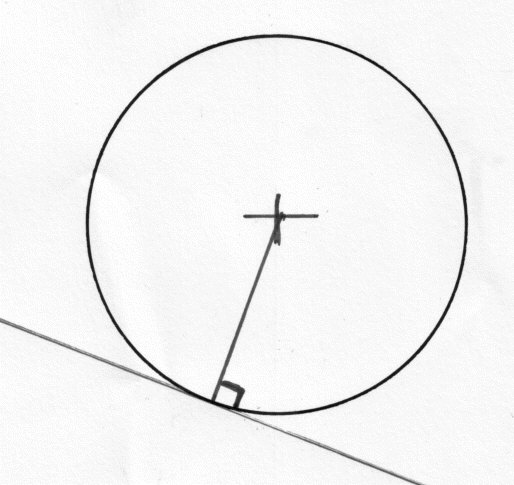
The tangent to a circle and the radius through the point of contact are perpendicular to each other.
Theorem E
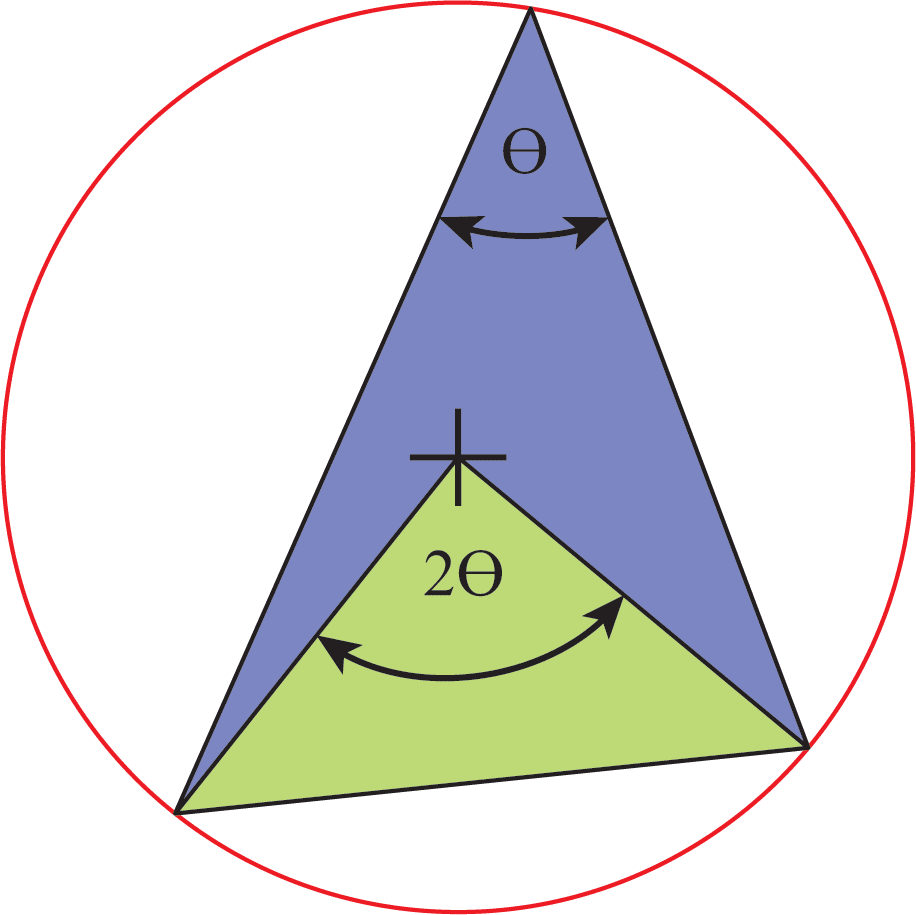
The angle which an arc of a circle subtends at the centre is double that which it subtends at any point on the remaining part of the circumference.
Theorem F Angles in the same segment of a circle are equal.
Theorem G
The angle in a semicircle is a right angle.
Theorem H
The opposite angles of any quadrilateral inscribed in a circle are supplementary.
Theorem I
If a straight line touches a circle and from the point of contact a chord is drawn, the angles which this tangent makes with the chord are equal to the angles in the alternate segment.
Example:
Example - Supplementary
Problem
To Prove
A line parallel to the base of the triangle cuts , at and respectively. The circle which passes through and touches at meets at . Prove that ,,,, lie on a circle.
Workings
Construction
Draw the line Proof
Since is parallel to the angles and are supplementary
Hence the angles and are supplementary
Solution
Conclusion
from Theorem H above the points ,,,, lie on a circle.
Statements Of Some Theorems On Proportions And Similar Triangles.
Theorem J
If a straight line is drawn parallel to one side of a triangle, the other two sides are divided proportionally.
Theorem K
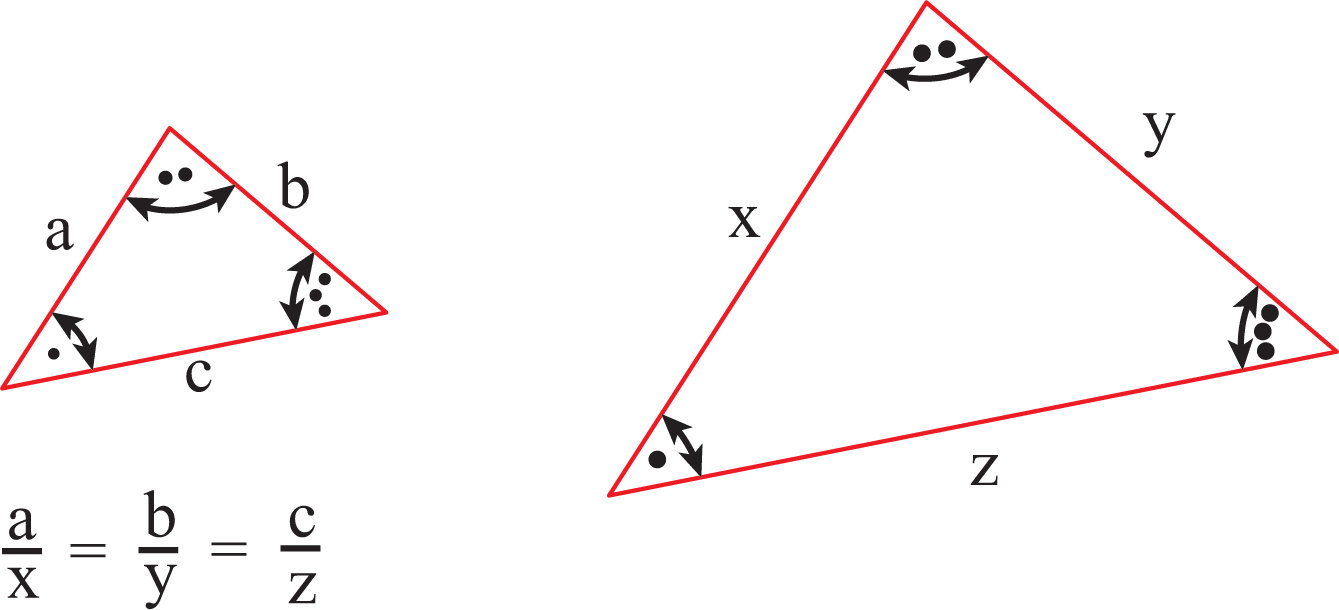
If two triangles are equiangular their corresponding sides are proportional.
Theorem L
If two triangles have one equal angle and the sides about these equal angles are proportional, then the triangles are similar.
Theorem M
If a triangle is drawn from the right angle of a right angled triangle to the hypotenuse, then the triangles on each side of of the perpendicular are similar to the whole triangle and to one another.
Theorem N
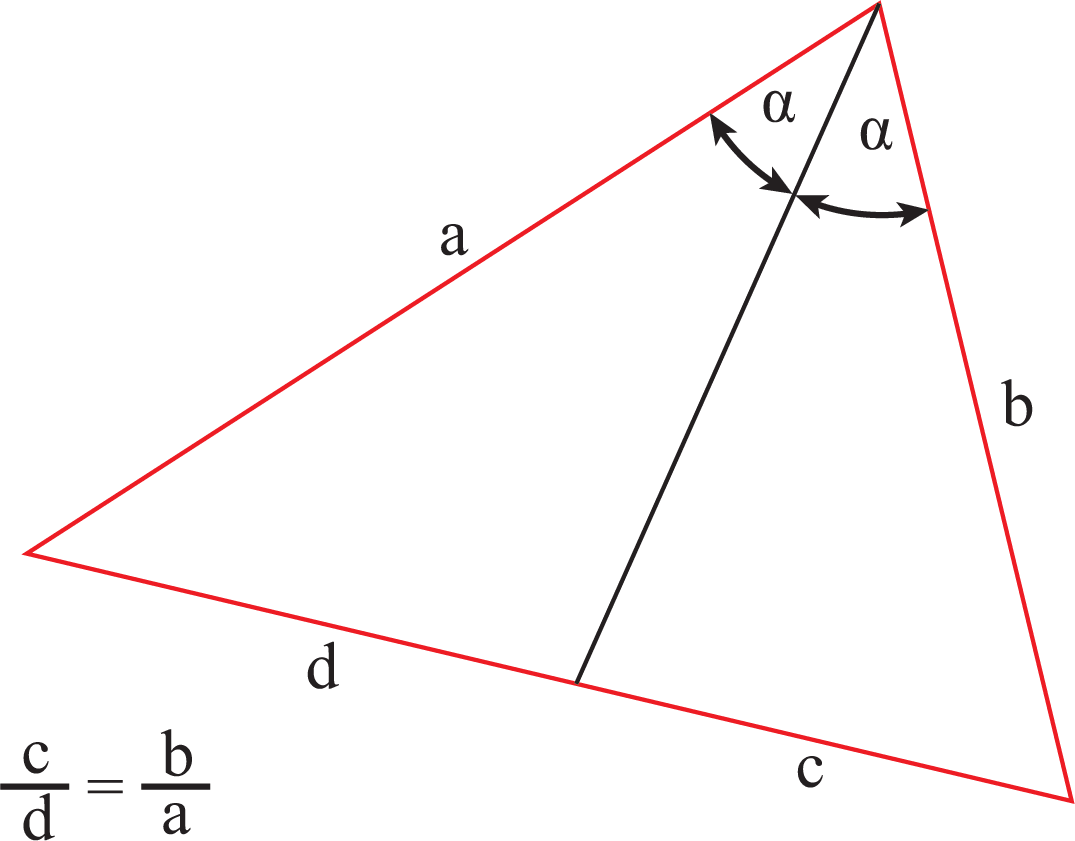
The internal bisector of an angle of a triangle divides the opposite side in the ratio of the sides containing the angle.
Example:
Example - Example 1
Problem
Any line parallel to the base of a triangle cuts and in and respectively. is any point on on a line through parallel to . If and produced cut at and respectively, Prove that = .
Workings
Proof
Since AP is parallel to BC
Hence triangle BHQ is equiangular with triangle APH
Likewise the triangles APK and KCR are equiangular and hence:-
Since HK is parallel to BC, theorem (K) applies and we can write:-
Combining the three above equations:-
Solution
Conclusion
It can be seen that =
Pythagoras Theorem
Theorem m provides a convenient method of proving Pythagoras theorem.
Consider the right angled triangle .
Pytagoras theorem
Given the right triangle prove that .
Construction.
Draw such that the angle is a right angle.
Proof
The triangles : and are equiangular and similar.
From
therefore
From
therefore
Add equations (22) and (24)
therefore
Note means that the two triangles are similar .
Two Theorems On Similar Rectilinear Figures.
Polygons which are equiangular and have their corresponding sides proportional are said to be similar. If also their corresponding sides are parallel, they are said to be similarly situated (or homothetic)
Theorem1
The ratio of the areas of similar triangles (or polygons) is equal to the ratio of the squares on
corresponding sides.
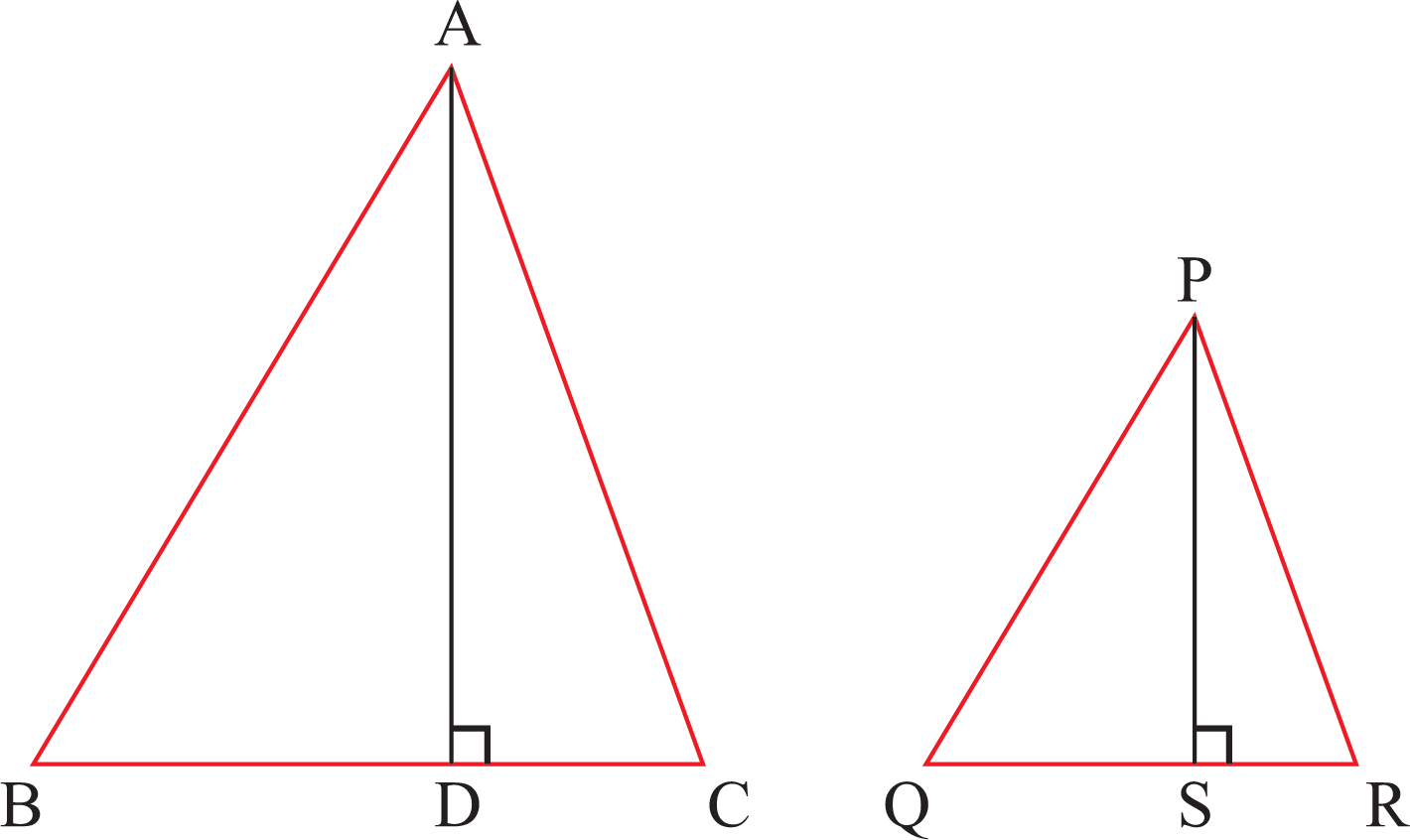
ABC and PQR are similar triangles and AD and PS are their heights. Since the angle ABD equals angle
PQS and the angle BDA equals angle QSP, the triangles ABD and PQS are equiangular and Hence:
The last equality follows from the fact that the triangles ABC and PQR are similar
If Polygons are similar they can be divided up into the same number of similar triangles and it
follows that the ratio of the areas of similar polygons is equal to the ratio of the squares on
corresponding sides.
Theorem2
If O is any fixed point and ABCD.....P is any polygon and if points A'B'C'.....P' are taken on
OA,OB,OC,....OP ( or these lines produced in either direction) such that :
Then the polygons ABCD.....P, A'B'C'D'.....P' are similar and similarly situated.
AB is parallel to A'B' and the triangles OAB and OA'B' are similar and hence:
Corresponding sides of the two polygons are therefore proportional and parallel and the two polygons
are similar and similarly situated.
In the above diagram "O" is said to be the centre of similitude of the two polygons. If the
corresponding points of the two polygons lie on the same side of O the Polygons are said to be
{directly homothetic} with respect to O and O is said to be the external centre of similitude. If
the corresponding points lie on opposite sides of O then the Polygons are said to be inversely
homothetic with respect to O and O is called the internal centre of similitude.
Example:
Example - Similarities
Problem
is an acute angle triangle. Show how to construct a square with two vertices on and one vertex on and one on .
Workings
Draw a square on the other side of to the triangle. Join and and let these lines meet at the points and respectively. Draw and perpendicular to to meet and at the points and respectively.
Solution
Then is the required square for regarding as the centre of Similitude is similar to and is therefore a square.