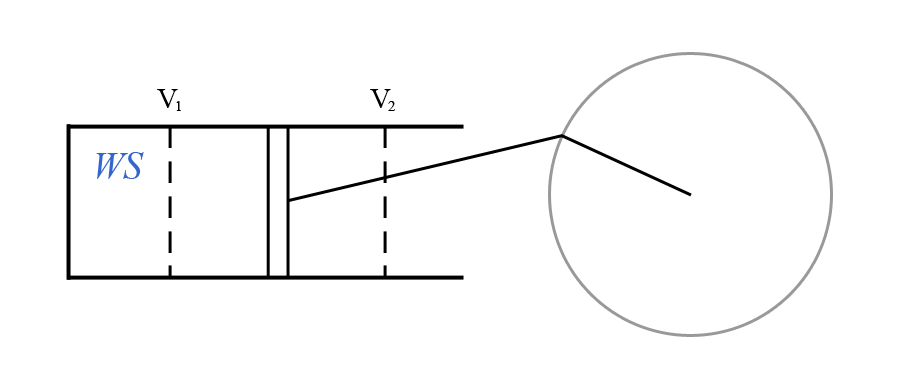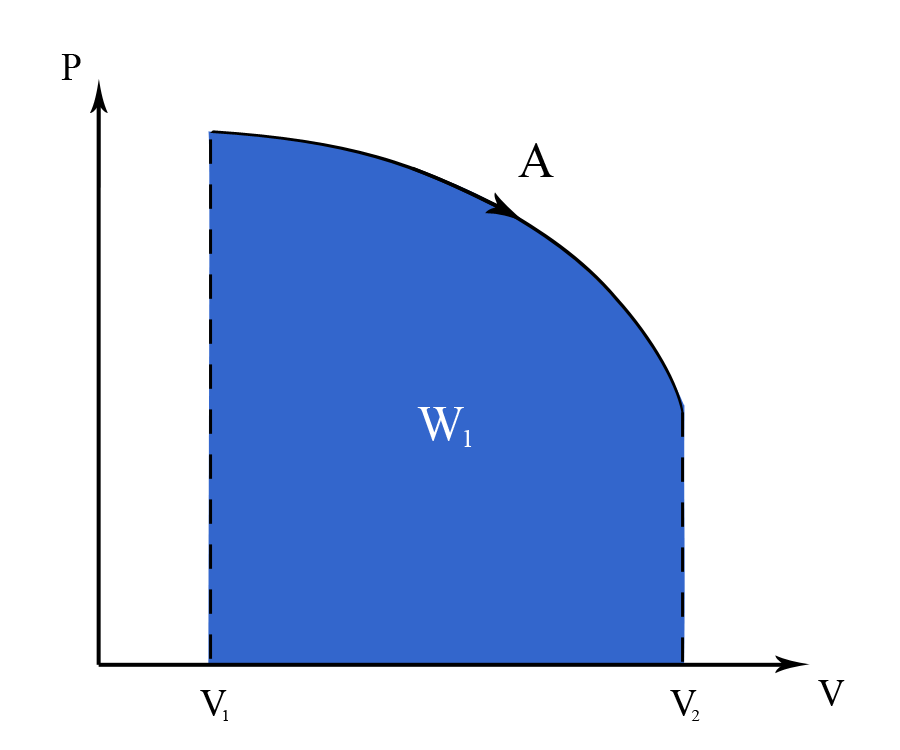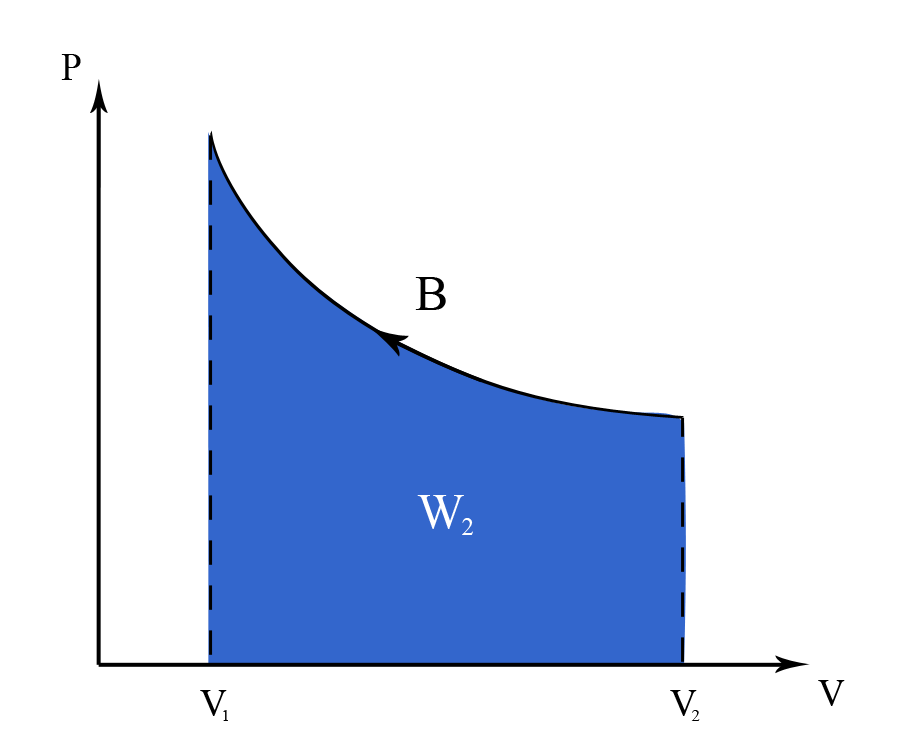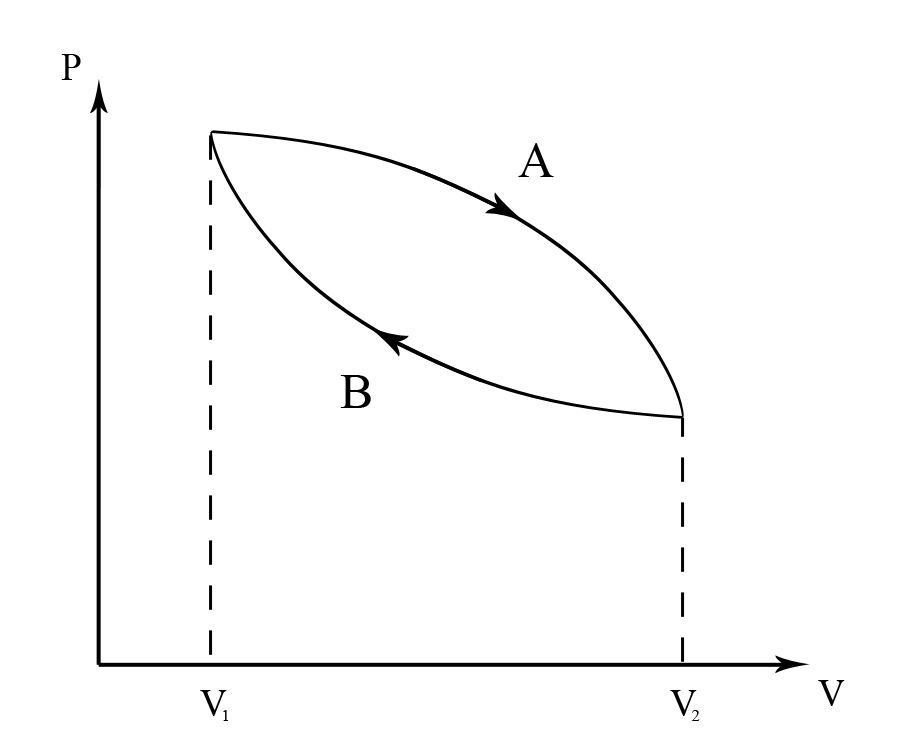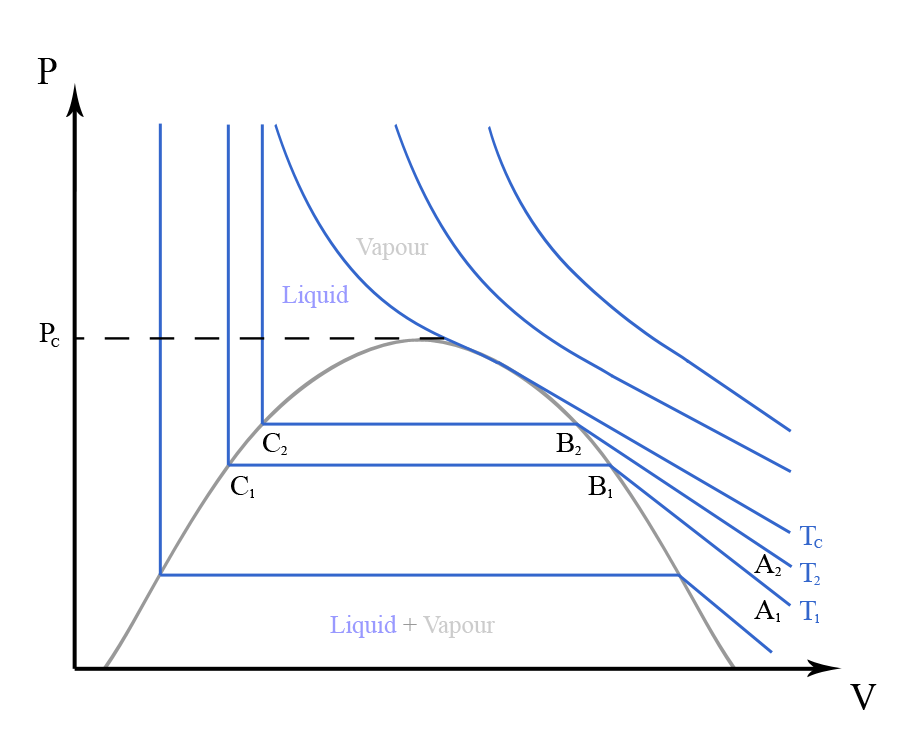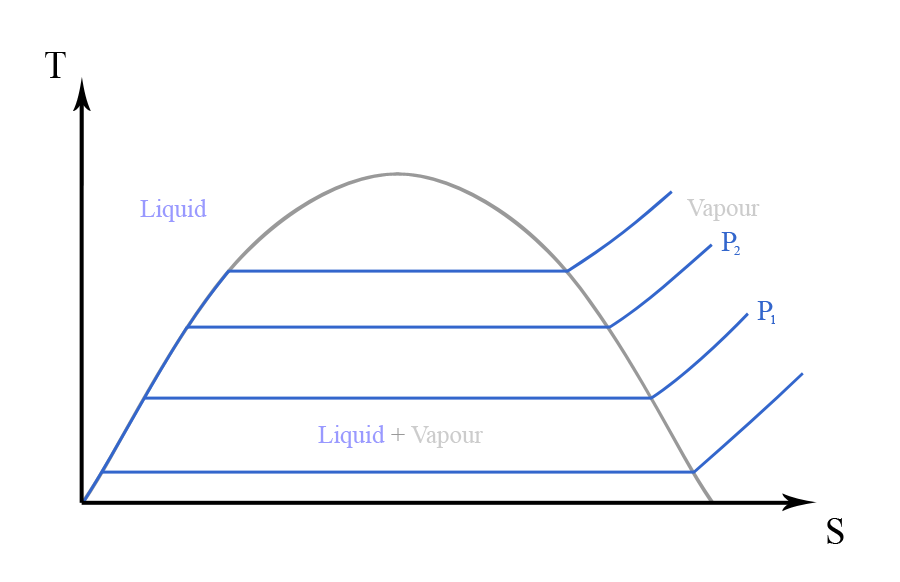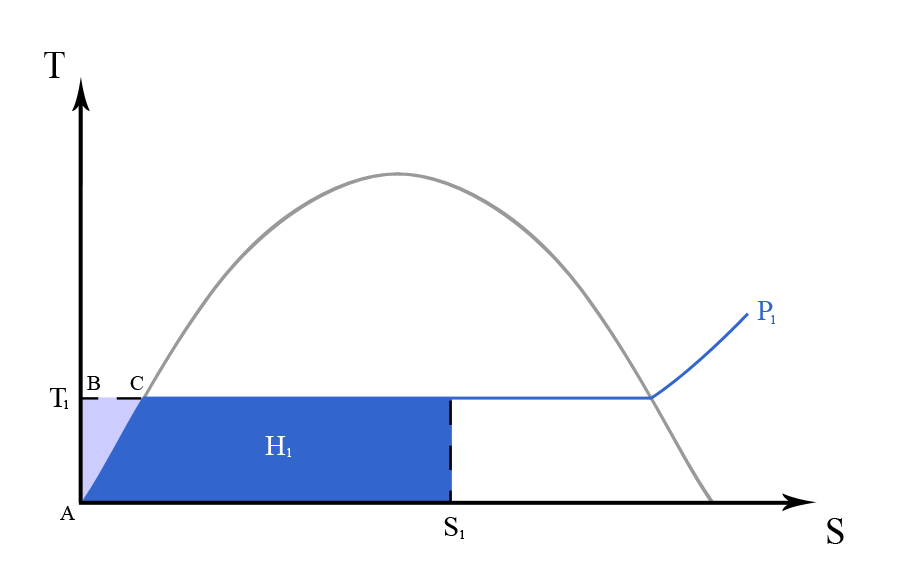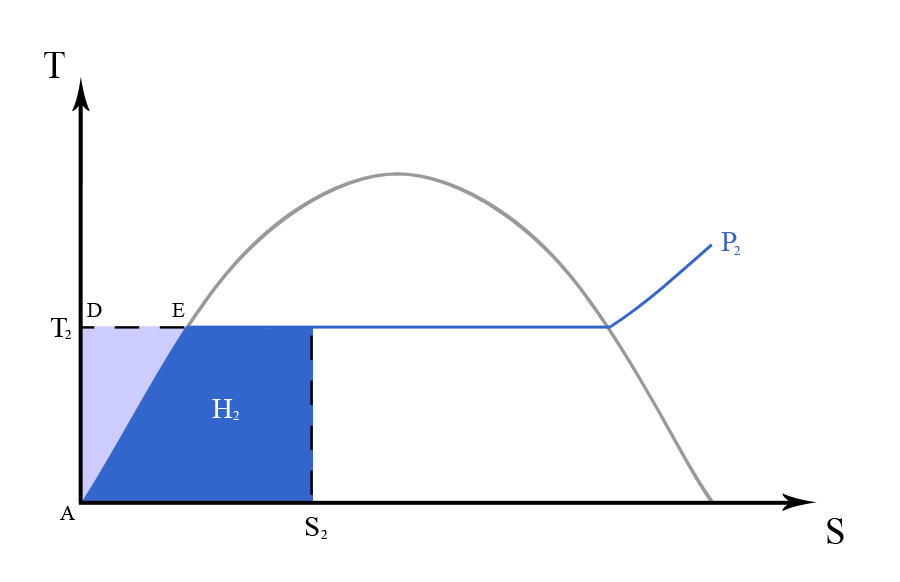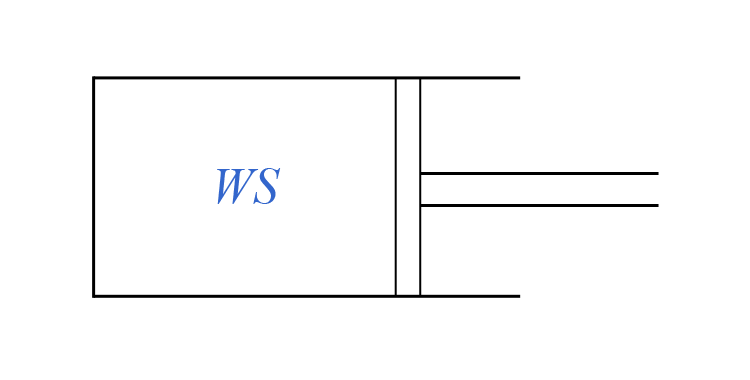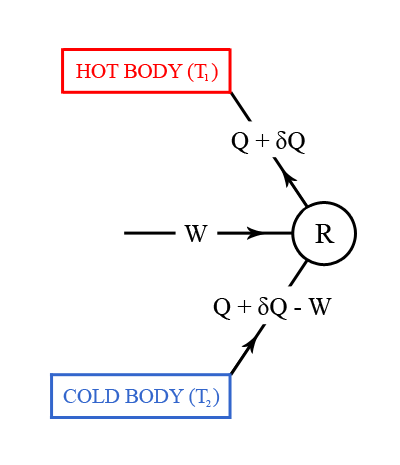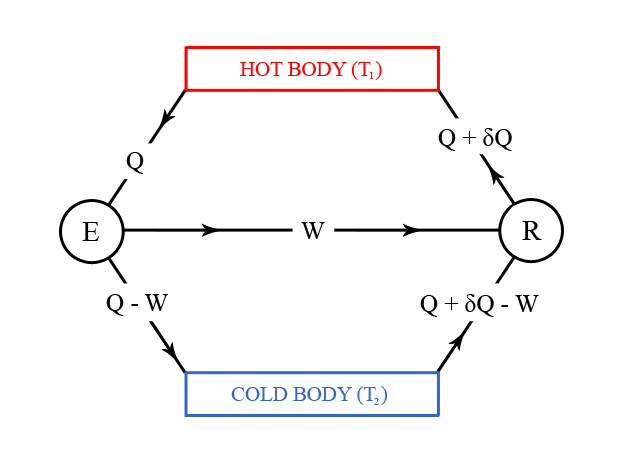
A thermodynamic cycle comprises a series of operations carried out on the
working substance (WS) during which heat is supplied, and after which the
WS is returned to its original state (for a more comprehensive introduction to thermodynamic cycles also see
Thermodynamic Cycles ).
An example of thermodynamic cycles are the internal combustion engine cycles. In these cases, the
WS is treated as pure air, the expansions and compressions are reversible and adiabatic, and heat can be added instantaneously if desired. Applications of such cycles are the Otto cycle, the Joule cycle, and the Diesel cycle.
Before discussing these cycles, we first have to introduce the thermal efficiency of a cycle.
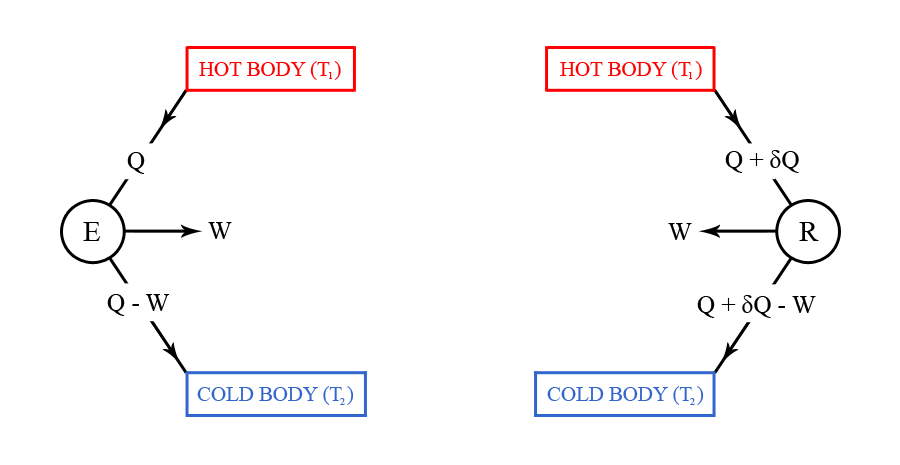
The thermal efficiency of a cycle, also denoted by

, is a measure of the ability to convert heat energy into work. Therefore, the thermal efficiency can be defined as:
where

is the work output, and

the heat energy supplied. As the work done

can also be expressed as:
where

is the heat rejected in the
WS and in losses (for a more detailed discussion see
Thermodynamic Cycles ), the thermal efficiency from (
1) becomes:
or, furthermore:
Otto Cycle
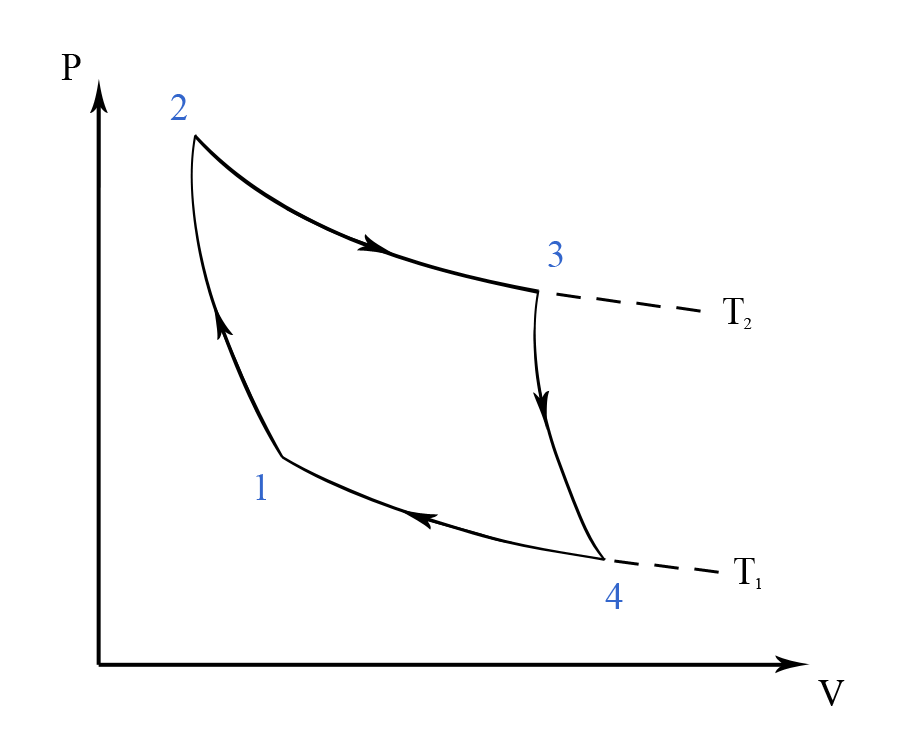
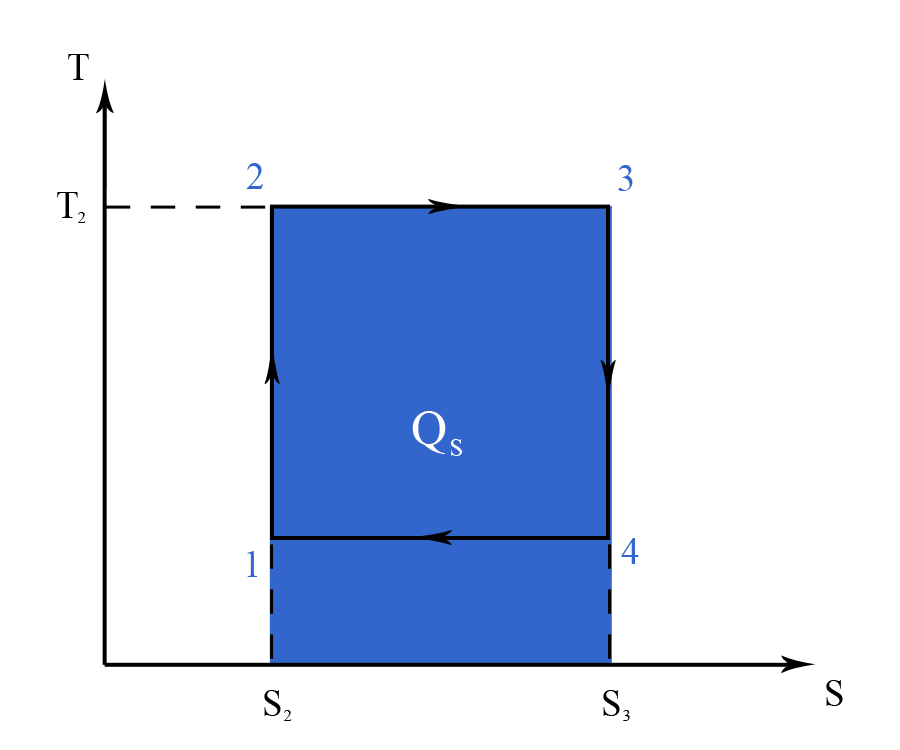
The Otto cycle (also sometimes called the Constant Volume cycle) is diagramed on a pressure (

) - volume (

) plot in Figure 1, and on a temperature (

) - entropy (

) plot in Figure 2.
This cycle consists of an adiabatic compression of the
WS (step

), followed by an isochoric heating (i.e. heating at constant volume) (step

), then an adiabatic expansion of the
WS (step

), and ended with an isochoric cooling which reverts the system back to its original condition (step

).
We know that the heat added or removed from the
WS during a process at constant volume can be written as:
where

is the number of moles of the
WS,

the heat capacity at constant volume, and

the change in temperature. Hence, for the Otto cycle depicted in Figure 1 and Figure 2, we have that the heat supplied

is:
and the heat rejected

is:
Therefore, the thermal efficiency of the Otto cycle becomes (see equation
4):
from which we obtain:
As in this case the
WS is treated as pure air, we can write for the adiabatic compression

that:
and for the adiabatic expansion

that:
In (
10) and (
11),

is the heat capacity ratio defined as:
where

is the heat capacity at constant pressure, and

the heat capacity at constant volume.
Equations (
10) and (
11) can also be written as:
and:
respectively. As

and

(steps

and

of the Otto cycle are isochoric - see Figure 1), we can rewrite equations (
13) and (
14) as:
and:
respectively, where

is called the compression ratio.
By subtracting equation (
15) from equation (
16), we get that:
or, furthermore, that:
which leads to:
By using (
19) in equation (
9), we obtain the thermal efficiency of the Otto cycle as:
It can be noted that the compression ratio

for carburettor engines is about

, while for fuel injector engines it increases to around

. By using these figures, and also considering a value for the heat capacity ratio

of

, the thermal efficiency of a petrol/gasoline engine is found to be between

and

. It can also be noted that for an Otto cycle engine, the ignition is usually performed by using a spark plug ("spark ignition").
Joule Cycle
The Joule cycle (also sometimes called the Brayton cycle, or the Constant Pressure cycle) is a thermodynamic cycle that describes the workings of the gas turbine engine. The Joule cycle is depicted on a

plot in Figure 3, and on a

plot in Figure 4.
This cycle consists of a reversible adiabatic (i.e. isentropic) compression of the
WS (step

), followed by an isobaric heating (i.e. heating at constant pressure) (step

), then a reversible adiabatic (isentropic) expansion of the
WS (step

), and ended with an isobaric cooling which reverts the system back to its initial state (step

).
Similarly to equation (
5), we can write the heat added or removed from the
WS during a process at constant pressure as:
where

is the number of moles of the
WS,

the heat capacity at constant pressure, and

the change in temperature. Therefore, for the Joule cycle depicted in Figure 3 and Figure 4, the heat supplied becomes:
and the heat rejected:
Hence, the thermal efficiency of the Joule cycle becomes (see equation
4):
from which we obtain:
As for the Joule cycle the
WS is also treated as pure air, we can write for the isentropic compression

that:
and for the isentropic expansion

that:
where

is the heat capacity ratio (see equation
12).
Equations (
26) and (
27) can also be written as:
and:
respectively.
By raising equations (
28) and (
29) to the

power, we respectively get that:
and:
As

and

(steps

and

of the Joule cycle are isobaric - see Figure 3), we can rewrite equations (
30) and (
31) as:
and:
respectively, where

is called the pressure ratio.
By subtracting equation (
32) from equation (
33), we get that:
or, furthermore, that:
which leads to:
By using (
36) in equation (
25), we obtain the thermal efficiency of the Joule cycle as:
Diesel Cycle
The Diesel cycle is diagramed on a

plot in Figure 5, and on a

plot in Figure 6.
This cycle consists of a reversible adiabatic (isentropic) compression of the
WS (step

), followed by an isobaric heating (step

), then a reversible adiabatic (isentropic) expansion of the
WS (step

), and ended with an isochoric cooling which returns the system back to its original state (step

).
Taking into account equations (
5) and (
21), we can write the heat supplied (at constant pressure, step

) as:
and the heat rejected (at constant volume, step

) as:
where

is the number of moles of the
WS,

the heat capacity at constant pressure, and

the heat capacity at constant volume.
Therefore, the thermal efficiency of the Diesel cycle becomes (see equation
4):
which can also be written as:
where

is the heat capacity ratio (see equation
12).
As for the Diesel engine the
WS is again treated as pure air, we can write for the isentropic compression

that:
for the isobaric heating

that:
and for the isentropic expansion

that:
Equation (
42) leads to:
which can also be written as:
where

is the compression ratio.
From equation (
43) we obtain:
which can also be written as:
where

is the expansion ratio during heating (also called the cut-off ratio).
The temperature

from (
48) can further be expressed, by considering the expression of

from (
46), as:
Equation (
44) leads to:
which can also be written, by considering the expression of

from (
49), as:
We can write equation (
51) in an analogous form as:
which leads to:
and, furthermore, to:
Thus, we managed to express

,

, and

all in function of

(see equations
46,
49, and
54 respectively). By using these expression forms in equation (
41), we get:
which leads to:
from which we obtain the thermal efficiency of the Diesel cycle as:
It can be noted that the ignition for the Diesel internal combustion engines is done by using a higher compression of the fuel, rather than by using a spark plug as in the case of gasoline powered Otto cycle engines. Therefore, the ignition for Diesel engines is sometimes called a "slow speed compression ignition", in contrast to the "spark ignition" of the Otto engines.