
Stability and Metacentric Height
Center of gravity refers to the mean location of the gravitational force acting on a body.
The conditions for the stability of floating bodies and ships with solid loads. Includis an introduction to Metacentric heights and centre of buoyancy
Introduction
In 1628 the Swedish warship Vasa was launched in Stockholm harbour.
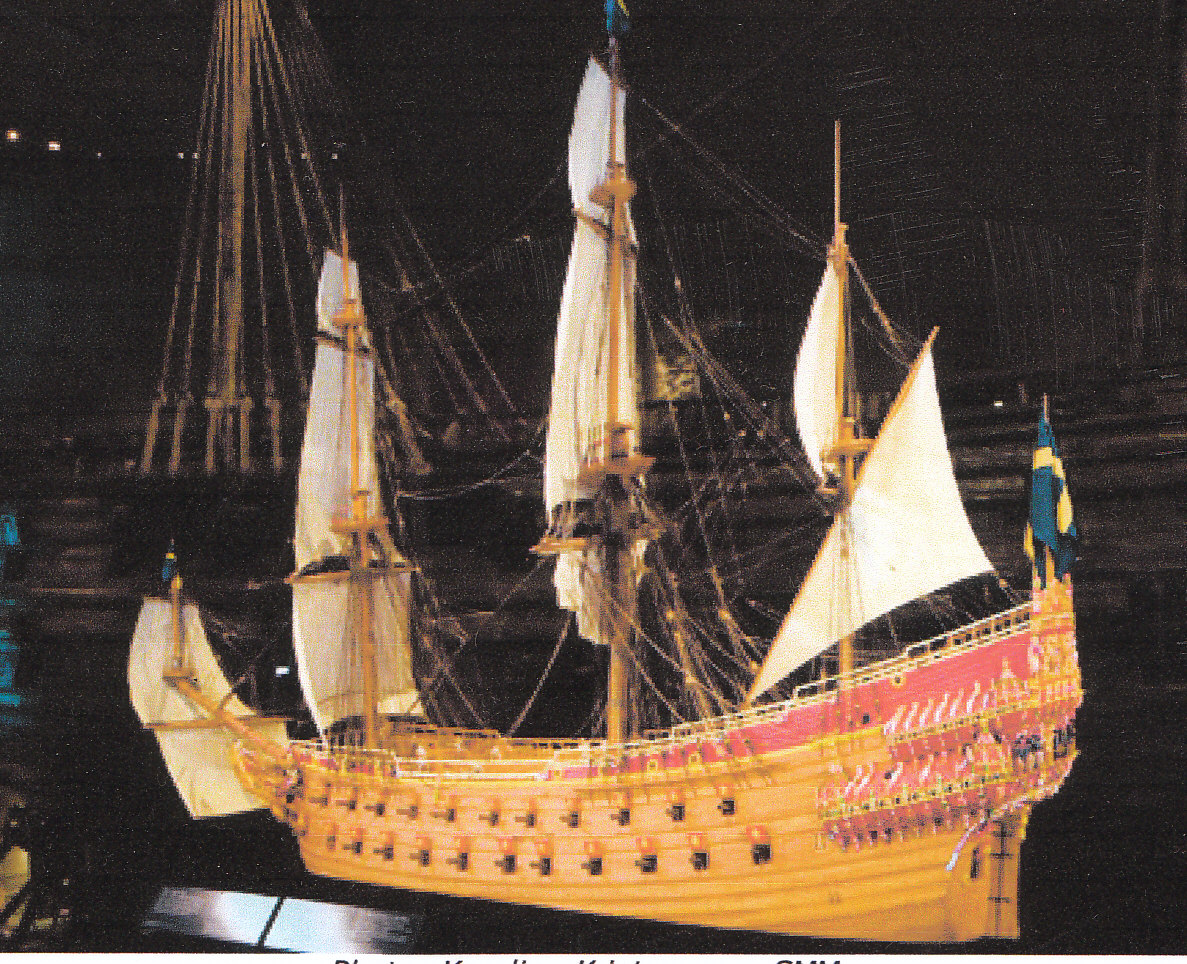
At some time during her construction it had been decided to increase the size and weight of the cannons on the upper gun deck. At the time of her launch she was ballasted but was not fully loaded. A full load would have increased her stability but whether it would have been enough to prevent a catastrophe, is not known. What is known is that she sailed a few yards, heeled over and sank. Sadly the ship builders of the time did not understand the requirements for a stable ship. This page, the first of three, examines these requirements and includes worked examples where the load or ballast is fixed. The two further pages will consider floating bodies with liquid loads or ballast and the period of roll.
Centre of Buoyancy and Stability
The Buoyancy Force act through the Centre of Gravity of the Displaced Fluid and is called The Centre of Buoyancy
There are three Types of Equilibrium:
- Stable. The body returns to its original position if given a small angular displacement.
- Neutral. The body remains in a new position if given a small angular displacement.
- Unstable. The body heels further over if given a small angular displacement.
The Stability of Fully Submerged Bodies
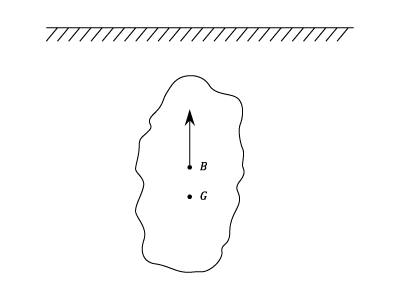
Let:
- $V$ = Volume of Body.
- $w$ = Specific weight of the fluid.
- $W$ = Weight of the Body.
- $G$ is the Centre of Gravity.
- $B$ is the Centre of Buoyancy and is the centre of gravity of the displaced liquid.
If:
- $B$ and $G$ are coincident then the Body will be in Neutral equilibrium.
- $B$ is below $G$ then the Body is in Unstable equilibrium.
- $B$ is above $G$ then the body is in Stable equilibrium.
This last case has a righting couple of $W\;BG\;\sin \theta$. Where $\theta$ is the angle of tilt. Note that the Position of $B$ and $G$ relative to the Body does not change when the body is rotated.
The Stability of Partially Submerged Bodies
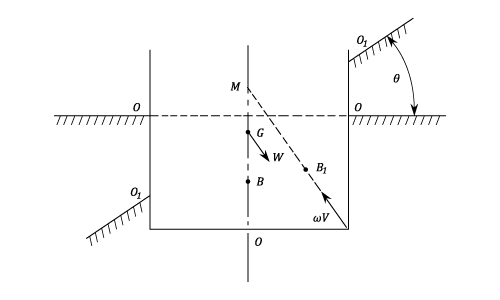
$G$ is the c. of g., $B$ is the c. of b. and the line $O$ $O$ is the original water surface.
After tilting $O'$ $O'$ is the new water line and the angle of Tilt is$\theta$.
$G$ remains in the same position relative to the ship but the Centre of Buoyancy moves to $B_1$.
$M$ is the "META CENTRE" and is defined as the point where the vertical through the new Centre of Buoyancy meets the original vertical through the Centre of Gravity after a very small angle of rotation.
$MG$ is called the METACENTRIC HEIGHT.
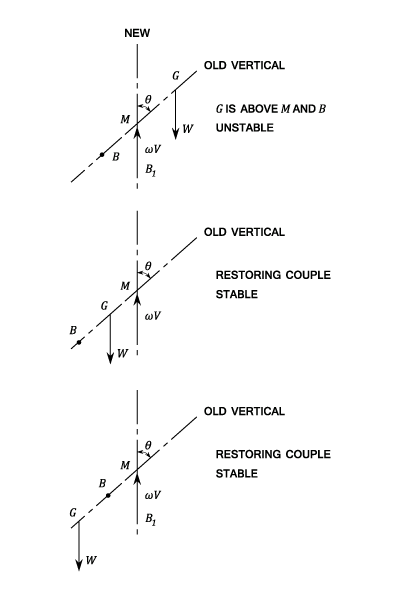
Therefore for stable equilibrium for a floating Partially Submerged Body the Meta centre must be above the Centre of Gravity $G$. If the Metacentric height is zero the Body will be in Neutral equilibrium.
In ship design the choice of the Metacentric height is a compromise between stability and the amount that the ship rolls. In British Dreadnaught Battle ships, for instance, the metacentric height was so great that they had a tendency to roll badly, even with large bilge keels.
The Righting couple $=\:W\;GM\;\sin \theta$
The Determination of Metacentric Height
Experimentally
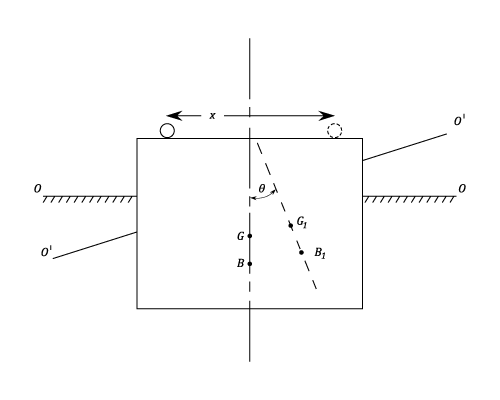
Let $W$ be the weight of the Boat plus its Load.
A small load $w$ is moved a distance $x$ and causes a tilt of angle $\theta$. The Boat is now in a new position of equilibrium with $B'$ and $G'$ lying along the Vertical through $M$.
The Moment due to the movement of the load is given by:
Moment due to movement of $C$ of $G=$
$wx = W\times GM\;\theta$
$\therefore\;\;\;\;\;\;GM = \frac{w\;x}{W\;\theta }$
Theory
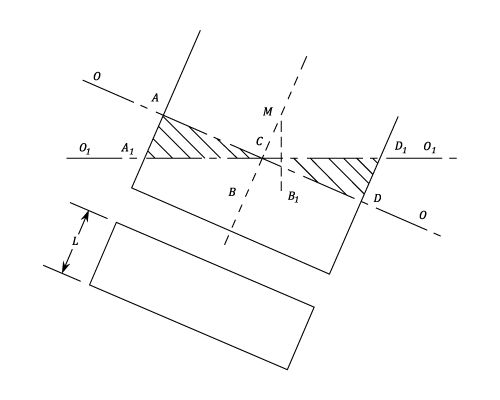
The Ship tilts from its old waterline $O$ $O$ to a new waterline $O'$ $O'$ as it moves through an angle $\theta$. Due to the movement of the wedge of water from $A'$ $A$ $C$ to $D'$ $D$ $C$, the Centre of Buoyancy moves from $B$ to $B'$.
The Change in the moment of the buoyancy Force = $wV$ $X$ $B$ $B'$
$= w\;V\times BM\;\theta \;\;\;\;$ where $\theta$ is small
The Volume of the Wedge $A$ $C$ $A'$ $= \frac{1}{2}\times \frac{b}{2}\times \frac{b}{2}\theta \times L = \frac{b^2\,L}{8}\;\theta$
Therefore the Moment of the Couple due to the movement of the wedge $=w\times \displaystyle\frac{b^2L\,\theta }{8}\times \displaystyle\frac{2}{3}b$
$wV\times BM\;\theta = \frac{wb^3\;L}{12}\;\theta$
Where $I$ is the Second Moment of Area of the Water Plane Section and $V$ is the volume of water Displaced.
Thus if the positions of $B$ and $G$ are known or can be calculated , then the distance $GM$ can be determined since:
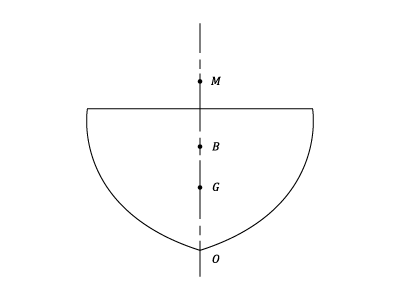
$GM = BM + BG = BM + BO - OG$
There are in fact two Metacentric heights of a ship. One for Rolling and the other for Pitching. The former will always be less than the latter and unless otherwise stated, the Metacentric given will be for Rolling.
Example 1 [imperial]

A Pontoon measuring 20ft.by 12ft. and 4ft deep, weighs 12 tons. It carries a load of 8 tons. The Pontoon sits in sea water with a density of 64 lb/cu. ft.
Find it's metacentric height and establish the angular tilt which will result if the load is moved by one ft. sideways.
Taking Moments about the Base: $(12\;+\;8)\times OG\;=\;12\times OG_P\;+\;8\times OG_L$ $\therefore\;\;\;\;\;OG\;=\;\frac{12\times 2\;+\;8\times 5}{(12\;+\;8)}\;=\;3.2ft.$
The Volume of water displaced $V$ = \f$\displaystyle\frac{(12\;+\;8)\times 2240}{64}\;=\;700 ft^3\f$
The Depth of immersion $h$ = \f$\displaystyle\frac{700}{20\times 12}\;=\;2.197\; ft.\f$
The height, $OB\;=\;\frac{h}{2}\;=\;1.458\;ft.$ And: $BM\;=\frac{I}{V}\;=\;\frac{L\;b^3}{12\;V}\;=\;\frac{20\times 12^3}{12\times 700}\;=\;4.143\;ft.$ But the Metacentric height $=\;BM\;+\;OB\;-\;OG\;=$ $=4.143\;+\;1.458\;-\;3.2\;=\;2.401\;ft.$
The Moment due to the Movement of the Load = 8 ft. tons
The Moment due to the movement of the $C$ of $G$ = \f$W\times GM\;\theta\f$ = 20 X 2.40
$\therefore\;\;\;\;\;\theta \;=\;\frac{8}{48}\;=\;\frac{1}{6}\;rds.\;=\;9^0\;31'$
- The metacentric heigh is $\;2.401\;ft.$
- The angle is $\theta=\;9^0\;31'$
Example 2 [imperial]
State the conditions for stable equilibrium of a body floating partially submerged in a liquid.
A cylinder of circular section, diameter $d$, made of material who's specific gravity is $S$, floats in a liquid of specific gravity $S_O$.
Find the maximum lehgth of cylinder if the axis is to remain vertical.
The required conditions for stable equilibrium are stated above.

The weight of the cylinder must equal the weight of fluid displaced and hence:
$\pi\times \frac{d^2}{4}\times L\times S=\pi\times \frac{d^2}{4}\times h\times S_O$
$\therefore \;\;\;\;\;\;h=\frac{S}{S_O}\times L$
$BG=\frac{L}{2}-\frac{h}{2}=\frac{L}{2}-\frac{S}{2S_O}=\frac{L}{2}\left ( \frac{S_O-S}{S_O} \right )$ From equation (1)
$BM=\frac{I}{V}=\frac{\pi d^2}{64}\times \frac{4}{\pi d^2h}=\frac{d^2}{16h}=\frac{d^2}{16h}\times \frac{S_O}{S.L}$ For stability, $BM>BG$ i.e. $\frac{d^2}{16}\times \frac{S_O}{S.L}>\frac{L}{2}\left ( \frac{S_O-S}{S_O} \right )$ Thus: $L^2<\frac{d^2\times S{_{O}}^{2}}{8S(S_O-S)}$
$\therefore \;\;\;\;\;\;\L=\frac{d\times S_O}{\sqrt{8S(S_O-S)}}$
Example 3 [imperial]
State the conditions to be met to ensure the stable equilibrium of a body partly immersed in water.
A right solid cone with apex angle equal to $60^0$ is of density $k$ relative the that of the liquid in which it floats with the apex downwards.
Determine what range of $k$ is compatible with stable equilibrium.
The first part of the question is essentially the same as the previous question and the conditions have been stated in the notes which preceded these examples.
Let $\omega$ be the specific weight of the liquid. And $\omega$ the specific weight of the cone material. Then: $k=\frac{\omega_1}{\omega}$ The weight of the cone $=\omega_1\times \frac{\pi R_1^2}{3}\times \sqrt{3}R_1$ The weight of the displaced liquid $=\omega\times \frac{\pi R^2}{3}\times \sqrt{3}R$ From the above two equations:
$\frac{\omega_1}{\omega}=\left ( \frac{R}{R_1} \right )^3$ Or:

$BG=BO-OG=\frac{1}{4}h-(AG-AO)$ $=\frac{h}{4}-(\frac{h_1}{4}-h_1+h)=\frac{3}{4}(h_1-h)$ i.e. $BG=\frac{3}{4}\sqrt{3(R_1-R)}$ Now: $BM=\frac{I}{V}=\frac{\pi R^4}{4}\times \frac{3}{\sqrt{3}\times \pi R^3}= \frac{\sqrt{3}}{4} R$
For stable equilibrium BM > BG
i.e. $R\;>\;3(R_1-R)$ Or:
$\sqrt[3]{k}\;>\;\frac{3}{4}$ i.e. $k\;>\;\frac{27}{64}$
Thus the the range of $k$ is between $\fraqc{27}{64}$ and $1$.
Example 4 [imperial]
A hollow cylinder with closed ends is 12 in in diameter, weighs 60 lb. and has a small hole in the bottom.
Calculate:
- The depth to which it will sink .
- The height to which the water will rise.
- The final air pressure in the cylinder.
Disregard the wall thickness of the cylinder but assume that the compression of the air is isothermal. ( Atmospheric pressure is $14.7\;lb./in^2$)
Determine also whether the cylinder will be stable in the vertical position when in equilibrium.
The cylinder will sink until the excess air pressure on the top balances the weight. If $p\;lb./in^2$ is the final air pressure then :

$60=\frac{\pi\times 12^2}{4}\;(p-14.7)$ $\therefore \;\;\;\;\;\;p=15.23\;lb./in^2$
If $h_1$ is the depth the cylinder sinks. Then for an isothermal compression of the air in the cylinder:
$14.7\times 18=15.23(18-h_1)$
Note: The cross sectional area has been neglected from both sides of the equation. Hence: $h_1=0.65\/in.$ Thus the weight of water in the cylinder is:
$0.65\times \frac{\pi\times 12^2}{4}\times \frac{62.4}{12^3}=2.66 \;lb.$
Note one cubic foot of water weighs 62.4 lb.
Let $h_2$ be the depth that the cylinder sinks.
It can now be assumed that the hole at the bottom is sealed and that the weight of water in the cylinder is part of the total weight.
$\therefore \;\;\;\;\;\;(h_2-h_1)\times \frac{\pi\times 12^2}{4}\times \frac{62.4}{12^3}=60$ From which:
$h_2=15.3\;in.$
The weight of water in the cylinder is the volume $X$ density of water and is:
$\frac{\pi}{4}\times 12^2\times \frac{62.4}{12^3}=2.66\;lb.$
If $G$ is the resultant c.of g then by taking moments about $E$:
$(60+2.66)\times GE=60\times \frac{18}{2}+2.66\times \frac{0.65}{2}$ $\therefore \;\;\;\;\;GE=8.63\;in.$
Now: $EG=BG+BE=BG+\frac{h_2}{2}$ Thus: $BG=8.63-\frac{h_2}{2}=8.63-\frac{15.3}{2}=1\;in.$ $BM=\frac{I}{V}=\frac{\pi\times 12^4}{64}\times \frac{4}{\pi\times 12^2\times 15.3}=0.588\;in.$
Thus the meta centre is below the centre of gravity and the cylinder is unstable.
- The depth is $h_2=15.3\;in.$
- The height is $h_1=0.65\/in.$
- The final air pressure is $p=15.23\;lb./in^2$