
Accelerated along inclined plane
Fluid masses subjected to acceleration along inclined plane
Consider a tank open at top, containing a liquid and moving upwards along inclined plane with a uniform acceleration as shown in fig-1(a).
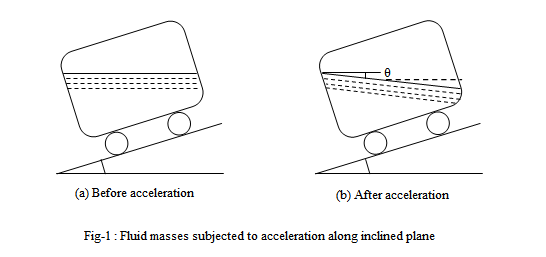
We know that when the tank starts moving, the liquid surface falls down on the front side and rises up on the back side of the tank as shown in fig-1(b).
Let,
- $\phi$ = Inclination of the plane with the horizontal
- $\theta$ = Angle, which the liquid surface makes with the horizontal, and
- $a$ = Acceleration of the tank
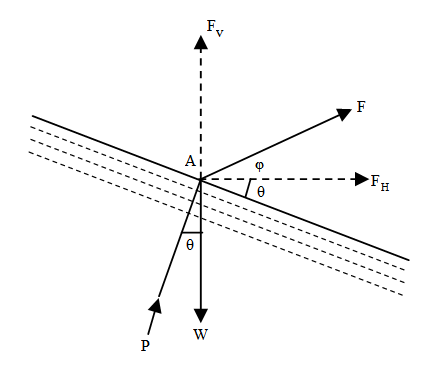
Now consider any particle A on the liquid surface. We know that the forces acting on the liquid particle are :
1. Weight of the particle (W) acting vertically down.
2. Accelerating force (F) on an angle $\phi$ with the horizontal.
3. Pressure (P) exerted by the liquid particles normal to the free surface.
Now resolving the accelerating force (F) horizontally and vertically, we get
$F_H = F \cos\phi$ and $F_V = F \sin\phi$
We know that the weight of the particle,
$W = mg$
Similarly, the accelerating force,
$F = ma$
Now resolving all the forces horizontally at A,
$P\sin\theta = F_H = F\cos\phi = ma\cos\phi$
And resolving all the forces vertically at A,
$P\cos\theta = F_V = F\sin\phi + W = ma\sin\phi + mg$
$\frac{P\sin\theta}{P\cos\theta} = \frac{ma\cos\phi}{ma\sin\phi + mg} = \frac{a\cos\phi}{a\sin\phi + g}$ $\tan\theta = \frac{a_H}{a_V + g}$
where,
- a\_H = horizontal component of the acceleration
- a\_V = vertical component of the acceleration