 CodeCogs®
Accelerated vertically
Fluid masses subjected to vertical acceleration
Consider a tank open at top, containing a liquid and moving vertically upwards with a uniform acceleration. Since the tank is subjected to an acceleration in the vertical direction only, therefore the liquid surface will remain horizontal.
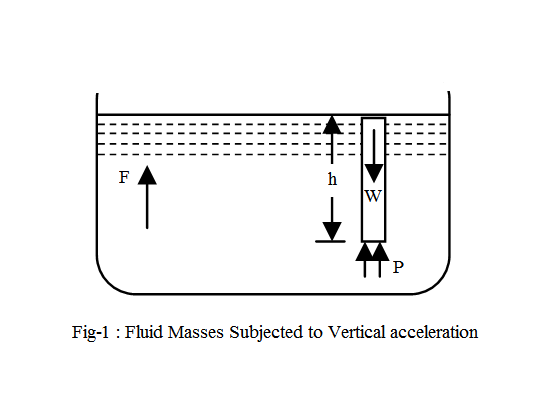
Now consider a small column of the liquid of height h and area dA in the tank as shown in fig-1.
Let, $p$ = Pressure due to vertical acceleration
We know that the forces acting on this column are :
1. Weight of the liquid column $[W = w(h.dA)]$ acting vertically downwards,
2. Acceleration force, $F = ma = \frac{w}{g}(h.dA)a$
3. Pressure $(P = p.dA)$ exerted by the liquid particles on the column.
Now resolving the forces vertically,
$P = W + F$ $\Rightarrow p.dA = w(h.dA) + \frac{w}{g}(h.dA)a = wh.dA(1 + \frac {a}{g})$ $\therefore p = wh(1 + \frac {a}{g})$