
Chezy Equation
Mean flow velocity within pipes with turbulent flow
The Chezy equation applied to pipes with turbulent flow is
where
- i is $\displaystyle \frac{h_f}{l}$ or head loss due to friction over the pipe length,
- m is $\displaystyle \frac{A}{P}$ or wetted area divided by the wetted perimeter,
- and C is $\displaystyle \sqrt{\frac{2g}{f}}$ where f is the coefficient of friction.
Theory
For the flow of a fluid within a pipe with velocity (v), there will be a reduction in mean pressure with distance, which is usually referred to as "head loss".
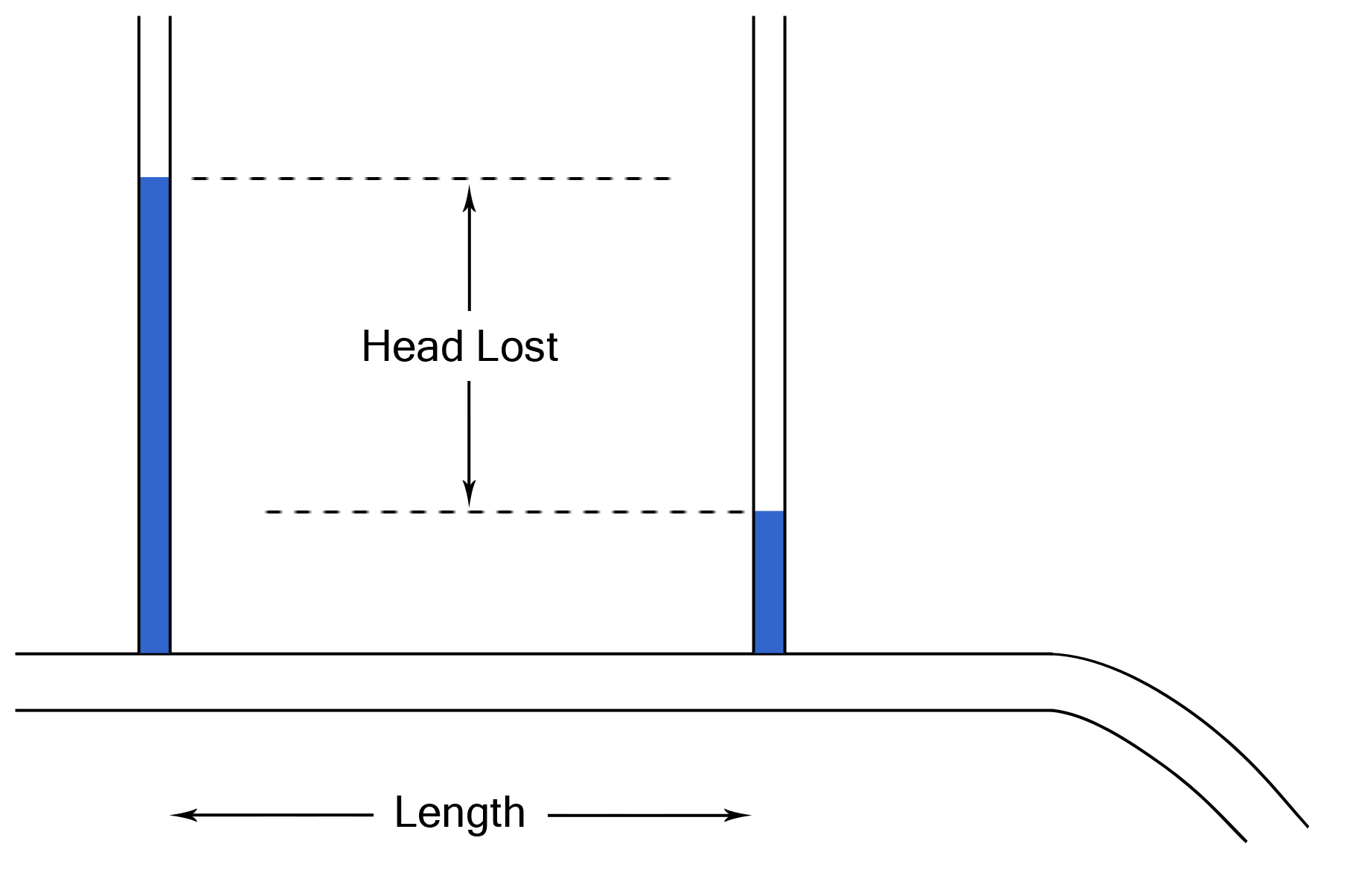
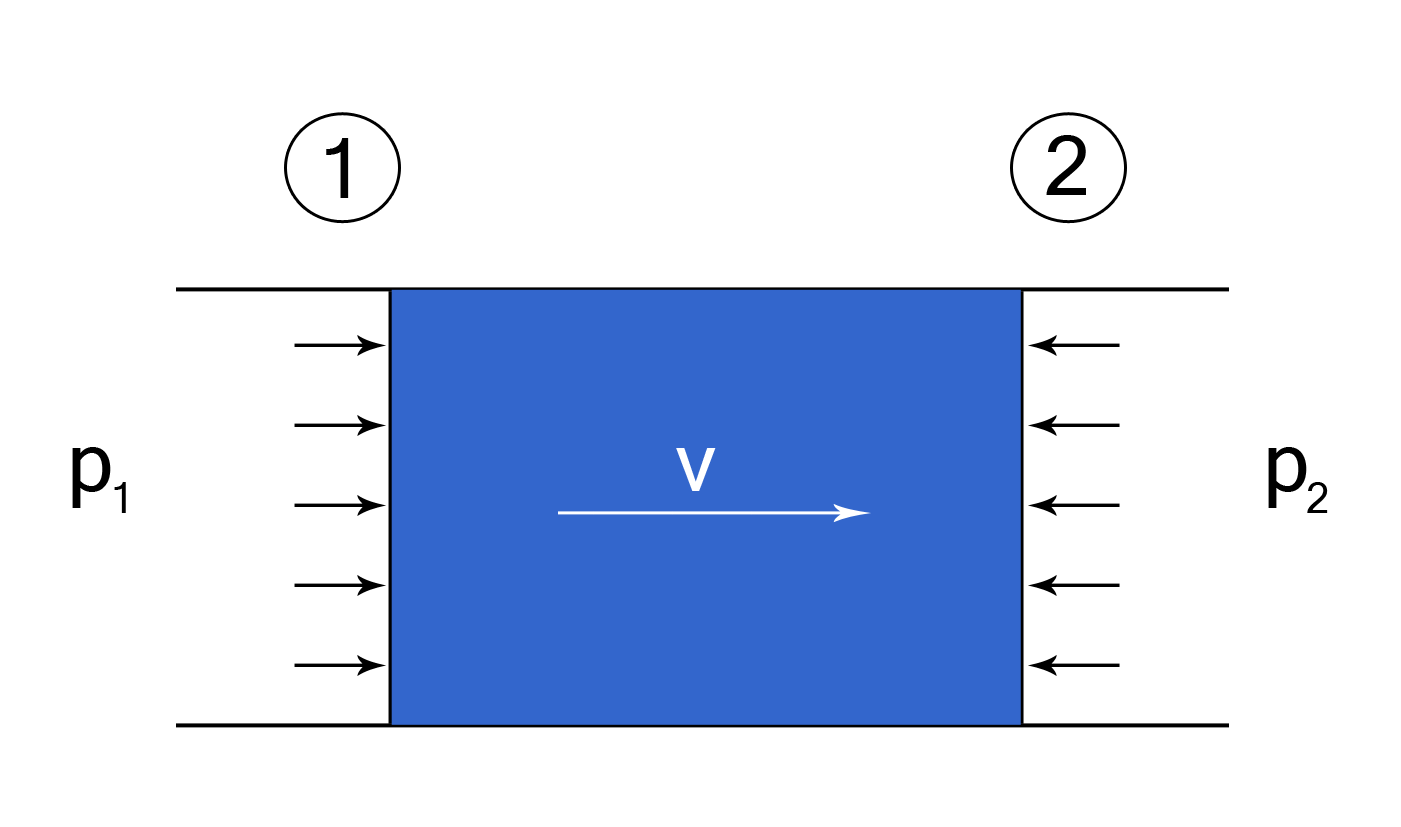
Frictional resistance is proportional $\frac{1}{2}\:\rho\:v^2$ and the wetted area around the circumference of the pipe. Therefore, $H_l=f\:P\:L\:\frac{1}{2}\rho v^2$ where
- P is the perimeter of the pipe,
- L is the length of the pipe section
- and f is the coefficient of friction
Rearranging $v^2 = \frac{2}{f\rho}\:\frac{A}{P}\:\left( \frac{h_1\:-\:h_2}{l} \right)$
$\therefore\;\;\;v = C\:\sqrt[]{\mu\:i}$ where: $C = \sqrt[]{\frac{2\:w}{f\:\rho}} = \sqrt[]{\frac{2g}{f}}$
$$m$ =\frac{A}{P}$ where m is the hydraulic mean depth
$$h$=\frac{m}{l}$ where h is the slope of the hydraulic gradient.
Note: C is not a constant since f is a function of Reynolds number