
Masonry Walls
Water pressure on masonry walls
Consider a vertical masonry wall having water on one of its sides as shown in figure. Now consider a unit length of the wall. We know that the water pressure will act perpendicular to the wall. A little consideration will show, that the intensity of pressure, at the water level, will be zero, and will increase by a straight line law to $wH$ at the bottom as shown in figure. Thus the pressure diagram will be a triangle.
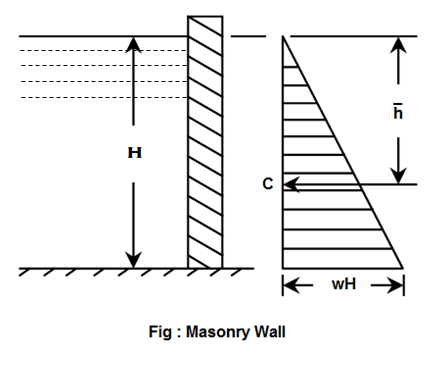
The total pressure on the wall will be the area of the triangle, i.e., $P = \frac{wH}{2}\times H = \frac{wH^2}{2}$
This pressure will act through the center of gravity of the pressure diagram.
Let, $\bar{h}$ = Depth of the center of pressure from the water surface.
We know that the c.g. of triangle is at a height of $\frac{H}{3}$ from the base, where $H$ is the height of the triangle. Therefore depth of center of pressure from the water surface, $\bar{h} = H - \frac{H}{3} = \frac{2H}{3}$
Thus the pressure of water on a vertical wall will act through a point at a distance $\frac{H}{3}$ from the bottom, where $H$ is the depth of water.
Example 2 [metric]
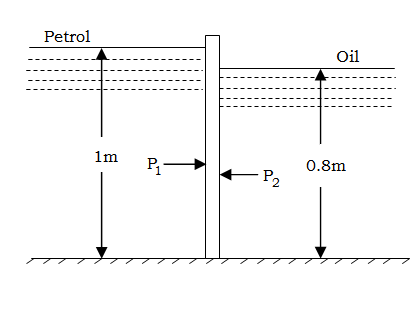
A rectangular container 2.5m wide has a vertical partition in the middle. It is filled with petrol of specific gravity 0.8 to a height of 1m on one side and oil of specific gravity 0.9 to a height of 0.8m on the other. Find the resultant thrust per meter length of the partition wall and its point of application.
Given,
- Width of partition wall = 2.5m
- Specific gravity of petrol = 0.7
- Depth of petrol, H\_1 = 1m
- Specific gravity of oil = 0.9
- Depth of oil, H\_2 = 0.8m
Resultant thrust on the partition wall
We know that pressure of petrol per meter length of the partition wall,
$P_1 = \frac{w_1H_1^2}{2} = \frac{0.7\times 9.81\times (1)^2}{2}\;KN = 3.434\;KN$
and pressure of oil per meter length of the partition wall,
$P_2 = \frac{w_2H_2^2}{2} = \frac{0.9\times 9.81\times (0.8)^2}{2}\;KN = 2.825\;KN$
$\therefore$ Resultant thrust per meter length of the partition wall, $P = P_1 - P_2 = 3.434 - 2.825 = 0.609\;KN$
Point of application of the thrust
Let, $\bar{h}$ = Height of the center of the resultant pressure from the base.
We know that the pressure P\_1 and P\_2 will act at a height of $H/3$ from the base, where $H$ is the respective height of petrol and oil from the base. Taking moments of the pressures about the base and equating the same,
$P\times \bar{h} = P_1\times \frac{1}{3}-P_2\times \frac{0.8}{3}$
$\Rightarrow 0.609\times \bar{h} = 3.434\times \frac{1}{3} - 2.825\times \frac{0.8}{3} = 1.145 - 0.753 = 0.392$
$\Rightarrow \bar{h} = \frac{0.392}{0.609} = 0.644\;m$
Resultant thrust on the partition wall = 0.609 KN
Point of application of the thrust = 0.644 m