
Cantilever Beams
A beam is a horizontal structural element that is capable of withstanding load primarily by resisting bending. The bending force induced into the material of the beam as a result of the external loads, own weight, span and external reactions to these loads is called a bending moment.
Deflection is a term that is used to describe the degree to which a structural element is displaced under a load.
Formulae for the shear and deflection of Cantilever Beams under a selection of differing loadings.
This section covers Beams used as Cantilever. The examples include Beams which are "Built-in" at one end and either supported or guided at the other.
Fixed at one end with a Uniform Load.
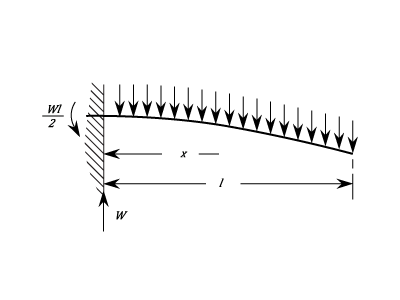
The stress is given by: $S = \displaystyle\frac{W}{2\;Z\;l}\;\;(l - x)^2$
The Stress at the Support: $S_s = \displaystyle\frac{W\;l}{2\;Z}$
If the cross section is Constant then this is the maximum stress.
The Deflection is given by: $y = \displaystyle\frac{W\;x^2}{24\;E\;I\;l}\;\;[2l^2 + (2l - x)^2]$
The Maximum deflection is at the end and is: $\hat{y} = \displaystyle\frac{W\;l^3}{8\;E\;I}$
Fixed at one End. Load at the other
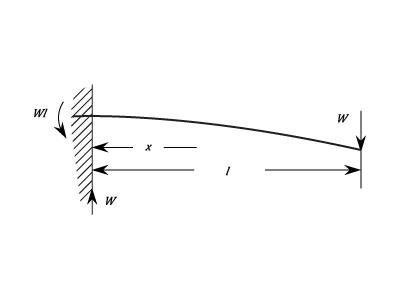
The Stress is given by: $S = \displaystyle\frac{W}{Z}\;\;(l - x)$
The Stress at the Support: $S = \displaystyle\frac{W\;l}{Z}$
If the Cross-Section is Constant, then this is the Maximum Stress.
The Deflection at any point is given by: $y = \displaystyle\frac{W\;x^2}{6\;E\;I}\;\;(3\,l - x)$
The Maximum Deflection is at the end and is: $\hat{y} = \displaystyle\frac{W\;l^3}{3\;E\;I}$
Fixed at one End. Intermediate Point Load
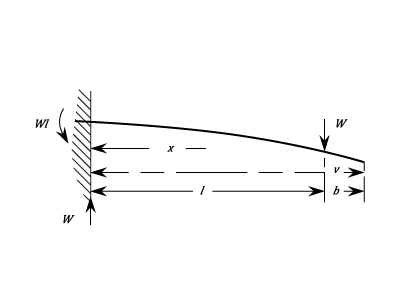
Between the Fixed End and the Load: $\displaystyle S = \frac{W}{Z}\;\;(l - x)$
Beyond the Load the stress is zero.
At the Fixed End: $\displaystyle S = \frac{W\;l}{Z}$
If the Cross-section is Constant, then this is the Maximum Stress.
The Deflection of any point between the Fixed end and the Load is: $\displaystyle y = \frac{W\;x^2}{6\;E\;I}\;\;(3\;l - x)$
Beyond the load the Deflection is: $\displaystyle y = \frac{W\;l^2}{6\;E\;I}\;\;(3\;x- l)$
The Maximum Deflection at the "Free" end is: $\displaystyle y_{max} = \frac{W\;l^2}{6\;E\;I}\;\;(2\;l + 3\;b)$
Deflection at the Load: $\displaystyle y = \frac{W\;l^3}{3\;E\;I}$
Fixed at one End. Supported at the other. Uniform Load.
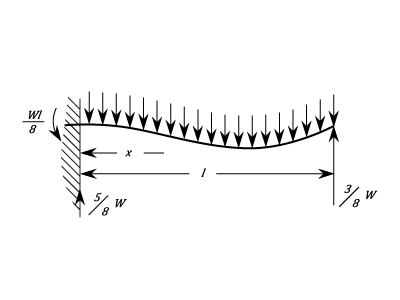
The Stress at any point is : $S = \displaystyle\frac{W\;(l - x)}{2\;Z\;l}\;\;\left(\displaystyle\frac{1}{4}\;l - x \right)$
The Maximum Stress at the Fixed End: $S = \displaystyle\frac{Wl}{8Z}$
The Stress is zero at $\displaystyle x = \frac{1}{4}\;l$. The greatest negative Stress is at $\displaystyle x = \frac{5}{8}\;l$ and is: $S= - \frac{9}{128}\;\;\frac{Wl}{Z}$
The deflection is given by: $y = \displaystyle\frac{W\;x^2(l - x)}{48EI\;l}\;\;(3\;l - 2\;x)$
The maximum Deflection is at x = 0.5785 l and is: $\hat{y} = \displaystyle\frac{Wl^3}{185\;EI}$
The Deflection at the centre is: $y_c = \displaystyle\frac{Wl^3}{192\;EI}$
The Deflection at the point of greatest negative Stress, i.e. at $x = \displaystyle\frac{5}{8}l$, is: $y = \frac{Wl^3}{187\;EI}$
Fixed at one end, Supported at the other with a central point Load.
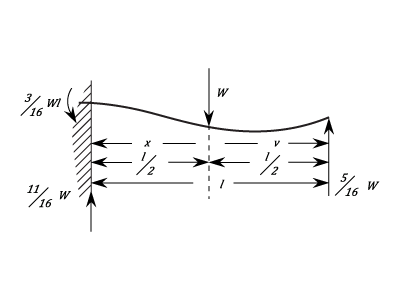
The Stress between the Fixed Point and the Load: $S = \displaystyle\frac{W}{16\;Z}\left(3\;l - 11\;x \right)$
Between the Support and the Load: $S\;= - \displaystyle\frac{5}{16}\;\displaystyle\frac{W\;v}{Z}$
Stress at the Fixed end. This is the maximum value $S = \displaystyle\frac{3}{16}\;\displaystyle\frac{W\;l}{Z}$
The Stress is Zero at $\displaystyle x = \frac{3}{11}\;l$
The Greatest negative Stress is at the centre and is $\displaystyle - \frac{5}{32}\;\;\frac{W\;l}{Z}$
The Deflection of any Point between the Fixed End and the Load:
$y = \frac{W\;x^2}{96\;E\;I}\;\;(9\;l - 11\;x)$
The Deflection of any Point between the Support and the Load $y = \frac{W\;v}{96\;E\;I}\;\;(3\;l^2 - 5\;v^2)$
The Maximum Deflection is at $\displaystyle v = 0.4472\;l$ $\hat{y} = \frac{W\;l^3}{107.33\;E\;I}$
The Deflection of the Load is: $\displaystyle\frac{7}{768}\;\;\displaystyle\frac{W\;l^3}{E\;I}$
Fixed at One End and Free but guided at the other. Uniform Load.
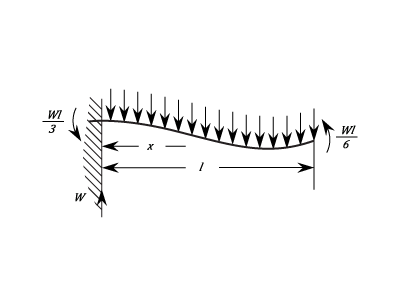
The Stress at any Point $S = \displaystyle\frac{W\;l}{Z}\;\;\left\{\displaystyle\frac{1}{3} - \displaystyle\frac{x}{l}\;+\displaystyle\frac{1}{2}\;\left(\displaystyle\frac{x}{l} \right)^2 \right\}$
The Maximum Stress is at the support and is $\displaystyle \frac{W\;l}{3\;Z}$
The Stress is zero when $\displaystyle x = 0.4227\;l$
The Greatest negative stress is at the free end and is $\displaystyle - \frac{W\;l}{6\;Z}$
The Deflection at any Point is given by: $y = \displaystyle\frac{W\;x^2}{24\;E\;I\;l}\;\;(2l - x)^2$
The Maximum Deflection is at the free end and is: $\hat{y} = \displaystyle\frac{W\;l^3}{24\;E\;I}$
Fixed at one End. Free but Guided at the other. Point Load.
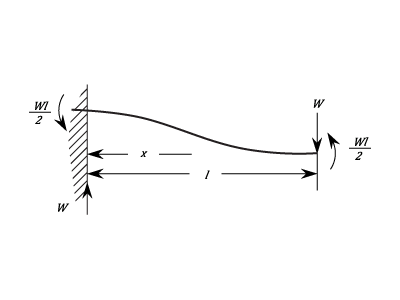
Stress at any Point: $S = \displaystyle\frac{W}{Z}\;\;\;\left(\displaystyle\frac{1}{2}l - x \right)$
The Stress at the Support $S_s = \displaystyle\frac{W\;l}{2\;Z}$
The Stress at the Free End: $S_f\;= - \displaystyle\frac{W\;l}{2\;Z}$
These are the Maximum Stresses and are equal and opposite. The Stress is zero at the Centre.
The Deflection at any Point is: $y = \displaystyle\frac{W\;x^2}{12\;E\;I}\;\;(3l - 2x)$
The Maximum Deflection is at the Free End and is: $\hat{y} = \displaystyle\frac{W\;l^3}{12\;E\;I}$