A force is any influence that causes a free body to undergo a change in speed, a change in direction, or a change in shape.
Centre of gravity is the point in or near a body at which the gravitational potential energy of the body is equal to that of a single particle of the same mass located at that point and through which the resultant of the gravitational forces on the component particles of the body acts.
Acceleration is the rate of change of velocity as a function of time. It is vector and it is the second derivative of position with respect to time or, alternately, the first derivative of the velocity with respect to time.
Power is the rate of work. In the f.slug.sec. system 1 horse-power (h.p.) is 550 ft.lb./sec. 0r 33,000 ft.lb./min.
The kinetic energy of an object is the energy which it possesses due to its motion. It is defined as the work needed to accelerate a body of a given mass from rest to its stated velocity.
A series of Dynamical Problems that come within the study of machines.
In the study of Machines there are a number of problems that do not fit neatly into a specific topic, but which at the same time are essential to the understanding of machines. In addition, some notations have multiple applications and are useful in deriving solutions to common spectrum of problems associated with machines. Such problems have been grouped together in this section.
Force, Mass and Momentum
The force $F$ required to give an acceleration $a$ to the centre of gravity of a mass $M$ is obtained from Newton 's Second Law:
$$F=Ma$$
(1)
If $W$ is the weight of the body (i.e. the force exerted by gravity upon it) then:
$W=Mg\;\;\;$ or $\;\;\;M=\displaystyle\frac{W}{g}$
From this it follows that:
Imperial Units
If the unit of force is to be $lb. wt$, and the acceleration is measured in $ft./sec^2$, then the unit of mass is $lb.wt./32.2$; sometimes called a slug.
i.e. A force of $1\;lb.wt.$ acting on a mass of $1\;slug$ will produce an acceleration of $1\;ft/sec.^2$
If other units are used ($tons$ or $in./sec.^2$) then it is better to use the form $F=\displaystyle\frac{W}{g}\;a$ and substitute values in consistent units throughout.
MKS units
The unit of Force is Newton and the unit of mass Kilogram or Kilo
Thus a force of 1 Newton acting on a mass of 1 Kilo will produce an acceleration of $1\;metre/sec.^2$
Conversion of units
A complete list of the corresponding units in the Imperial and MKS systems is given in "Engineering General". Here it is simply mentioned that:
A force of 1 lb = 4.45 Newtons.
The product Mv is called the Momentum of the body and the general form of Newton's second Law (which has to be used when the mass is varying) is:
The rate of change of Momentum=
$$F=\left ( \frac{d}{dt} \right )M\,v$$
(2)
Note that $F$, $v$, and $a$ are all vector quantities and must all be measured in the same direction.
Moment of Inertia, Angular motion
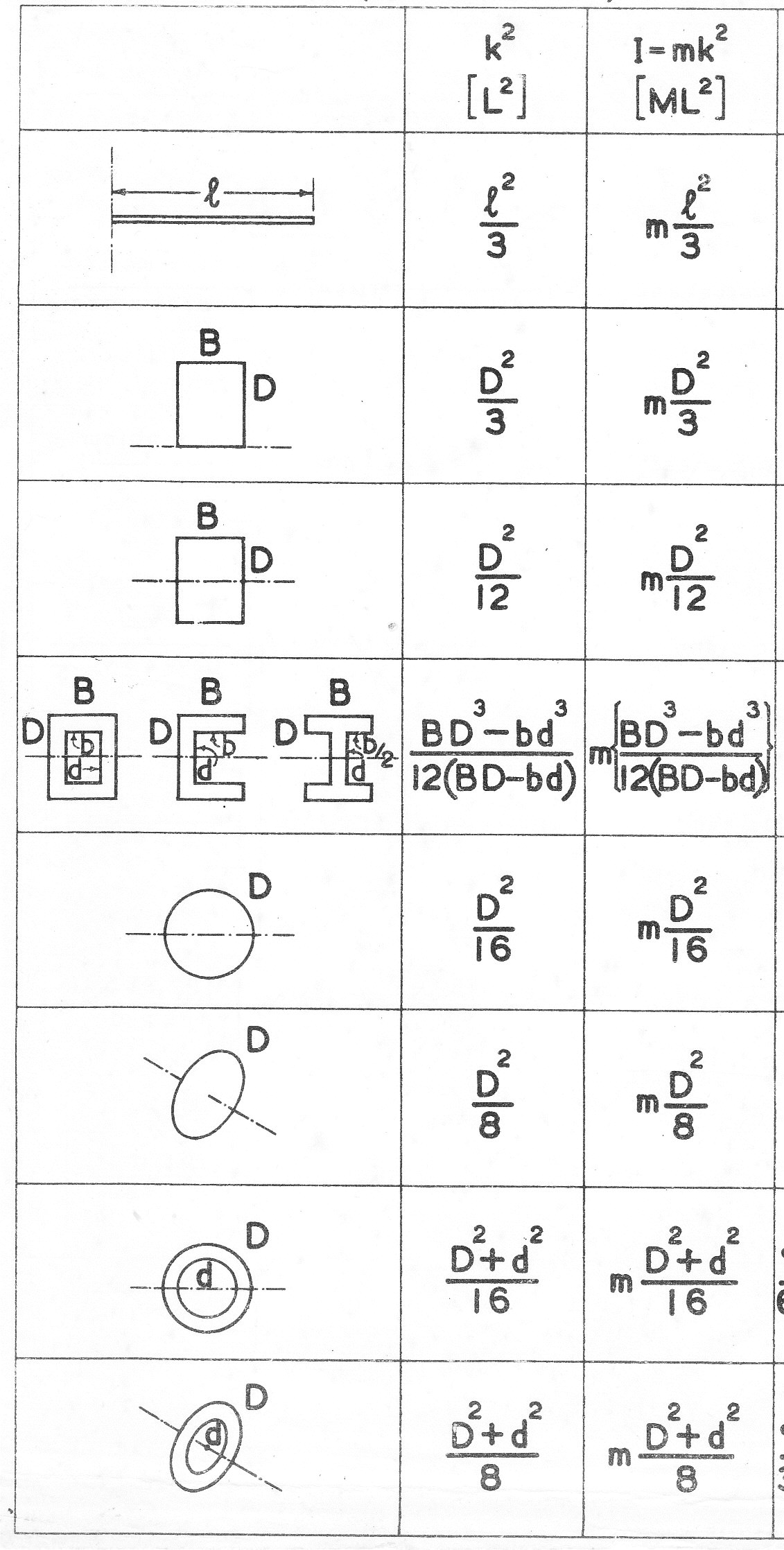
The Moment of Inertia $I$ of a body about a given axis is the sum of the products of mass and distance squared for all the particles of the body, i.e.
$I=\int r^2\;dm=Mk^2$
$k$ is called the Radius of Gyration and $M=\displaystyle\frac{W}{g}$
The units of $I$ are slugs. $ft^2$: i.e. $lb.ft.^2/g$ or $lb.ft.sec^2$ or $Wk^2/g$ in any consistent units.
The following Table gives $k^2$ and $I$ for a number of common shapes.
It must be stressed that all the shapes shown above are of uniform thickness and composition, and that the Moments of Inertia are about the axis shown.
Where it is necessary to know the Moment of Inertia about an axis of distance $h$ from the Centre of Gravity,
$k^2=k{_{g}}^{2}+h^2$ This is known as the Parallel Axis Theorem. $k_g$ is the radius of gyration about a parallel axis through the centre of gravity.
The product $I_g\omega$ is called the Angular Momentum about an axis through the centre of gravity. It is also known as the spin couple.
The total Moment of Momentum about any other axis is given by: $I_g\omega+Mv_gh$ where $h$ is the perpendicular distance from the axis onto the line of action of $v_g$.
About an axis of rotation $O$, $v_g=h\omega$ and the Moment of Momentum reduces to
$$\left ( I_g+Mh^2 \right )\omega=I_o\omega$$
(3)
The equation of Angular Motion is: Moment of Forces = Rate of Change of Angular Momentum
(For a constant $I$) This can be applied about any fixed axis of rotation, or about an axis through the centre of gravity.
Motion under Variable Acceleration.
There are many problems in which the resultant force(or torque) acting on a body is not constant and consequently the acceleration produced will vary. General methods of solution are given below and are applicable to linear and angular motion by interchanging $\theta$ for $s$ and $\omega$ for $v$.
It is assumed that expressions for acceleration have been obtained by substituting into equations (1) or (4).
Note. A further integration of equation (5) can be carried out by writing $v=\displaystyle\frac{ds}{dt}$. This allows the time interval to be determined. ( See Example 6)
Acceleration as a function of time
Writing $a=\displaystyle\frac{dv}{dt}$ and re-arranging
$$v=\int a\;dt+B$$
(6)
Which corresponds to the momentum equation:
$M(v_2-v_1)=\int F.dt$
i.e. The change of Momentum = Impulse.
A further integration of equation (6) will give the distance traversed.
Acceleration as a function of velocity.
Writing $a=\displaystyle\frac{dv}{dt}$ and re-arranging, $t=\displaystyle\int \displaystyle\frac{dv}{a}+C_1$ (See Example 4)
or $a=v\;\displaystyle\frac{dv}{ds}$
Which gives $s=\displaystyle\int v\;\displaystyle\frac{dv}{a}+C_2$ (See Example 5)
If $F$ is the force (or resolved part) in the direction $OX$ and it moves its point of application a distance $x$, then, Work done= $F\;x$
Similarly, the work done by a Couple $\tau$ turning through an angle $\theta =\tau\; \theta$
Kinetic Energy
The energy possessed by a body is a measure of its capacity to do work. If a body has an angular velocity $\omega$ and its centre of gravity has a linear velocity $v$, then its total Kinetic Energy (K.E.) is given by:
If the body is rotating about a fixed axis $O$ and since $v=h\omega$ and $k{_{0}}^{2}=k{_{g}}^{2}+h^2$
the above equation is: $K.E.=\displaystyle\frac{1}{2}I_o\omega^2$
Impact, Impulse.
When two bodies collide, each exerts an equal force on the other and for the same period of time. By the integration of equation (2)
$\int F.dt=M(v_2-v_1)$
i.e., for one body the impulse force is equal to the change of momentum. It follows that in a closed system of bodies the total Momentum remains constant (i.e.The Conservation of Momentum).
Similarly the moment of the impulse force about a fixed axis ( or axis through the centre of gravity) is equal to the change of angular momentum about that axis.
Example 1 [imperial]
Problem
The speed of a car on the level is 40 m.p.h., the engine indicating 25 h.p. and the weight of the car being 2,500 lb. The car will just run down a gradient of 1 in 25 when the clutch is in but ignition cut off.
Assuming the engine and transmission friction and the road resistance to be independent of speed and the wind resistance to be proportional to the square of the speed, determine the horse-\b{power} required to drive the car up a gradient of 1 in 25 at a speed of 25 m.p.h.
Workings
Let the friction and road resistance be $F$ lb.and the wind resistance be $Cv^2 lb.$ ( $v$ is in $ft./sec.$)
Then, Total resistance $X$ velocity = 550 X h.p
On the level, $\left [ F+C\left ( 40\times \displaystyle\frac{88}{60} \right )^2 \right]40\times\displaystyle\frac{88}{60}= 550
\times 25$
$$\therefore \;\;\;\;\;F+3430C=234$$
(7)
Down the gradient, $F-\displaystyle\frac{2500}{25}=0$ (Zero velocity)
$$\therefore \;\;\;\;\;F=100\;lb.$$
(8)
From equations (7) and (8), $C=\displaystyle\frac{134}{3430}=0.392$
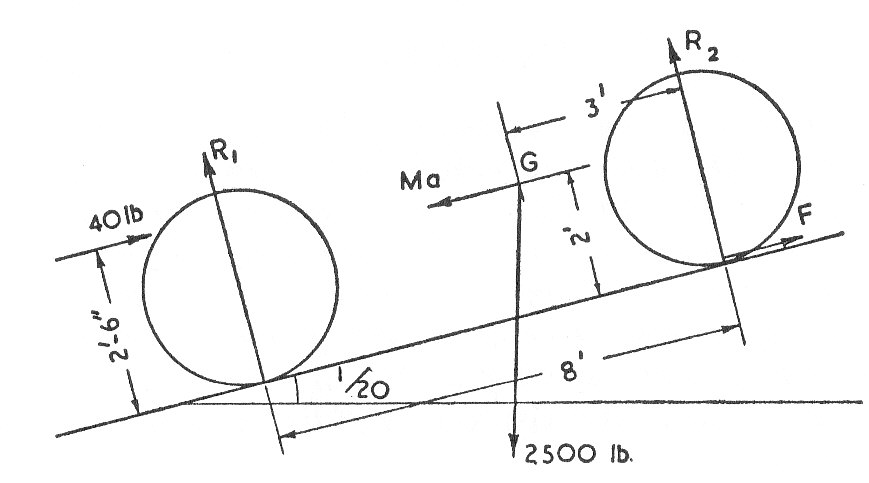
A motor car weighing 2500 lb. has axles 8 ft apart. When standing on a level road, the centre of gravity of the car is 2 ft. above ground level and 3 ft. in front of the rear axle .
Calculate the normal reaction on each wheel when the car is moving down a gradient of 1 in 20 against a wind resistance of 40 lb. acting parallel to the road and 2 ft. 6 in from it, with the engine switched off and the rear wheel brakes applied so as to give a deceleration of $2;ft./sec^2$. What must be the coefficient of friction between the rear wheels and the road if the rear wheels are not to skid under these conditions. Neglect the rotational inertia of the wheels and engine.
Workings
The diagram shows diagrammatically the side elevation of the car. $R_1$ and $R_2$ are the normal reactions at the front and rear wheels respectively and $F$ is the friction at the rear wheels.
By Newton's second Law, the inertia force =$Ma=\displaystyle\frac{2500}{32.2}\times 2=15.5\;lb.$
This acts down the plane in the opposite direction to the acceleration and the problem can now be considered as being one of statical equilibrium.
Note that the weight has been resolved parallel and perpendicular to the plane. Its normal component being approximately 2500 lb.
Resolving normal to the plane
$R_2=2500-R_1=1505\;lb.$
Resolving parallel to the plane
$F=155+\frac{2500}{20}-40=240\;lb.$
The coefficient of friction =$\displaystyle\frac{F}{R_2}=\displaystyle\frac{240}{1505}=0.16$
Solution
$R_1=995\;lb.$ and $R_2=1505\;lb.$
The coefficient of friction is $0.16$
Example 3 [imperial]
Problem
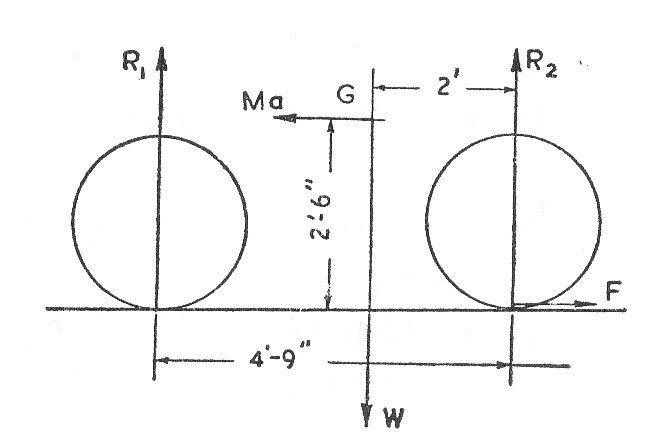
A motor-cycle has wheels 4ft.9in. apart. The centre of gravity of the cycle and rider is 2ft.^in. above ground level and 2 ft. in front of the rear axle. The coefficient of friction between the tyres and the road is 0.75.
If the rear wheel only is braked, find the greatest deceleration that can be obtained if:
a) The cycle is moving in a straight path.
b) It is going round a curve of 150 ft radius at 30 m.p.h. Neglect rotational inertia and obliquity when turning.
Workings
In the following diagram, the motor cycle is traveling from right to left and the inertia force $Ma$ is in the opposite direction to the acceleration. $F$ is the friction force at the rear wheel and acts in a direction to oppose motion.
a) Cycle moving in straight line
Friction = $\mu\;R$ and hence $F=0.75R_2$
Resolving horizontally, $0.75R_2=Ma$ or $R_2=1.33Ma$
Taking Moments about the base of the front wheel: $R_2\times 4.75=W\times 2.75-2.5Ma$ (Note $\;4ft.9in.=4.75ft.$ etc.)
By substituting in the value of $R_2$, $6.32\;Ma=2.75\;Mg-2.5\;Ma$
From which the greatest deceleration $\displaystyle \hat{a}$, $\hat{a}=2.75\times \displaystyle\frac{32.2}{8.82}=10.0\;ft/sec.^2$
b) Travelling around a curve
There is now a centrifugal force acting through the centre of gravity, $G$. This is balanced by a sideways frictional force at the front and rear wheels. This is distributed such that 2/4.75 is attributed to the front wheel and $\displaystyle\frac{2.75}{4.75}$ to the rear.
The Centrifugal Force =$M\displaystyle\frac{v^2}{r}=M\times \displaystyle\frac{44^2}{150}=12.9M$ at $G$
Hence the sideways frictional force at the rear wheel is:
$\left ( \frac{2.75}{4.75} \right )12.9M=7.47M$
But the total frictional force at the rear wheel is $0.75\;R_2$ Hence the component of frictional force in the direction of motion is given by:
$$F=\sqrt{(0.75R_2)^2-(7.47)^2}$$
(9)
Resolving Horizontally
$$F=Ma$$
(10)
Taking Moments about the front wheel. ( This is exactly the same as in case a) above)
$$4.75R_2=2.75W-2.5Ma$$
(11)
Substituting into equation (9) for $F$ and $R$ from (10) and (11) and squaring
The velocity of a train traveling at 60 m.p.h. decreases by 10% in the first 40 seconds after the application of the brakes.
a) Calculate the velocity at the end of a further 80 seconds, assuming that during the whole period of 120 seconds, the retardation is proportional to the velocity.
b) Derive an expression for the retardation force in lb.per ton weight of train.
c) Find the horse-\b{power} being dissipated at the end of the whole period if the train weighs 500 tons.
Workings
a) Retardation =$-\displaystyle\frac{dv}{dt}=kv$
Where $k$ is a constant to be determined from the given conditions.
Rearranging and integrating: $\displaystyle\int \frac{dv}{v}=-\displaystyle\int k\,dt+A$ or $ln v=-kt+A$
A car weighing 3000 lb. has when running on the level, a resistance to motion of $a+bV^2\;lb.$ where $a$ is 60 lb., $b$ is a constant and $V$ is the speed in miles per hour: it is also found that the car maintains a speed of 80 m.p.h. with an effective horse-power of 50 when running on the level.
Find:
1) The value of the constant $b$.
2) How far the car will run up a slope of 1 in 10 before the speed drops to 40 m.p.h. assuming that it starts at 80 m.p.h. and that a constant torque is maintained on the road wheels throughout.
Workings
1) The value of $b$
At a uniform speed on the level, Horse-power= Resistance $X$ Speed / 550 i.e. $50=(60+b\times 80^2)80\times \displaystyle\frac{88}{60\times 550}$
A frictionless flexible chain, of total length 24 in. hangs over the edge of a table by an amount 6 in. and is held there in that position.
Determine the time taken for the chain to just slide off the table, if released.
Workings
If $W$ is the total weight of the chain, let $x$ in. be the length overhanging the table at any instant. The force accelerating the chain is $\displaystyle\frac{Wx}{24}$ and applying Newton'\b{s second Law}: $\displaystyle\frac{Wx}{24}=\displaystyle\frac{W}{g}\times a$
A thin bar of length $2a$ turns freely about a horizontal hinge at the upper end. It is released from rest when making an angle $\alpha$ with the downwards vertical.
By equating the loss of potential energy to the kinetic energy, show that the angular velocity $\omega$ when making an angle $\theta$ with the downwards vertical is given by: $\omega ^2=\frac{2ga}{k^2+a^2}(\cos\theta-\cos\alpha)$ where $k$ is the radius of gyration about a parallel axis through its centre of gravity. Hence find an expression for the angular acceleration when in this position.
If $a$ = 15 in., $W$ = 12 lb., and $\alpha=60^0$ find the force exerted by the pivot on the bar at the instant it passes through the lowest position.
Workings
For rotation about a fixed axis, Kinetic Energy =$\displaystyle\frac{1}{2}I\omega^2$
Using the parallel axis theorem, $I=I_G=\left ( \displaystyle\frac{W}{g} \right )a^2=\displaystyle\frac{W}{g}(k^2+a^2)$
Loss of Potential Energy =$Wa(\cos\theta-\cos\alpha)$
The angular acceleration is $\displaystyle\frac{d\omega}{dt}=-\displaystyle\frac{ga}{k^2+a^2}\sin\theta$
The force is $21\;lb.$
Example 8 [imperial]
Problem
A flywheel weighing 100 lb. is mounted on a 3 in. diameter shaft supported in two bearings, one on either side of the wheel. Under the action of the friction of the bearings,the speed of the flywheel falls from 200 r.p.m. to 150 r.p.m. in 14 sec. with uniform deceleration.
A plain cast-iron ring 18 in. outside diameter, 14 in. inside diameter and 3 in. thick is now bolted on to the side of the flywheel, concentrically with it.
The cast-iron weighs 0.26 lb./cu.in. The effect of friction is now to reduce the speed uniformly from 200 r.p.m. to 150 r.p.m. in 20 sec.
Assuming that the coefficient of friction is constant, find its value. Find also the radius of gyration of the flywheel.
Workings
Initially, since the the angular deceleration is uniform, $\alpha_1$ is given by:-
i.e. The radius of gyration of the flywheel is $5.75 in.$
Solution
The coefficient of friction is $\mu=0.0213$
The radius of gyration of the flywheel is $5.75 in.$
Example 9 [imperial]
Problem
A flywheel of weight 180 lb. and radius of gyration 16 in.,is accelerated from rest to a steady speed of 75 rad./sec. by the application of a constant torque, the friction torque being $10\omega%$ lb.ft. at any instant.
Find the applied torque and obtain an expression for the speed at any time $t$ sec. from the start. Calculate the speed after 1 sec.
If the wheel had been acted upon by a torque of magnitude $90(75-\omega)\;lb.ft.$ find the final steady speed and obtain an expression for the speed at time $t$ sec. Calculate this speed after 0.1 sec.
Workings
When the steady speed of 75 rds. has been reached, the applied torque must equal the friction torque. i.e. The applied torque $=10\times 75 =750\;lb.ft.$
As above this can be rearranged and integrated to give an expression for $t$.
$t=\displaystyle\frac{1}{10}\int_{0}^{\omega}\displaystyle\frac{d\omega}{67.5-\omega}$ Or $10t=\ln\displaystyle\frac{67.5}{67.5-\omega}$
This can be rearranged and solved for $\omega$
$\omega=67.5(1-e^{-10t})$
When $t=0.1sec.$, $\omega=67.5(1-0.368)=42.7\;rad./sec.$
Solution
The torque is $750\;lb.ft.$
The speed at any time is $\omega=75(1-e^{-t})$, The speed after 1 sec. is $47.4\;rad./sec.$
The final steady speed is $67.5\;rad./sec.$, The speed after 0.1 sec. is $42.7\;rad./sec.$
Example 10 [imperial]
Problem
A riveting machine is driven by a 5 h.p.motor. The moment of inertia of the rotating parts of the machine is equivalent to $1500 \;lb.ft.^2$ at the shaft on which the flywheel is mounted. At the commencement of an operation the flywheel is making 240 r.p.m.
If closing a rivet occupies 1 sec. and corresponds to an expenditure of 8000 ft.lb. of energy, find the reduction of speed of the flywheel. What is the maximum rate at which rivets can be closed ?
Workings
Let $n$ r.p.m. be the speed of the flywheel immediately after closing a rivet. Then:
The loss of kinetic energy of the flywheel = The energy used to close the rivet - The energy supplied by the motor.
i.e. $\displaystyle\frac{1}{2}(\omega{_{1}}^{2}-\omega{_{2}}^{2})=8000-5\times 550$
In an experiment to determine the modulus of rigidity by a mass vibrating at the bottom of a vertical helical spring, it is usual to add one-third of the mass of the spring to the vibrating mass in calculating the results.
Justify this rule.
State and justify the corresponding rule for the method of finding:
a)The modulus of elasticity by the torsional oscillations of a disc at the end of a similar spring.
b) The modulus of rigidity by the torsional oscillation of a disc at the end of a circular rod.
Workings
Let $W$ be the weight of the spring and $L$ its axial length.
Consider the kinetic energy of an element the spring at an axial length $l$ from the fixed end and of axial length $\delta l$
If $v$ is the velocity of the vibrating mass at any instant, then the velocity of the element is $\displaystyle\frac{vl}{L}$
The kinetic energy of the element is given by: K.E.=$\displaystyle\frac{1}{2}\left ( \displaystyle\frac{W\delta l}{gL} \right )\left ( \displaystyle\frac{vl}{L} \right )^2$
The total K.E. of the spring =$v^2\int_{0}^{L}\left ( \displaystyle\frac{Wl^2}{2gL^3} \right )dl=\displaystyle\frac{1}{2}\left ( \displaystyle\frac{1}{3}\displaystyle\frac{W}{g} \right )v^2$
This is the same as that of a weight of $\displaystyle\frac{1}{W}$ moving with the vibrating mass.
a) Let $\omega$ be the angular velocity of the disc at any instant, then the angular velocity of the element will be $\omega l/L$ and if the coil radius is $R$ , its linear velocity will be $R\omega l/L$
K.E. of element =$\displaystyle\frac{1}{2}\left ( \displaystyle\frac{W\delta l}{gL} \right )\left ( \displaystyle\frac{R\omega l}{L} \right )^2$
The total K.E. of the spring =$\omega^2\displaystyle\int_{0}^{L}\left ( \displaystyle\frac{WR^2l^2}{2gL^3} \right )dl=\displaystyle\frac{1}{2}\left (\displaystyle \frac{1}{3}\times \displaystyle\frac{WR^2}{g} \right )\omega^2$
i.e. Add on to the inertia of the disc one-thirde of the moment of inertia of the spring about its axis.
b)This is similar to the above with the exception that the radius of gyration of a circular rod about its axis is $\displaystyle\frac{d}{\sqrt{8}}$ and hence:
The K.E. of the rod =$\displaystyle\frac{1}{2}\left ( \displaystyle\frac{1}{3}\times \displaystyle\frac{Wd^2}{8g} \right )\omega^2$
i.e. Add on to the inertia of the disc one-third of the moment of inertia of the rod about its axis.
Example 12 [imperial]
Problem
A valve is opened mechanically, released by a trip gear and closed by a close-coiled helical spring. The maximum valve opening is 0.75 in., the weight of the valve and attached parts is 8 lb., the weight of the spring is 1.25 lb. The stiffness of the spring is 60 lb./in. of compression and the spring is compressed by 1.825 in. when the valve is fully open.
Determine the time taken to close the valve and the velocity at the moment of impact. Neglect friction and assume that there is no dash-pot.
Workings
From the answers to Example (11) it can be seen that the weight moved : $=8+\frac{1}{3}(1.25)=8.417\;lb.$
Let $x$ be the distance moved from the fully open position.
Using Newton'\b{s second law} and neglecting gravity, the equation of motion can be written. $\left ( \frac{8.417}{32.2\times 12} \right )\ddot{x}=(1.825-x)\times 60$
i.e. $\ddot{x}+2750x=5020$
The complete solution to this differential equation is : $x=A\sin\sqrt{2750.t}+B\cos\sqrt{2750.t}+\frac{5020}{2750}$ $=A\sin52.5\;t+B\cos52.5\;t+1.825$
When $t=0$, $x=0$ and $B=-1.825$
When $t=0$ $\dot{x}=0$ and $A=0$
Substituting in the above values for $A$ and $B$:
$$x=1.825(1-\cos52.5\,.\,t)$$
(15)
When $x=0.75$, $\cos52.5t=1-0.411=0.589$
From which, $t=\displaystyle\frac{0.943}{52.5}=0.018\;sec.$
The time taken to close the valve is $0.018\;sec.$
The velocity at the moment of impact is $77.5\;in./sec.$
Example 13 [imperial]
Problem
A Steam Locomotive of mass $M_1$, including its tender, starts to pick up water from a water trough when drawing a train of mass $M_2$ at a steady speed $u$. During the period of watering it may be assumed that:
The mass of water $m$ picked up per unit distance is constant.
The tractive effort of the engine and the resistance of the engine and train are unaffected.
Obtain an expression for the speed of the train after it has picked up water for a distance $S$ and show that the initial instantaneous diminution of draw-bar pull is :
$\frac{M_2\;m\,u^2}{M_1+M_2}$
Find also an expression for the time taken by the train to travel a given distance.
Note. Steam Locomotives are not that common these days. There was no method of condensing and re-using the water and as a result they needed to take on fresh water at regular intervals. This produced problems for long distance locomotives and the solution was to have narrow, shallow, and long water troughs placed between the rails. The engine lowered a scoop into the trough and the speed of the locomotive swept water into its water tanks.
Workings
In traveling a distance $\delta s$ the mass of water picked up is $m\deltas$, and the momentum given to it is $(m\delta s )(\delta s/\delta t)$. Hence the rate of change of momentum is given by:
Let $\delta s}/{\delta t} =V$ and let the initial value of $V$ be $u$.
Then the rate of change of momentum= $mV^2$
This produces a retarding force on the total mass $(M_1+M_2+ms)$ and using Newton'\b{s second law}: $-(M_1+M_2+ms)\left ( V\displaystyle\frac{dV}{ds} \right )=mV^2$
This worked example is only visible to registered users. Sign in to see it.
Example 15 [imperial]
Problem
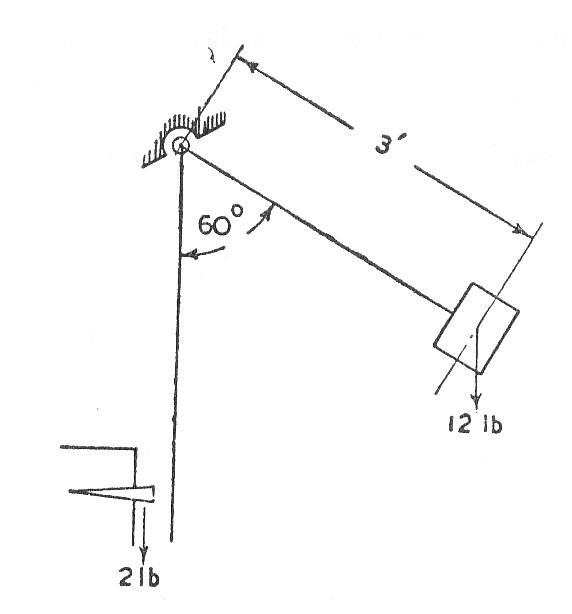
The diagram shows a hammer weighing 12 lb. and pivoted at $A$. It falls against a wedge weighing 2 lb. which is driven forward 0.25 in. by the impact into a heavy rigid block.
The resistance to the wedge varies from uniformly with the distance through which it moves varying from zero to $R$ lb.
Neglecting the small amount by which the hammer rises after passing through $A$ and assuming that the hammer does not rebound find:
a) The value of $R$
b) The time interval during which the wedge is moving forward.
Workings
Let $V$ ft./sec. be the velocity of the hammer just before impact with the wedge. Then:
The kinetic energy of the hammer = The loss of potential energy by the hammer
i.e.$\displaystyle\frac{WV^2}{2g}=Wh$ Or $V=\sqrt{2\times 32.2\times 3(1-\cos60^0)}=9.82\;ft./sec.$
Now let $v$ ft./sec. be the common velocity of the wedge and hammer just after impact ( The hammer does not rebound).
Equating the momentum before and after impact ( The conservation of Momentum) $(12+2)v=12V$
a) To find the value of $R$
The work done by driving the wedge into the block against the resistance must equal the loss of kinetic energy .
i.e. $\displaystyle\frac{1}{2}R\times \displaystyle\frac{1}{4\times 12}=\displaystyle\frac{1}{2\times }\displaystyle\frac{12+2}{ 32.2}\times 8.42^2$