
Carnot Cycle
The ideal thermodynamic cycle
The Carnot Cycle is an entirely theoretical thermodynamic cycle utilising reversible processes.
Thermal Efficiency
The thermal efficiency of a cycle, also denoted by $\eta_{th}$, is a measure of the ability to convert heat energy into work. Therefore, the thermal efficiency can be defined as:
where W is the work output, and Q\_S the heat energy supplied. Replacing W with the heat supplied minus the head rejected, then equation (1) becomes:
from which:
The cycle with the highest possible thermal efficiency is the Carnot cycle (diagramed on a $PV$ plot in Figure 8).
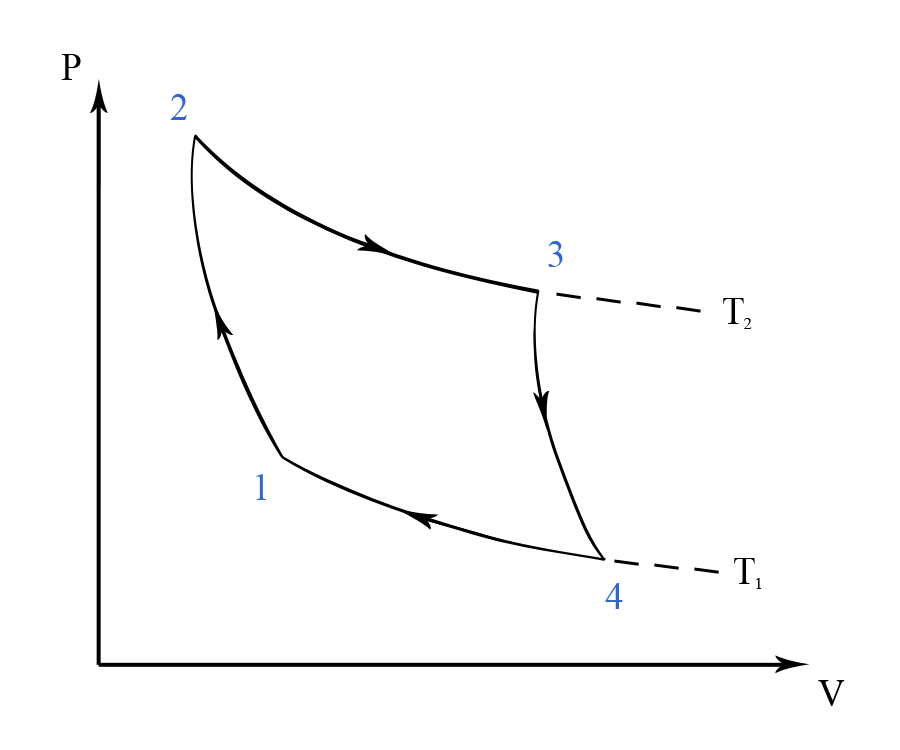
This cycle consists of
- a reversible adiabatic (i.e. isentropic) compression of the gas from temperature T\_1 to T\_2 (step 1-2),
- followed by an isothermal heating with expansion (step 2-3),
- then a reversible adiabatic (isentropic) expansion of the gas from T\_2 to T\_1 (step 3-4),
- and ending with an isothermal cooling with compression which reverts the system back to its initial state (step 4-1).
The Carnot Cycle can be represented on a TS diagram (see Figure 9), which is useful for calculating the Carnot Cycle efficiency.
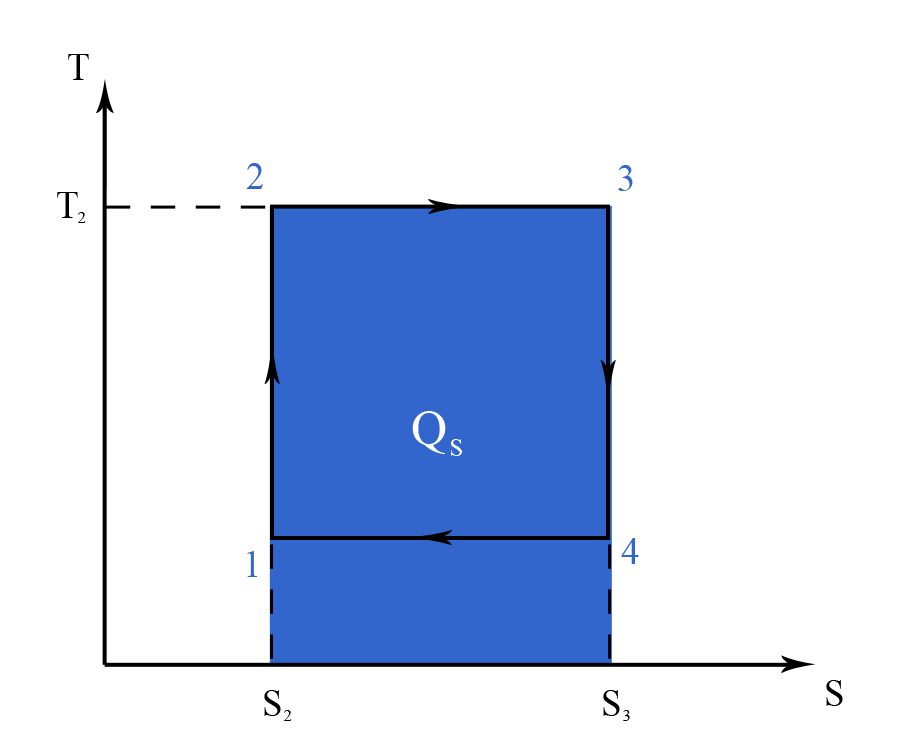
To calculate the thermal efficiency, first calculate the Q\_S and Q\_R terms (see Eq. 3). The heat supplied Q\_S during step 2-3 can be calculated on a TS diagram as the area under the cycle beneath the T\_2 line (the blue shaded area in Figure 9).
The area of this rectangle can also be calculated as:
On the other hand, the heat rejected Q\_R during step 4-1 of the Carnot cycle can be calculated on a TS diagram as the area under the cycle beneath the T\_1 line (the blue shaded area in Figure 9C).
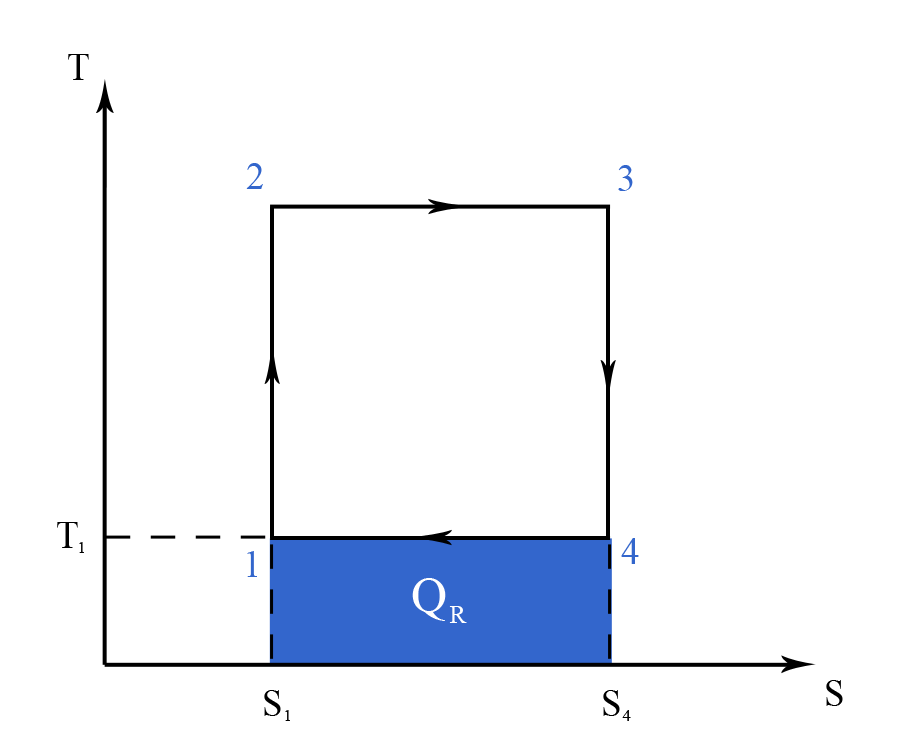
The area of this rectangle is also given by:
Taking into account (4) and (5), the thermal efficiency of the Carnot cycle becomes:
\calc{1-(T_C/T_H)} "Instant calc. Carnot eff. (K)"
However, we can see from Figure 9 that $S_1=S_2$ and $S_3=S_4$. Therefore, we obtain the Carnot cycle efficiency as:
or, written in a different form:
\calc{1-( (T_C+459.67)/(T_H+459.67) )} "Instant calc. Carnot eff. (F)"
It should be noted that in equations (7) and (8) the temperatures (also identified as T\_1=T\_C, the temperature of the cold reservoir, and T\_2=T\_H, the temperature of the hot reservoir) are expressed on an absolute scale, such as the Kelvin scale. On the right side we provide calculators for the Carnot efficiency where you can input the temperatures in degrees Fahrenheit or degrees Celsius as well (the conversions are computed automatically).
\calc{1-( (T_C+273.15)/(T_H+273.15) )} "Instant calc. Carnot eff. (C)"
The thermal efficiency of the cycle (and in general of any reversible cycle) represents the highest possible thermal efficiency (this statement is also known as Carnot's theorem - for a more detailed discussion see also Second Law of Thermodynamics ). This ultimate thermal efficiency can then be used to compare the efficiencies of other cycles operating between the same two temperatures. Thus, taking into account (7), the thermal efficiency of any engine working between the temperatures of T\_1 and T\_2 is:
From equation (9) it can be seen that in order to improve the thermal efficiency of an engine, we should basically increase the value of (T\_2 - T\_1), i.e. increase the temperature difference under which the engine works.