
FUNCTION
hm_cylinder
Computes the temperature inside a thin homogeneous cylindrical wall.
Interface
#include <codecogs/engineering/thermodynamics/conduction/hm_cylinder.h>
using namespace Engineering::Thermodynamics::Conduction;
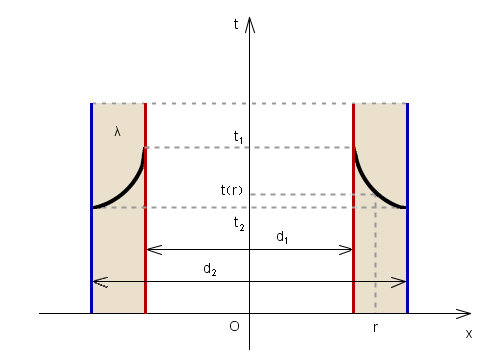
Consider the case of a thin homogeneous cylindrical wall with internal diameter $d_1$, external diameter $d_2$, length $L$, satisfying the inequalities:
and having constant thermal conductivity $\lambda$ at any of its points.
The conductive heat flow may be thought of as radial, thus by the law of conduction we have the following equation using cylindrical coordinates:
where a is the thermal diffusivity and r, z, $\varphi$ are cylindrical coordinates.
For a radial heat flow and considering the x-axis along the length of the wall, the next equalities hold:
Also, assuming steady-state conditions, the temperature does not vary with time, so $\frac{\partial t}{\partial \tau} = 0$. Hence it is true that:
which by integration and considering appropriate limit conditions, gives the formula for the temperature inside the cylindrical wall at a radius of r:
In the diagram below the value of the function $t(r)$ is shown for a particular value of $r$.
Example 1
#include <codecogs/engineering/thermodynamics/conduction/hm_cylinder.h>
#include <stdio.h>

int main()
{
  // input data
  double r = 0.28, d1 = 0.5, d2 = 0.6,
        t1 = 45.7, t2 = 20.8;

  // display the various input data
  printf("Input data:\n\n");
  printf(" r = %.2lf\n", r);
  printf("d1 = %.2lf\nd2 = %.2lf\n", d1, d2);
  printf("t1 = %.2lf\nt2 = %.2lf\n\n", t1, t2);

  // compute the temperature inside the cylindrical wall
  double t = Engineering::Thermodynamics::Conduction::hm_cylinder
  (r, d1, d2, t1, t2);

  // display the result
  printf("The temperature inside the cylindrical wall is:\n\n");
  printf("%.10lf\n\n", t);

  return 0;
}
Output:
Input data:

 r = 0.28
d1 = 0.50
d2 = 0.60
t1 = 45.70
t2 = 20.80

The temperature inside the cylindrical wall is:

30.2224870072
Parameters
Returns
The following inequalities must always hold when passing various values to the function:
References
Dan Stefanescu, Mircea Marinescu - "Termotehnica"
Interactive Calculator
Computing…
Set a range above first to export a graph.