
Integration
Standard mathematical integrals
Definition
In calculus an indefinite integral of a function f is a function F whose derivative is equal to $f$, i.e., $F' = f$. The process of solving for antiderivatives is called antidifferentiation (or indefinite integration) and its opposite function is called differentiation, which is the process of finding a derivative. Antiderivatives are related to definite integrals through the fundamental theorem of calculus: the definite integral of a function over an interval is equal to the difference between the values of an antiderivative evaluated at the endpoints of the interval.
For example
$I(x)=\int\;x\;dx=\frac{x^2}{2}+C$
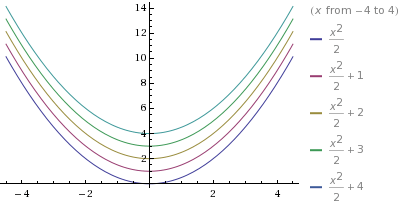
Integration
Polynomial
$\displaystyle \int x^n dx = \frac{x^{n\,+\,1}}{n\:+\:1}+C$ for all values of n except n = - 1
Logarithm
$\displaystyle \int\frac{1}{x}dx = \; Ln\:x + C$
Exponential
$\displaystyle \int e^x\:dx = e^x + C$
Sine
$\displaystyle \int\sin\:x\:dx = \;-\:cos\:x+C$
Cosine
$\displaystyle \int cos\:x\:dx = \;sin\:x +C$
Tangent
$\displaystyle \int tan\:x\:dx = \:-\:Ln\:cos\:x + C$
Example 1
Find $I=\int\;tan\;2x\;dx$
We can see that : $(-Ln\;cos(2x)+C)'=2tan(2x)$
Hence $I=\frac{-1}{2}Ln\;cos(2x)+C$
$\displaystyle \int sec^2\:x\:dx = tan\:x + C$
$\displaystyle \int\frac{1}{a^2\:+\:x^2}\:dx = \frac{1}{a}\:tan^{-1}\frac{x}{a} + C$
$\displaystyle \int\frac{1}{a^2\:-\:x^2}\:dx = \frac{1}{2a}\:Ln\:\frac{a\:+\:x}{a\:-\:x} = \frac{1}{a}\:tanh^{-1}\frac{x}{a}+C$
$\displaystyle \int\frac{1}{x^2\:-\:a^2}\:dx = \frac{1}{2\,a}\:Ln\,\left(\frac{x-a}{x+a} \right) = -\:\frac{1}{a}\:coth^{-1}\frac{x}{a}+C$
$\displaystyle \int\frac{1}{\sqrt{(a^2\:-\:x^2)}}\:dx = sin^{-1}\:\frac{x}{a}+C$
$\displaystyle \int\frac{1}{\sqrt{(a^2+x^2)}}\:dx= Ln\left(x\:+\:\sqrt{(x^2+a^2)} \right) = sinh^{-1}\frac{x}{a}+C$
$\displaystyle \int\frac{1}{\sqrt{(x^2\:-\:a^2)}}\:dx = Ln\left(x\:+\:\sqrt{(x^2\:-\:a^2)} \right) = cosh^{-1}\frac{x}{a}+C$
INTEGRATION OF THE SQUARES OF THE CIRCULAR FUNCTIONS
$\displaystyle \int sin^2(x)dx=\frac{1}{2}\:x\:-\:\frac{1}{4}\:sin\:2\,x + C$
$\displaystyle \int cos^2(x)dx=\frac{1}{2}\:x\:+\:\frac{1}{4}\:sin\:2\,x + C$
$\displaystyle \int tan^2\:x\:dx = (tan\:x)\:-\:x + C$
$\displaystyle \int cot^2\:x\:dx = -\:(cot\:x)\:-\,x + C$
$\displaystyle \int cosec^2\:x\:dx = -\:cot\:x + C$