
Trigonometrical Formulae
The sine of an angle gives the ratio of the length of the side opposite an angle to the length of the hypotenuse.
Arcsine is the inverse function of sine. If $y = \sin x$, then $x = \arcsin y$.
The cosine of an angle is the ratio of the length of the adjacent side to the length of the hypotenuse.
Arccosine is the inverse function of cosine. If $y = \cos x$, then $x = \arccos y$.
The tangent of an angle is the ratio of the length of the opposite side to the length of the adjacent side.
Arctangent is the inverse function of tangent. If $y = \tan x$, then $x = \arctan y$.
The cotangent is the ratio of the length of the adjacent side to the length of the opposite side.
Arccotangent is the inverse function of cotangent. If $y = \cot x$, then $x = \arccot y$.
A collection of formulae covering addition and subtraction of Sin cos and tan
Initial considerations
Considering the trigonometrical circle
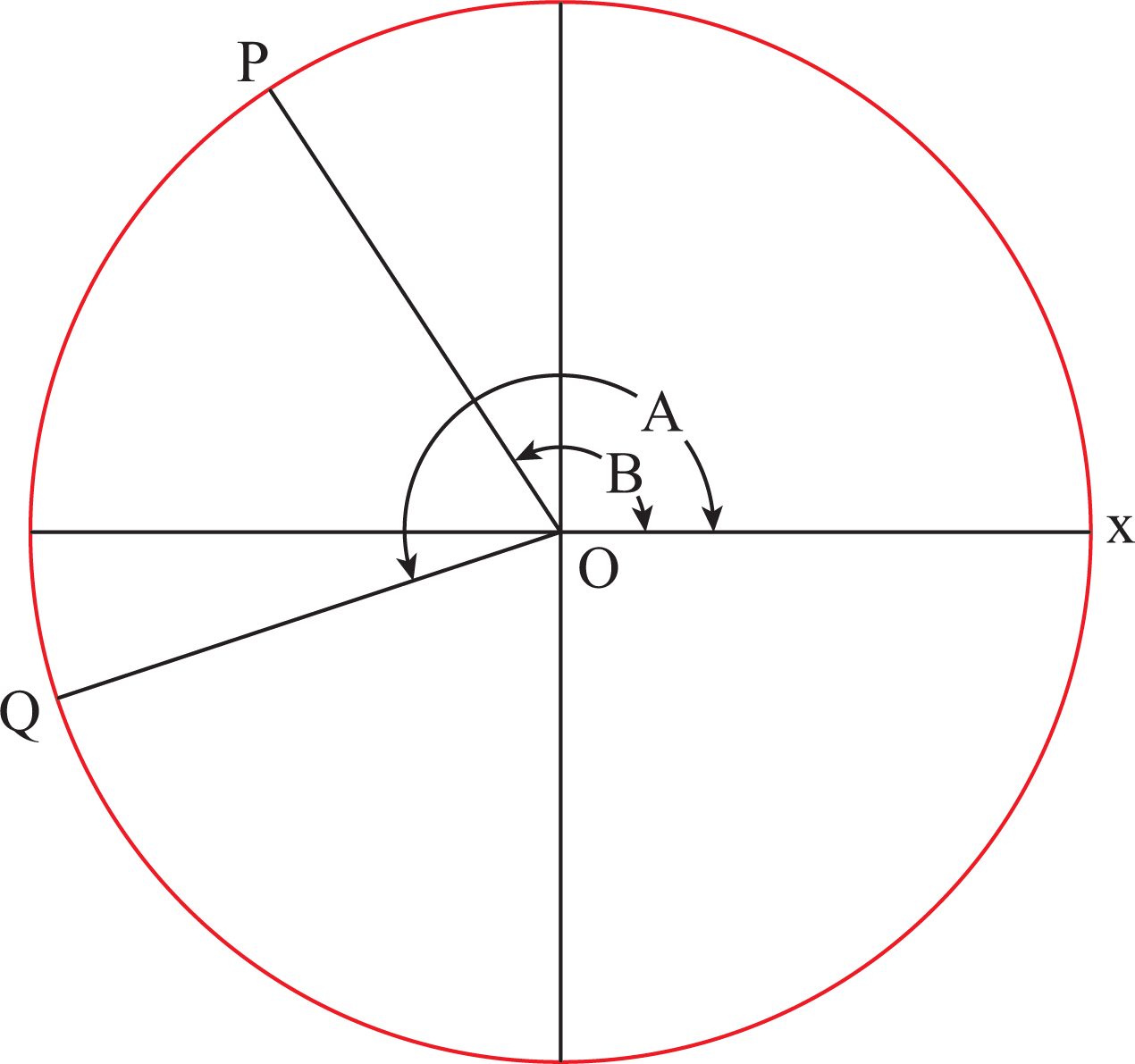
If $OP$ and $OQ$ are unit radii which make angles with the $x$ axis of $B$ and $A$ respectively.
Then the coordinates of $P$ are $(\cos B$, $\sin B)$ and for $Q (\cos A$, $\sin A)$.
By inspection the angle $POQ$ is of magnitude $A- B$.
Using the Pythagora theorem,
$PQ^2 = (\cos\,B - \cos\,A)^2 + (\sin\,B - \sin\,A)^2$
Applying the cosine formula to triangle $POQ$:
Equating equations (1) and (2)
$\cos(A - B) = \cos\,A\;\cos\,B + \sin\,A\;\sin\,B$
This equation applies for all values of $A$ and $B$
Writing $(90^0 + A)$ for $A$
$\cos(90^0 + A - B) = \cos\,(90^0 + A)\;\cos\,B + \sin\,(90^0 + A)\;\sin\,B$
therefore $\sin\,(A - B) = \sin\,A\;\cos\,B - \cos\,A\;\sin\,B$
If $B$ is replaced by $-B$ and making use of the fact that $\cos B = \cos(-B)$
and that $- \sin B = \sin(-B)$. Then:
$\cos\,(A + B) = \cos\,A\;\cos\,B - \sin\,A\;\sin\,B$
Putting $A$ = $B$
The above equation can be expressed in two different forms:
$\cos\,2A = 2\;\cos^2\,A - 1$
$\cos\,2A = 1 - 2\;\sin^2\,A$
Equation (3) can be treated the same way in which case:
Addition Formulae for the Tangent
Divide the Numerator and the denominator by $\;\cos\,A\;\cos\,B$
therefore $\displaystyle \tan\,(A + B) = \frac{\tan\,A + \tan\,B}{1 - \tan\,A\;\tan\,B}$
If $B$ is replaced in the above equation by $-B$
$\tan\,(A - B) = \frac{\tan\,A - \tan\,B}{1 + \tan\,A\;\tan\,B}$
From equation (7) it can be seen that :
$\tan\,2A = \frac{2\;\tan\,A}{1 - \tan^2\;A}$
It is worth noting that :
$\tan\,(A + B + C) = \frac{\tan\,A + \tan\,(B + C)}{1 - \tan\,A\;\tan\;(B + C)}$
therefore $\tan\,(A + B + C)\;$
This is a particular case of the more general formlua
$\tan\,(A + B + C + ....) = \frac{s_1 - s_3 + s_5 - ...}{1 - s_2 + s_4 - ...}$
Where $s_n$ stands for all the possible products of $\tan$ $A$ ,$\tan$ $B$ etc taken $n$ at a time.
It follows from equation (9) that since the $\tan\,180^0\,= 0$ and if $A$, $B$, $C$ are the angles of a triangle then:
$\tan\,A + \tan,B + \tan\,C = \tan\,A\;\tan\,B\;\tan\,C$
Useful Formulae
$\sin\,2A = 2\;\sin\,A\;\cos\,A = \frac{2\;\tan\,A}{\sec^2\,A} = \frac{2\;\tan\,A}{1 + \tan^2\,A}$
And
$\cos\,2A = \cos^2\,A - \sin^2\,A = \frac{\cos^2\,A - \sin^2\,A}{\cos^2\,A + \sin^2\,A} = \frac{1 - \tan^2\,A}{1 + \tan^2\,A}$
The Product Formulae
Since $\;\sin\,(A + B) = \sin\,A\;\cos\,B + \cos\,A\;\sin\,B$
and $\;\;\;\sin\,(A - B) = \sin\,A\;\cos\,B - \cos\,A\;\sin\,B$
By adding the two above equations we get:
$\sin\,(A + B) + \sin\,(A - B) = 2\;\sin\,A\;\cos\,B$
And by subtraction:
$\sin\,(A + B) - \sin\,(A - B) = 2\;\cos\,A\;\sin\,B$
In these two new equations we can substitute $(A + B) =$ $X$ and $(A - B) =$ $Y$ from which :
$A = \frac{1}{2}(X + Y)\;\;\;\;\;and\;\;\;\;\;B = \frac{1}{2}(X - Y)$
$\sin\,X + \sin\,Y = 2\,\sin\,\frac{1}{2}(X + Y)\times \cos\,\frac{1}{2}(X - Y)$
And
$\sin\,X - \sin\,Y = 2\,\cos\,\frac{1}{2}(X + Y)\times \sin\,\frac{1}{2}(X - Y)$
Proceeding in a similar way we get:
$\cos\,X + \cos\,Y = 2\,\cos\,\frac{1}{2}(X + Y)\times \cos\,\frac{1}{2}(X - Y)$
and $\cos\,X - \cos\,Y\;= - 2\,\sin\,\frac{1}{2}(X + Y)\times \sin\,\frac{1}{2}(X - Y)$
The Half Angle Formulae
By writing $A = x/2$ in formulae from the last sections :
From equation (5)
And from (4)
and from equation (8)
These formulae allow us to express the sine, cosine and tangent of an angle in terms of the tangent of the half angle.
It is therefore possible to write
$\displaystyle t = \tan\,\frac{1}{2}x$ from which $\displaystyle \tan\,x = \frac{2t}{1\;-t^2}$
Equation (12) can be re-written as :
$\sin\,x = 2\;\tan\,\frac{1}{2}x\;\cos^2\,\frac{1}{2}x = \frac{2\;\tan\,\frac{1}{2}x}{\sec^2\,\frac{1}{2}x}= \frac{2\;\tan\,\frac{1}{2}x}{1 + \tan^2\,\frac{1}{2}x}$
therefore $\displaystyle \sin\,x = \frac{2\,t}{1 + t^2}$
And from equation (4)
$\cos\,x = \cos^2\,\frac{1}{2}x(1 - \tan^2\,\frac{1}{2}x) = \frac{1 - \tan^2\,\frac{1}{2}x}{\sec^2\,\frac{1}{2}x} = \frac{1 - \tan^2\,\frac{1}{2}x}{1 + \tan^2\,\frac{1}{2}x}$
therefore $\displaystyle \cos\,x = \frac{1 - t^2}{1 + t^2}$
These equations are useful in the solution of a certain type of trigonometrical equation. They also have other important applications.
Example 1
If $\displaystyle tan \theta = \frac{4}{3}\;$ and if $\;0^0\;<\;\theta\;<\;360^0$ find without tables the possible
values of $\,tan\,\frac{1}{2}\;\theta$ and of $\;sin\,\frac{1}{2}\;\theta$
Let $\displaystyle\;t = tan\,\frac{1}{2}\theta$ then $\displaystyle \;\frac{4}{3} = tan\,\theta = \frac{2t}{1 - t^2}$
therefore $\displaystyle 4 - 4t^2 = 6t$ or $2t^2 + 3t - 2 = 0$
Solving the quadratic:
$\displaystyle t = \frac{1}{2}$ or $2$ to find $\displaystyle sin\,\frac{1}{2}\,\theta$
$t = tan\,\frac{1}{2}\theta = sin\,\frac{1}{2}\,\theta \;sec\,\frac{1}{2}\,\theta = sin\,\frac{1}{2}\,\theta (1 + tan^2\,\frac{1}{2}\,\theta)^{\frac{1}{2}}$
therefore $\displaystyle sin\,\frac{1}{2}\theta = \frac{t}{\sqrt{1 + t^2}}$
If $\displaystyle t = \frac{1}{2}$ then $\displaystyle sin\,\frac{1}{2}\,\theta = \frac{1}{\sqrt{5}}$
If $t= - 2$ then $\sin\,\frac{1}{2}\,\theta = \frac{-2}{\pm \sqrt{5}} = \frac{2}{\sqrt{5}}$ if $\theta$ is $<\; 360^0$ and $\frac{\theta }{2}<\;180^0$
The Auxiliary Angle
The equation $a\;\cos\,\theta + b\;\sin\,\theta = c$ in which $a$ , $b$ , $c$ are known numerical quantities . A method of solution is to divide throughout by $\sqrt{(a^2 + b^2)}$
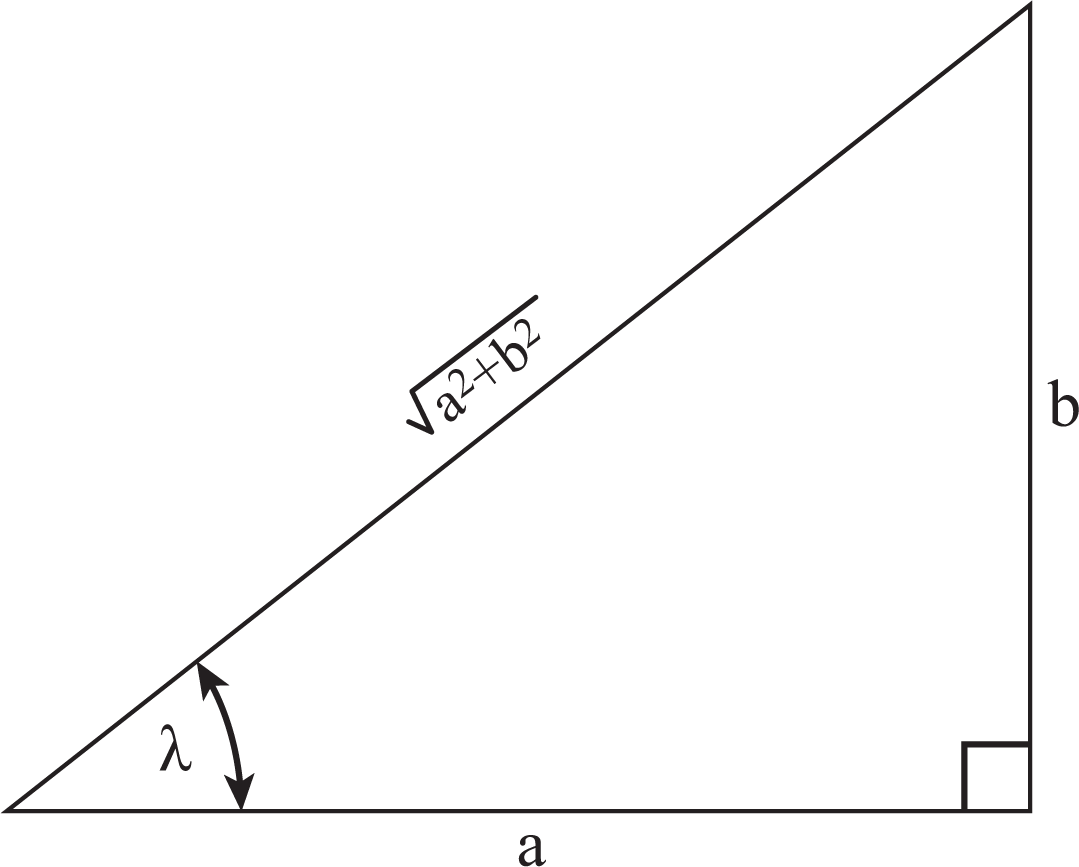
$\therefore\;\;\;\;\;\;\;\frac{a}{\sqrt{(a^2 + b^2)}}\cos\,\theta + \frac{b}{\sqrt{(a^2 + b^2)}}\sin\;\theta = \frac{c}{\sqrt{a^2 + b^2}}$
If we introduce an angle $\lambda$ whose tangent is $\frac{b}{a}$ it can be seen that we can read off values for both the sine and cosine. Hence the equation can be re-written as:
$\cos\,\theta \;\cos\,\lambda + \sin\,\theta \;\sin\,\lambda = \frac{c}{\sqrt{(a^2 + b^2)}}$
$\therefore\;\;\;\;\;\;\cos\,(\theta - \lambda )= \frac{c}{\sqrt{(a^2 + b^2)}}$
$\cos\,\theta \;\cos\,\lambda + \sin\,\theta \;\sin\,\lambda = \frac{c}{\sqrt{(a^2 + b^2)}}$
The equation has now been reduced to one of the standard forms whose solution is known. Hence a value for $\theta - \lambda$ can be found and as the value of $\lambda$ is known $\theta$ can be calculated. For real solutions it is necessary for the value of $c$ to be less than $\sqrt{(a^2 + b^2)}$
A second method of solution is to use the half angle formulae :
Hence $\displaystyle a(1 - t^2) + b(2t) = c(1 + t^2)$
therefore $(a + c)t^2\;-2bt - (a - c) = 0$
This quadratic gives two values for $t$ from which general value of $\theta$ can be found.
The Inverse Notation
If sin$\theta$ = $x$ where $x$ is a given quantity numerically less than unity, we know that $\theta$ can be any one of a whole series of angles.
Thus if $\displaystyle \sin\,\theta = \frac{1}{2}$ then $\displaystyle \theta = n\pi + (-1)^n(\frac{\pi }{6})$ and $\theta$ can have a number of values.
Arcsine
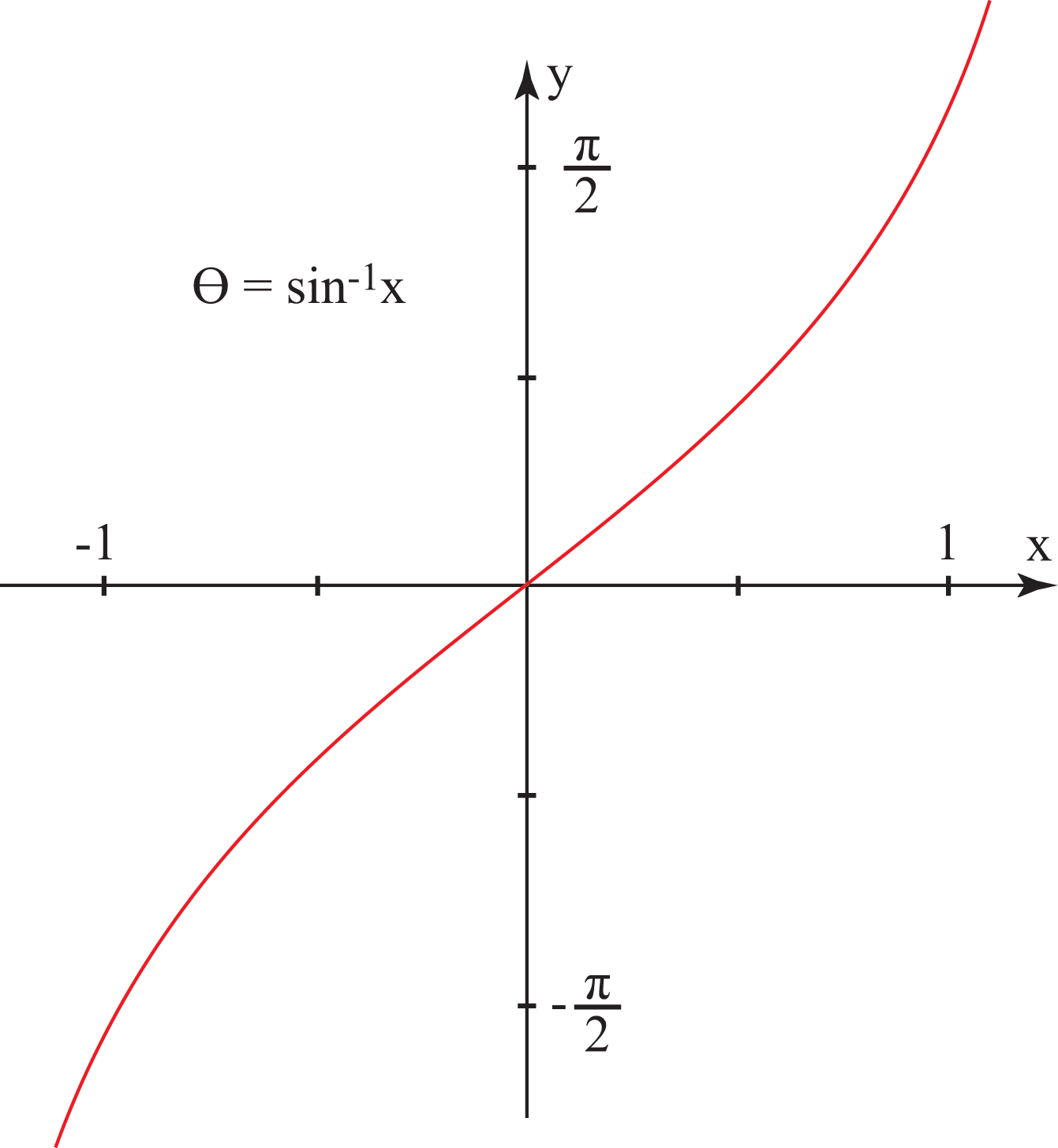
The inverse notation $\theta = \sin^{-1}\,x$ is used to denote the angle whose sine is $x$ and the numerically smallest angle satisfying the relationship $x = \sin\,\theta$ is chosen as the principal value.
Here and in what follows we shall deal only with principal values and the statement $\theta = \sin^{-1}\,x$ to mean that $\theta$ is the angle that lies between $\displaystyle -\frac{\pi }{2}\;$ and $\displaystyle \frac{\pi }{2}$ radians whose sine is $x$.
The statement $\mathbf{\theta = \sin^{-1}\,x}$ means that $\theta$ is the inverse sine of $x$. On the continent this is sometimes written as $\mathbf{\theta = arc\;\sin\,x}$
The graph of $\theta = \sin^{-1}\,x$ is that part of the graph $x = \sin\,\theta$ given by $- \frac{\pi}{2}\; <\;\theta\;<\;\frac{\pi}{2}$ with the $x$-axis horizontal and the $\theta$ axis vertical.As shown:
Arccosine
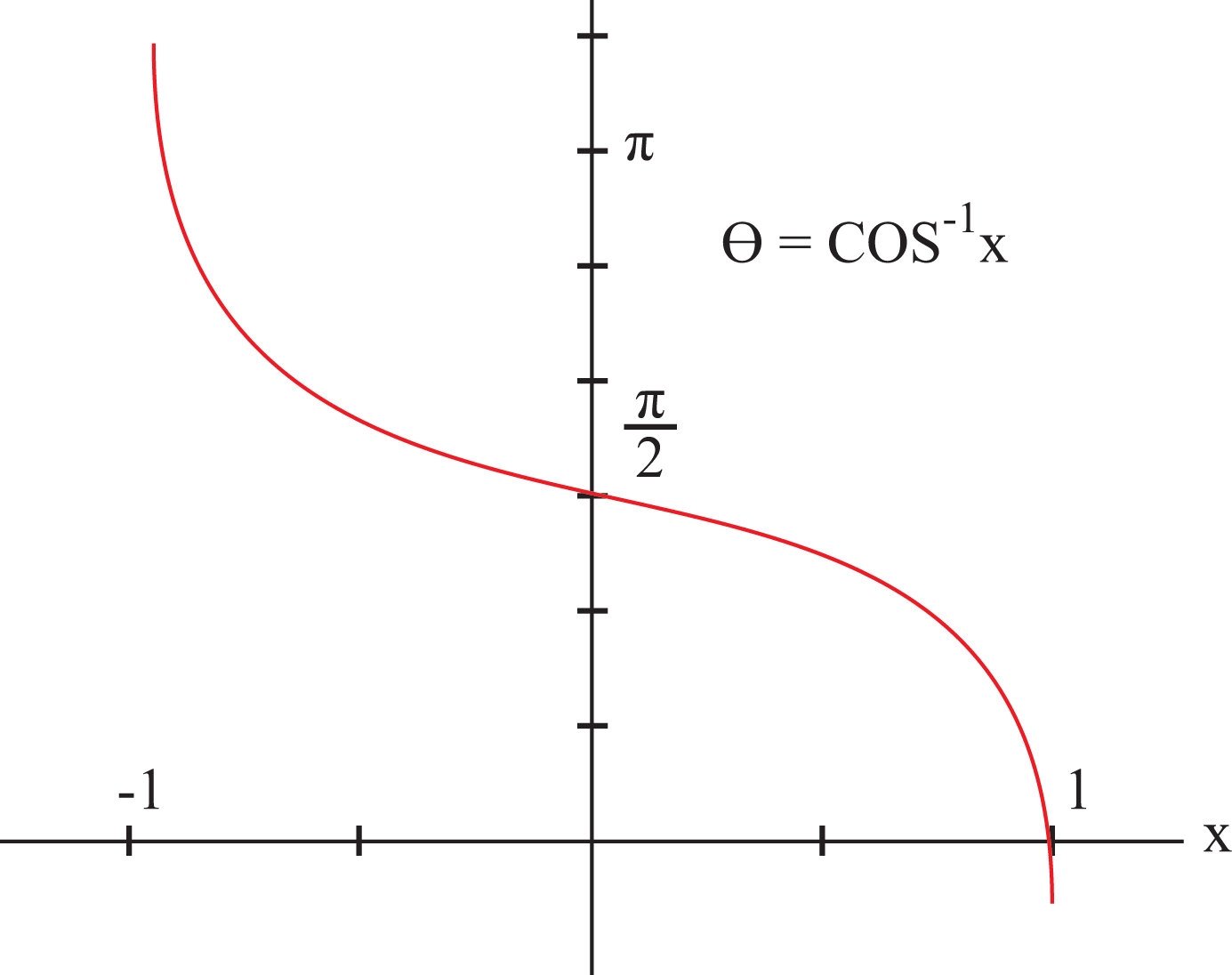
In a similar way $\theta = \cos^{-1}\,x$ will be taken to denote the smallest angle whose cosine takes the same value for negative as for positive angles and we require a notation which gives an unique value of $\theta$ when $x$ is given, we conventionally take $\theta$ as the angle lying between $0$ and $\pi$ radians whose cosine is $x$.
For example
$\displaystyle \cos^{-1}\,\left(\frac{1}{2} \right) = \frac{\pi }{3}$ and $\displaystyle \cos^{-1}\,\left(-\,\frac{1}{2} \right) = \frac{2\,\pi }{3}$
The graph of $\theta = \cos^{-1}\;x$ is derived from that of $x = \cos\theta$
Arctangent
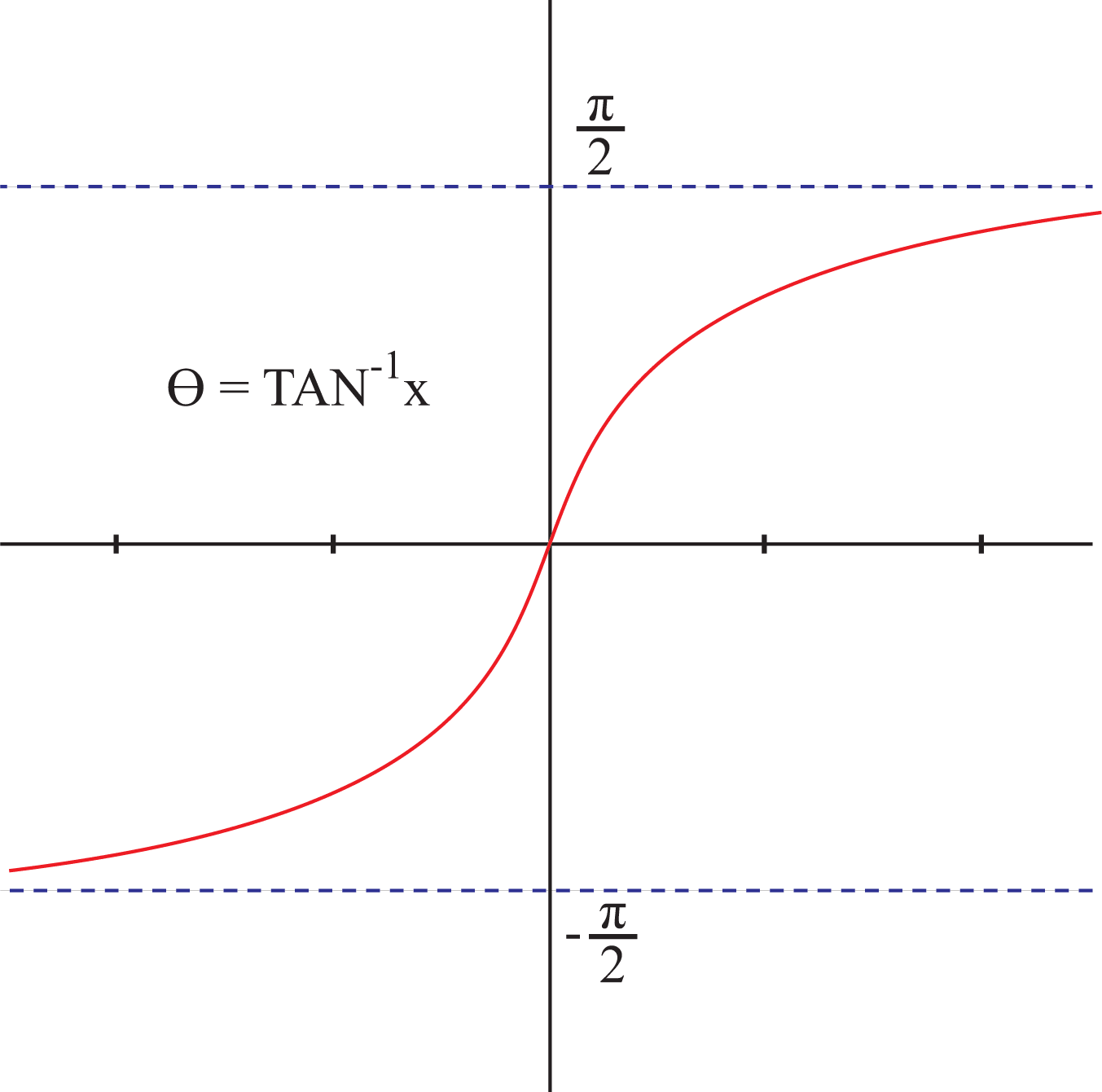
The inverse tangent is similarly defined but as, unlike the sine and cosine, the tangent can take all values, $x$ is quite unrestricted in value. $\theta = \tan^{-1}\;x$ is taken to mean $\tan^{-1}(1) = \frac{\pi }{4}$ and $\tan^{-1}\;(-\,1) = -\frac{\pi}{4}$ and that $\theta$ lies
between $\displaystyle \frac{-\,\pi}{2}$ and $\displaystyle\frac{\pi}{2}$ radians.
$\displaystyle\tan^{-1}(1) = \frac{\pi }{4}$ and $\displaystyle\tan^{-1}\;(-\,1) = -\frac{\pi}{4}$
It follows from these definitions that:
$\sin\,(\sin^{-1}\,x) = x\;\;\;\;\;\cos(\cos^{-1}\;x) = x\;\;\;\;\;\tan(\tan^{-1}\,x) = x$
These relationships will be found useful in some situations.
NOTE care must be taken avoid confusion between the inverse sine, cosine etc and the reciprocal of $\sin x$, $\cos x$ etc. The latter should always be written as : $\frac{1}{\sin\,x}\;\;or\;\;\cosec\,x\;\;\;\;and \;\;\;\frac{1}{\cos\,x}\;\;or\;\;\sec\,x,\;\;\;etc.$