
FUNCTION
Secant
Calculates the zeros of a function using the secant method.
Interface
#include <codecogs/maths/rootfinding/secant.h>
using namespace Maths::Rootfinding;
This is a root-finding algorithm which assumes a function to be approximately linear in the region of interest. Each improvement is taken as the point where the approximating line crosses the axis. The secant method retains only the most recent estimate, so the root does not necessarily remain bracketed.
When the algorithm does converge, its order of convergence is
where C is a constant and is the golden ratio.
Let us now derive the actual recurrence relation used with this method.
therefore
To give you a better idea on the way this method works, the following graph shows different iterations in the approximation process. Here is the associated list of pairs chosen at consecutive steps
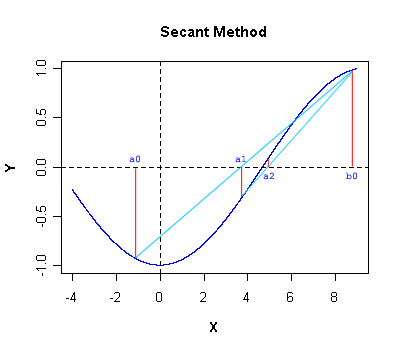
This algorithm finds the roots of the user-defined function f starting with an initial interval [x0, x1] and iterating the sequence above until either the accuracy eps is achieved or the maximum number of iterations maxit is exceeded.
References
- Jean-Pierre Moreau's Home Page, http://perso.wanadoo.fr/jean-pierre.moreau/
- F.R. Ruckdeschel, "BASIC Scientific Subroutines", Vol. II, BYTE/McGRAWW-HILL, 1981
- MathWorld, http://mathworld.wolfram.com/SecantMethod.html
Example 1
#include <codecogs/maths/rootfinding/secant.h>

#include <iostream>
#include <iomanip>

// user-defined function
double f(double x) {
    return (x - 4) * (x + 5);
}

int main()
{
  double x = Maths::RootFinding::secant(f, -2, 10);

  std::cout << "The calculated zero is X = " << std::setprecision(14) << x << std::endl;
  std::cout << "The associated ordinate value is Y = " << f(x) << std::endl;
  return 0;
}
Output:
The calculated zero is X = 3.9999998402552
The associated ordinate value is Y = -1.4377032269309e-006