
Cube
Dynamically allocates a zero_based 3D block (cube) of data.
Interface
#include <codecogs/computing/array/cube.h>
using namespace Computing::Array;
Overview
Dynamically allocates a zero_based 3D cube of memory. This memory block is continuous, and is in column, row, and finally depth order.
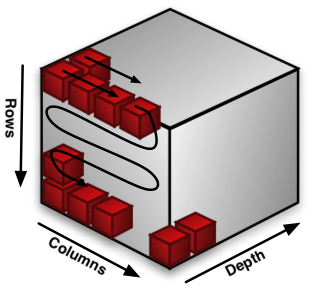
The opposite of this function is free_cube.
Example 1
With an allocation of the type:
#include <stdio.h>
#include <codecogs/computing/array/cube.h>

int main()
{
  // create a cube 2 deep (0-1), 4 rows (0-3) and 6 columns (0-5)
  char*** c = Array::cube<char>(2,4,6);
  for(int i=0; i<6; i++)
    for(int j=0; j<4; j++)
      for(int k=0; k<2; k++)
        c[k][j][i] = i+j+k;

  for(int i=0; i<(6*4); i++) {
    if(i % 6 == 0) printf("  ");
      printf("%hd ",c[0][0][i]);
  }

  printf("\n");

  for(int i=6*4; i<6*4*2; i++) {
    if(i % 6 == 0) printf("  ");
      printf("%hd ",c[0][0][i]);
  }

  printf("\n");

  Array::free_cube<char>(c);                     // de-allocated the memory from stack
  return 0;
}
Output: (with space between rows)
0 1 2 3 4 5   1 2 3 4 5 6   2 3 4 5 6 7   3 4 5 6 7 8
1 2 3 4 5 6   2 3 4 5 6 7   3 4 5 6 7 8   4 5 6 7 8 9
Parameters
You should always use free_cube to de-allocate memory allocated to this structure.
FUNCTION
free_cube
Removes any dynamically allocated memory for a 3D structure from the stack. This function is usually used on data structures created using cube<...>, though it can also be used on other 3D types, so long as the memory is continuously allocated with a pointers to pointers setup.
The opposite of this function is cube.
Parameters
Will Bateman (February 2005)