A collection of formulae covering addition and subtraction of Sin cos and tan

View versions (2)

Initial considerations

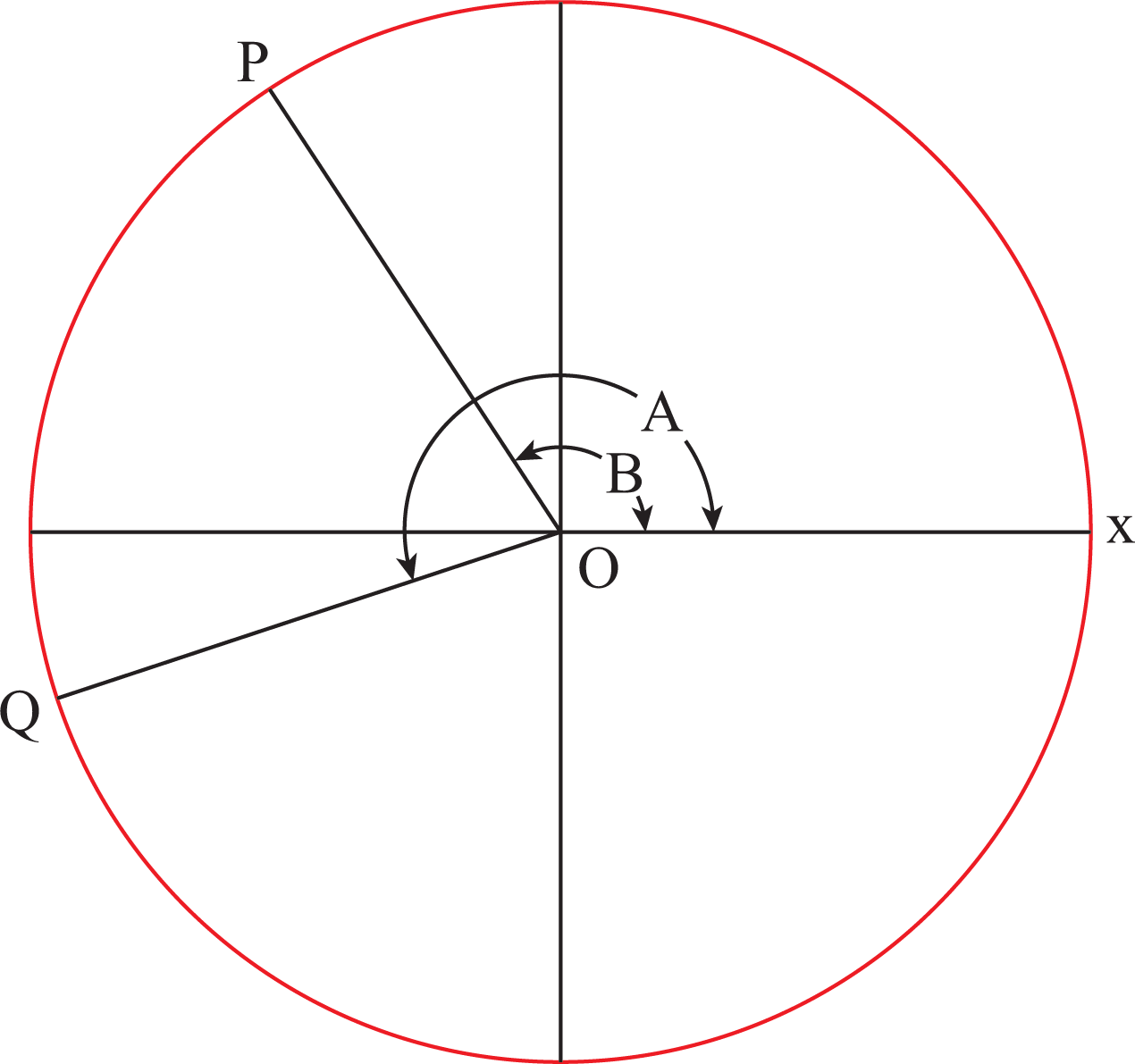
Considering the trigonometrical circle
22109/trig_a.gif


If OP and OQ are unit radii which make a angles with the x axis of B and A respectively.
Then the coordinates of P are (Cos B, sin B) and for Q (cos A, sin A).
By inspection the angle POQ is of magnitude A- B.
Using the Pythagora theorem,

PQ^2 = (cos\,B - cos\,A)^2 + (sin\,B - sin\,A)^2

= 2 - 2\;cos\,B\;cos\,A - 2\,sin\,B\;sin\,A
(1)

Applying the cosine formula to triangle POQ:

PQ^2 = 1^2 + 1^2 - 2\times 1\times 1\times cos\,(A - B)
(2)

Equating equations (#1) and (#2)

\cos(A - B) = cos\,A\;cos\,B + sin\,A\;sin\,B}

This equation applies for all values of A and B

Writing (90^0 + A) for A

cos(90^0 + A - B) = cos\,(90^0 + A)\;cos\,B + sin\,(90^0 + A)\;sin\,A


therefore \sin\,(A - B) = sin\,A\;cos\,B - cos\,A\;sin\,B
If B is replaced by -B and making use of the fact that cos B = cos(-B)
and that - sin B = sin(-B). Then:

\cos\,(A + B) = cos\,A\;cos\,B - sin\,A\;sin\,B

\sin\,(A + B) = sin\,A\;cos\,B + cos\,A\;sin\,B
(3)

Putting A = B

\cos\,2A = cos^2\,A - sin^2\;A
(4)

The above equation can be expressed in two different forms:

\cos\,2A = 2\;cos^2\,A - 1

\cos\,2A = 1 - 2\;sin^2\,A

Equation (#3) can be treated the same way in which case:

\sin\,2A = 2\;sin\,A\;cos\,A}
(5)

Addition Formulae for the Tangent

\tan\,(A - B) = \frac{tan\,A - tan\,B}{1 + tan\,A\;tan\,B}
(6)
\tan\,(A + B) = \frac{tan\,A + tan\,B}{1 - tan\,A\;tan\,B}
(7)


Divide the Numerator and the denominator by \;cos\,A\;cos\,B

tan\;(A + B)\;=\frac{sin\,(A + B)}{cos\;(A + B)}= \frac{sin\,A\;cos\,B + cos\,A\;sin\,B}{cos\,A\;cos\,B - sin\,A\;sin\,B}
(8)

therefore \displaystyle \tan\,(A + B) = \frac{tan\,A + tan\,B}{1 - tan\,A\;tan\,B}

If B is replaced in the above equation by -B
\tan\,(A - B) = \frac{tan\,A - tan\,B}{1 + tan\,A\;tan\,B}

From equation (#6) it can be seen that :

\tan\,2A = \frac{2\;tan\,A}{1 - tan^2\;A}}

It is worth noting that :

tan\,(A + B + C) = \frac{tan\,A + tan\,(B + C)}{1 - tan\,A\;tan\;(B + C)}


therefore tan\,(A + B + C)\;

=\frac{tan\,A + tan\,B + tan\,C\;-tan\,A\;tan\,B\;tan\,C}{1 - tan\,A\;tan\,C - tan\,C\;tan\,A - tan\,A\;tan\,B}
(9)

This is a particular case of the more general formlua

\tan\,(A + B + C + ....) = \frac{s_1 - s_3 + s_5 - ...}{1 - s_2 + s_4 - ...}

Where s_n stands for all the possible products of tan A ,tan B etc taken n at a time.

It follows from equation (#7) that since the tan\,180^0\,= 0 and if A, B, C are the angles of a triangle then:

\tan\,A + tan,B + tan\,C  = tan\,A\;tan\,B\;tan\,C

Useful Formulae

\sin\,2A} = 2\;sin\,A\;cos\,A = \frac{2\;tan\,A}{sec^2\,A} = \frac{2\;tan\,A}{1 + tan^2\,A}

And

\cos\,2A} = 2\;cos^2\,A - sin^2\,A = \frac{cos^2\,A - sin^2\,A}{cos^2\,A + sin^2\,A} = \frac{1 - tan^2\,A}{1 + tan^2\,A}

The Product Formulae

Since \;sin\,(A + B) = sin\,A\;cos\,B + cos\,A\;sin\,B

and \;\;\;sin\,(A - B) = sin\,A\;cos\,B - cos\,A\;sin\,B

By adding the two above equations we get:

sin\,(A + B) + sin\,(A - B) = 2\;sin\,A\;cos\,B

And by subtraction:

sin\,(A + B) - sin\,(A - B) = 2\;cos\,A\;sin\,B


In these two new equations we can substitute (A + B) = X and (A - B) = Y from which :

A = \frac{1}{2}(X + Y)\;\;\;\;\;and\;\;\;\;\;B = \frac{1}{2}(X - Y)

\sin\,X + sin\,Y = 2\,sin\,\frac{1}{2}(X + Y)\times cos\,\frac{1}{2}(X - Y)}

And

\sin\,X - sin\,Y = 2\,cos\,\frac{1}{2}(X + Y)\times sin\,\frac{1}{2}(X - Y)}

Proceeding in a similar way we get:

\cos\,X + cos\,Y = 2\,cos\,\frac{1}{2}(X + Y)\times cos\,\frac{1}{2}(X - Y)}

and \cos\,X - cos\,Y\;= - 2\,sin\,\frac{1}{2}(X + Y)\times sin\,\frac{1}{2}(X - Y)}

The Half Angle Formulae

By writing A = x/2 in formulae from the last sections :
From equation (#10)

sin\,x = 2\;sin\,\frac{1}{2}x\;cos\,\frac{1}{2}x
(10)

And from (#9)

cos\,x = cos^2\,\frac{1}{2}x - sin^2\,\frac{1}{2}x = 2\;cos^2\,\frac{1}{2}x - 1 = 1 - 2\;sin^2\,\frac{1}{2}x
(11)

and from equation (#11)

tan\,x = \frac{2\,tan\,\frac{1}{2}x}{1 - tan^2\,\frac{1}{2}x}
(12)

These formulae allow us to express the sine, cosine and tangent of an angle in terms of the tangent of the half angle.
It is therefore possible to write
\displaystyle t = tan\,\frac{1}{2}x from which \displaystyle \tan\,x = \frac{2t}{1\;-t^2}

Equation (#12) can be re-written as :

sin\,x = 2\;tan\,\frac{1}{2}x\;cos^2\,\frac{1}{2}x = \frac{2\;tan\,\frac{1}{2}x}{sec^2\,x}= \frac{2\;tan\,\frac{1}{2}x}{1 + tan^2\,\frac{1}{2}x}
therefore \displaystyle \sin\,x = \frac{2\,t}{1 + t^2}

And from equation (#9)

cos\,x = cos^2\,\frac{1}{2}x(1 - tan^2\,\frac{1}{2}x) = \frac{1 - tan^2\,\frac{1}{2}x}{sec^2\,\frac{1}{2}x} = \frac{1 - tan^2\,\frac{1}{2}x}{1 + tan^2\,\frac{1}{2}x}
therefore \displaystyle \cos\,x = \frac{1 - t^2}{1 + t^2}

These equations are useful in the solution of a certain type of trigonometrical equation. They also have other important applications.

Example 1
Problem

If \displaystyle tan \theta = \frac{4}{3}\; and if \;0^0\;<\;\theta\;<\;360^0 find without tables the possible
values of \,tan\,\frac{1}{2}\;\theta and of \;sin\,\frac{1}{2}\;\theta

Workings

Let \displaystyle\;t = tan\,\frac{1}{2}\theta then \displaystyle \;\frac{4}{3} = tan\,\theta  = \frac{2t}{1 - t^2}

therefore \displaystyle 4 - 4t^2 = 6t or 2t^2 + 3t - 2 = 0

Solving the quadratic:

\displaystyle t = \frac{1}{2} or 2 to find \displaystyle sin\,\frac{1}{2}\,\theta

t = tan\,\frac{1}{2}\theta  = sin\,\frac{1}{2}\,\theta \;sec\,\frac{1}{2}\,\theta = sin\,\frac{1}{2}\,\theta (1 + tan^2\,\frac{1}{2}\,\theta)^{\frac{1}{2}}
therefore \displaystyle sin\,\frac{1}{2}\theta  = \frac{t}{\sqrt{1 + t^2}}

Solution

If \displaystyle t = \frac{1}{2} then \displaystyle sin\,\frac{1}{2}\,\theta  = \frac{1}{\sqrt{5}}

If t= - 2 then \sin\,\frac{1}{2}\,\theta  = \frac{-2}{\pm \sqrt{5}} = \frac{2}{\sqrt{5}} if \theta is <\; 360^0 and \frac{\theta }{2}<\;180^0

The Auxiliary Angle

The equation a\;cos\,\theta + b\;sin\,\theta = c in which a , b , c are known numerical quantities . A method of solution is to divide throughout by \sqrt{(a^2 + b^2)}
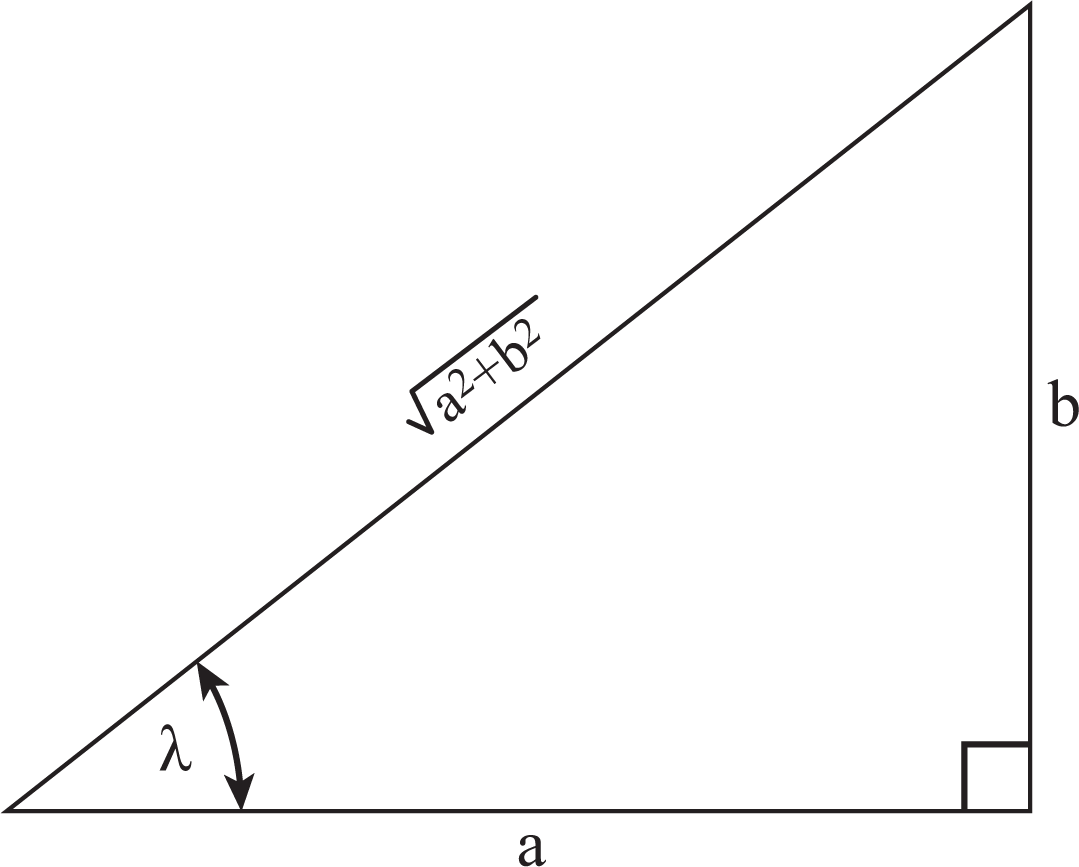
22109/trig_b.gif

\therefore\;\;\;\;\;\;\;\frac{a}{\sqrt{(a^2 + b^2)}}cos\,\theta  + \frac{b}{\sqrt{(a^2 + b^2)}}sin\;\theta = \frac{c}{\sqrt{a^2 + b^2}}

If we introduce an angle \lambda whose tangent is \frac{b}{a} it can be seen that we can read off values for both the sine and cosine. Hence the equation can be re-written as:

cos\,\theta \;cos\,\lambda  + sin\,\theta \;sin\,\lambda  = \frac{c}{\sqrt{(a^2 + b^2)}}

\therefore\;\;\;\;\;\;cos\,(\theta  - \lambda )= \frac{c}{\sqrt{(a^2 + b^2)}}

cos\,\theta \;cos\,\lambda  + sin\,\theta \;sin\,\lambda  = \frac{c}{\sqrt{(a^2 + b^2)}}

The equation has now been reduced to one of the standard forms whose solution is known. Hence a value for \theta - \lambda can be found and as the value of \lambda is known \theta can be calculated. For real solutions it is necessary for the value of c to be less than \sqrt{(a^2 + b^2)}

A second method of solution is to use the half angle formulae :
Hence \displaystyle a(1 - t^2) + b(2t) = c(1 + t^2)
therefore (a + c)t^2\;-2bt - (a - c) = 0
This quadratic gives two values for t from which general value of \theta can be found.

The Inverse Notation

If sin\theta = x where x is a given quantity numerically less than unity, we know that \theta can be any one of a whole series of angles.
Thus if \displaystyle sin\,\theta = \frac{1}{2} then \displaystyle \theta = n\pi  + (-\.1)^n(\frac{\pi }{6}) and \theta can have a number of values.

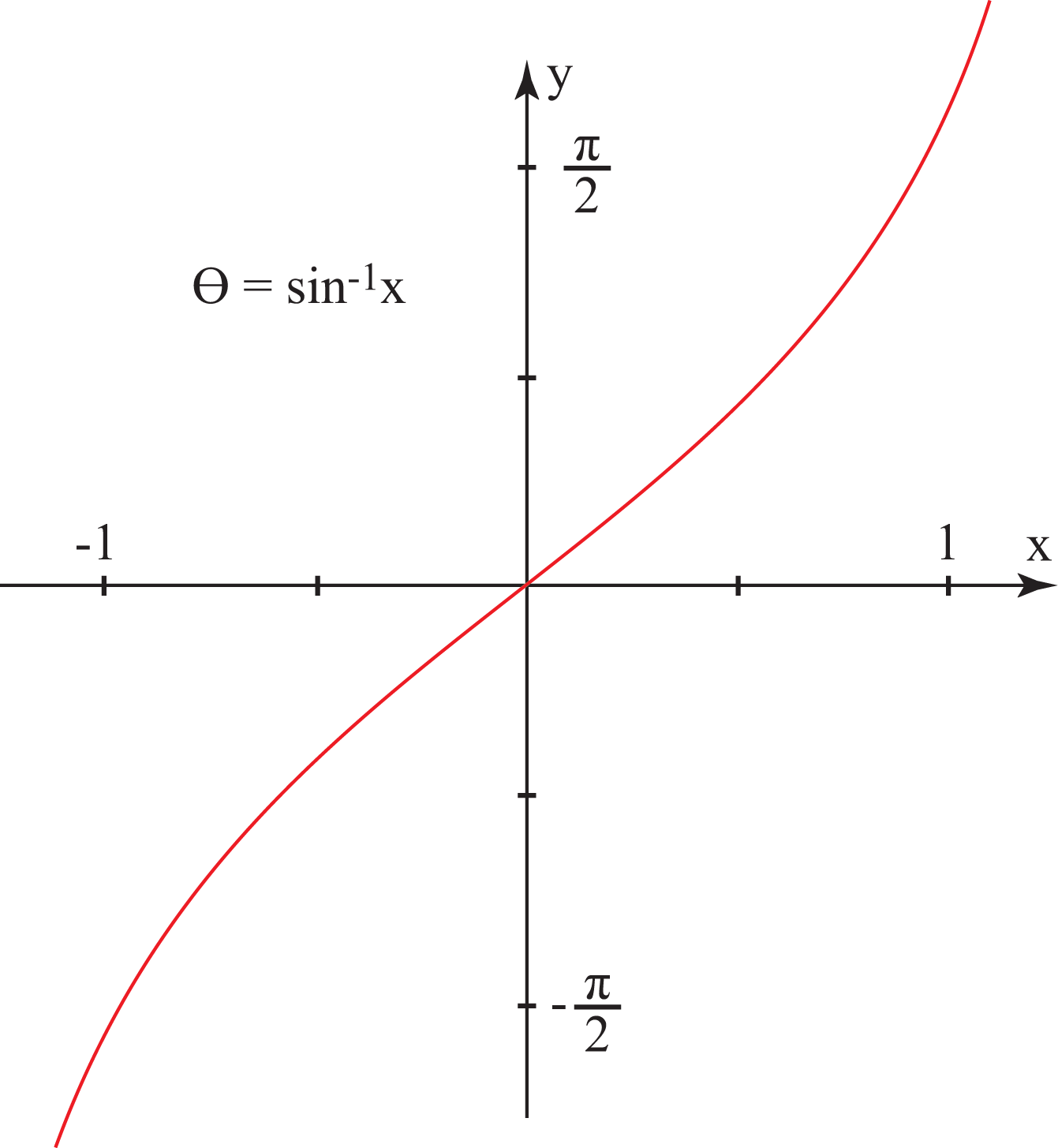
Arcsine

The inverse notation \theta = sin^{-1}\.x is used to denote the angle whose sine is x and the numerically smallest angle satisfying the relationship x = sin\,\theta is chosen as the principle value.

Here and in what follows we shall deal only with principle values and the statement \theta  = sin^{-1}\,x to mean that \theta is the angle that lies between \displaystyle -\frac{\pi }{2}\; and \displaystyle \frac{\pi }{2} radians whose sine is x.

The statement \mathbf{\theta = sin^{-1}\,x} means that \theta is the inverse sine of x. On the continent this is sometimes written as \mathbf{\theta  = arc\;sin\,x}

The graph of \theta = sin^{-1}\,x is, on thus that part of the graph x = sin\,\theta given by - \frac{\pi}{2}\; <\;\theta\;<\;\frac{\pi}{2} with the x-axis horizontal and the \theta axis vertical.As shown:

22109/trig_c.gif

Arccosine

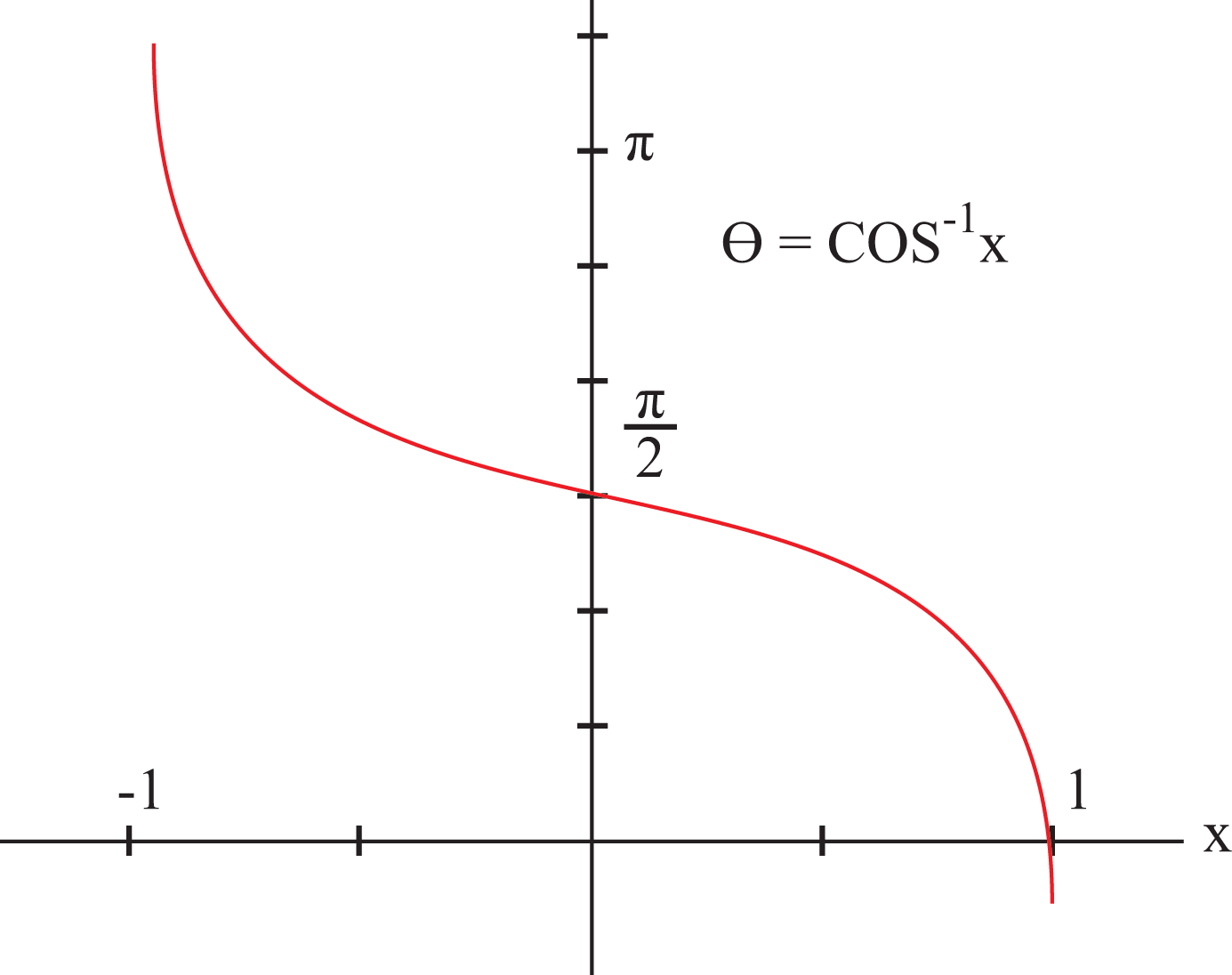
In a similar way \theta = cos^{-1}\,x will be taken to denote the smallest angle whose cosine takes the same value for negative as for positive angles and we require a notation which gives an unique value of \theta when x is given, we conventionally take \theta as the angle lying between 0 and \pi radians whose cosine is x.


For example
\displaystyle cos^{-1}\,\left(\frac{1}{2} \right) = \frac{\pi }{3} and \displaystyle cos^{-1}\,\left(-\,\frac{1}{2} \right) = \frac{2\,\pi }{3}

The graph of \theta = cos^{-1}\;x is derived from that of x = cos\theta

22109/trig_d.gif

Arctangent

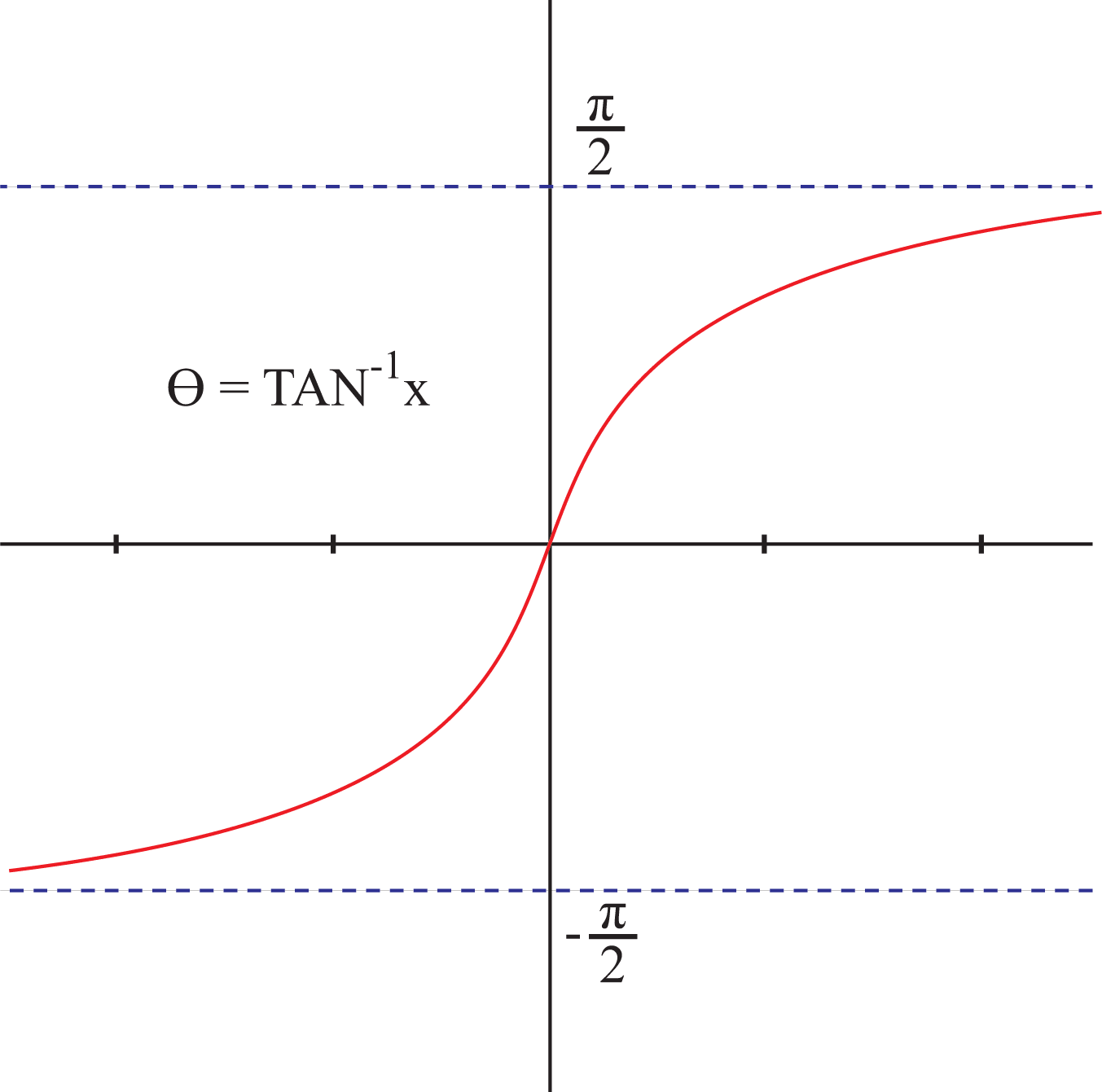
The inverse tangent is similarly defined but as, unlike the sine and cosine, the tangent can take all values, x is quite unrestricted in value. \theta = tan^{-1}\;x is taken to mean tan^{-1}(1) = \frac{\pi }{4} and tan^{-1}\;(-\,1) = -\frac{\pi}{4} and that \theta lies
between \displaystyle \frac{-\,\pi}{2} and \displaystyle\frac{\pi}{2} radians.

\displaystyle\tan^{-1}(1) = \frac{\pi }{4} and \displaystyle\tan^{-1}\;(-\,1) = -\frac{\pi}{4}

22109/trig_e.gif

It follows from these definitions that:

sin\,(sin^{-1}\,x) = x\;\;\;\;\;cos(cos^{-1}\;x) = x\;\;\;\;\;tan(tan^{-1}\,x) = x

These relationships will be found useful in some situations.

NOTE care must be taken avoid confusion between the inverse sine, cosine etc and the reciprocal of sin x, cos x etc. The latter should always be written as : \frac{1}{sin\,x}\;\;or\;\;cosec\,x\;\;\;\;and \;\;\;\frac{1}{cos\,x}\;\;or\;\;sec\,x,\;\;\;etc.