
Stability with liquid loads
Center of gravity refers to the mean location of the gravitational force acting on a body.
The center of buoyancy is the centre of the volume of water which the hull displaces.
Righting couple is a force which normally restores a ship to equilibrium once a heel has changed the relationship between her center of buoyancy and her center of gravity.
Metacentric height and conditions for buoyancy of ships and pontoons with liquid loads or ballast.
Introduction
Tankers are designed to transport liquid loads, but most large vessels have fuel tanks needed for their propulsion.
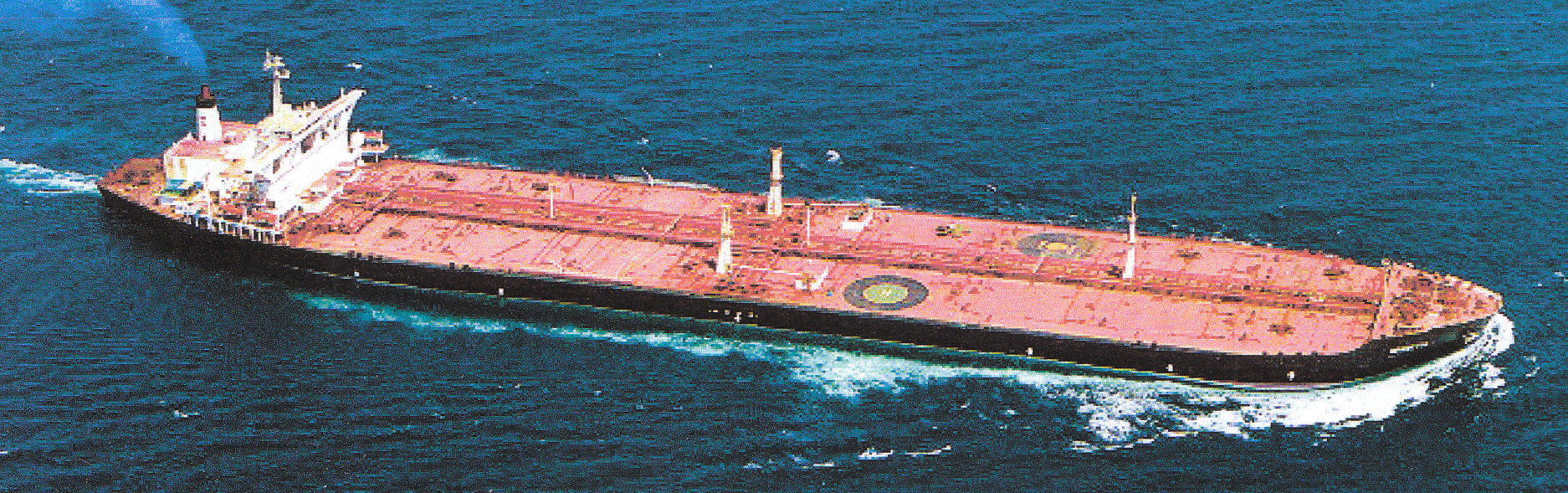
The presence of a significant volume of liquid with a free surface has an effect on the metacentric height and hence the stability of the ship.This is because the motion of the ship, as it is displaced from its equilibrium position, causes the liquids (load or ballast) to shift or slosh continuously. This is particularly applicable to large sea tankers and bulkships. In addition, in the context of large quantities of fuel for propulsion being carried on board a ship, the constant consumption of fuel means that the load, and the corresponding metacentric height, will shift. The effect of this on the stability of ships and pontoons is considered in this section.
Note: This page should be read in conjunction with http://www.codecogs.com/reference/engineering/fluid_mechanics/ships/stability_and_metacentric_height.php "Stability and Metacentric Height"
The Metacentric Height for a Vessel with Liquid Ballast.
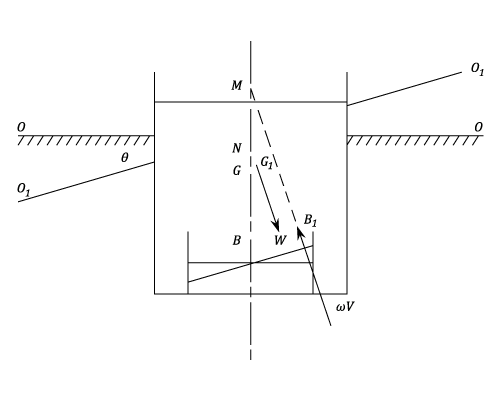
Where
is the original Waterline.
is the Centre of Gravity of the Ship and Ballast.
is the Centre of Buoyancy.
The Ship is tilted through a small angle clockwise giving a new waterline of
.
Due to the movement of the water wedge the Centre of Buoyancy of the Ship ( i.e. The of
of the displaced liquid) moves to
.
By the Previous Theory
where
is the second Moment of Area of the Water plane area and
is the Total displacement by the Ship and it's contents.
Due to the movement of the liquid in the Ballast tank, the of
of the Ship and Ballast moves to
. Now the vertical through
cuts the old vertical centre line at
. The Stability of the ship depends upon whether
is above or below
.
The Metacentric Height is now
Consider the Liquid in the Ballast Tank.
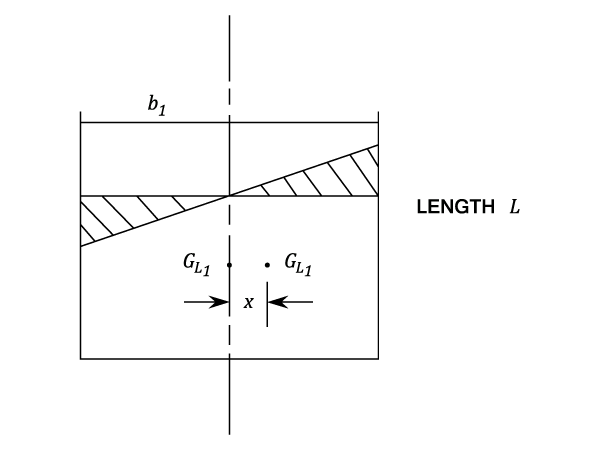
Let
= The second moment of area of the liquid surface about it's centre line.
= the Volume of liquid in the Tank.
= the specific weight of the liquid.
= The movement of the
of
The moment of the Couple due to the movement of the Wedge = The Moment of the Couple due to the movement of the of
.
Thus the of
of the ship and Contents moves from
to
where
is given by:
or,
but,
Therefore the Metacentric Height:
Thus the Metacentric Height has been reduced by the liquid ballast by an amount
Divided Ballast Tanks
If the Ballast Tank is divided into two by a longitudinal Partition, the above equation becomes:
and
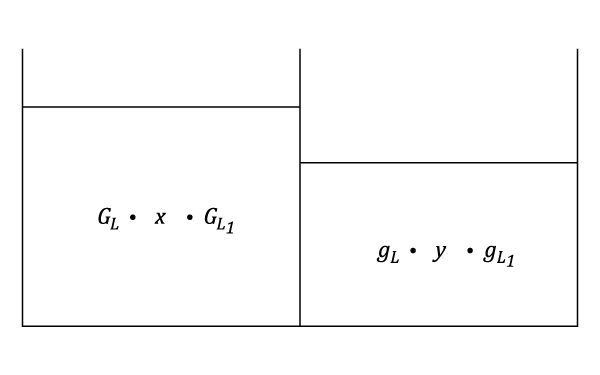
Comparing the two separate cases:
1) Single Tank of width .
2) Same tank divided into two equal compartments.
This shows that the reduction in the Metacentric height that occurs in case two is a quarter that experienced in case one. For this reason, the tanks in Oil Tankers are divided into small compartments.
The Righting Couple with a liquid Ballast.
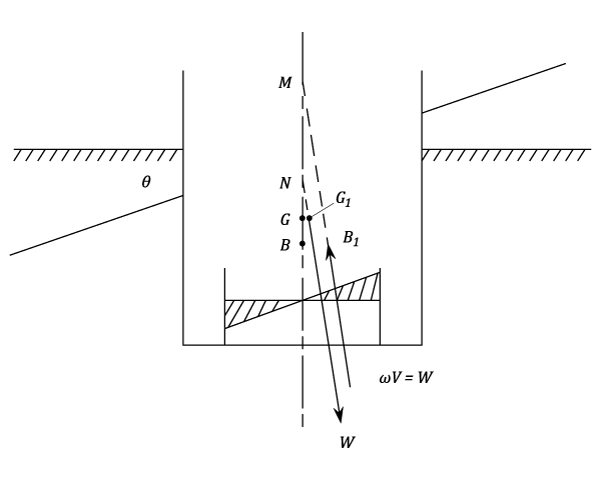
The Righting Couple due to the Buoyancy Force acting upwards through and
and the weight of the ship acting downwards through
and
.
where
is small.
This is the same as in the simple case without a liquid balance but it must be remembered that the Metacentric Height is now and not
.
Example 1 [imperial]
A Pontoon 50 ft. by 20 ft. and 7 ft. deep is ballasted with 40 tons of water.
The Pontoon and its load weigh 80 tons.

Find:
- a)The metacentric height.
- b)The angle through which the pontoon will heel if 2 tons of deck cargo are moved 10 ft. from the centre to edge.
Weight of Pontoon plus Ballast = 120 Tons.
Volume of Water displaced =
Draft =
Volume of Ballast Water =
Taking Moments about the Base:
And:
Metacentric Height:
Two Tons of Deck cargo are moved ten feet laterally.
Moment due to the movement of the load = The righting Couple. Thus:
- The metacentric height is
- The angle
Example 2 [imperial]
A rectangular pontoon 20 ft. wide ,50 ft. long and 7 ft. deep weighs 80 tons when loaded but without ballast water. A vertical diaphragm divides the pontoon longitudinally into two compartments each 10 ft. wide and 50 ft. long. 20 tons of ballast water are admitted to the bottom of each compartment, the water surface being free to move.
The centre of gravity of the pontoon, without ballast water, is 5 ft. above the bottom and on the geometrical centre of the plan .
- a) Calculate the metacentric height for rolling.
- b) If two tons of deck cargo is shifted 10 ft. laterally, find the appropriate angle of heel.

Note that the subscript 1 refers to the tanks.
When the loaded pontoon heels through a small angle ,
moves to
and :
i.e. the centre of gravity of the displaced volume moves such that:
from this it can be seen that the c. of g. of each tank will also be displaced by .
These movements will cause to move to
and if
is the specific weight of the water then
is given by:
Thus:
The unbalanced "righting" couple is thus :
The Metacentric height
Referring to the following diagram:

is the c.of g, of the tank volumes.
is the c.of g. of the unloaded pontoon.
Now:
Also:
And:
To find i.e.
take moments about the base:
From which:
Now:
And:
Therefore the metacentric height can be found from:
When the deck load moves to , the c. of g. will move from
and
will also be displaced.

As the load is comparatively small and if
is also small, then
and
can be assumed to be fixed relative to the pontoon.
Taking moments about :
And:
And:
substituting in equation (#1)
Thus:
- The metacentric height is
- The angle is