
Hemispherical
Time of emptying a hemispherical tank through an orifice at its bottom
Consider a hemispherical tank, containing some liquid and having an orifice at its bottom as shown in figure.
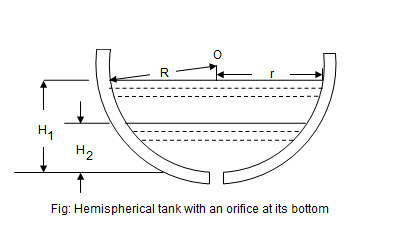
Let,
= Radius of the tank
= Initial height of the liquid
= Final height of the liquid
- a = Area of the orifice
At some instant, let the height of the liquid be h above the orifice.
We know that the theoretical velocity of the liquid at this instant,
At this instant, let r be the radius of the liquid surface.
Then the surface area of the liquid,
After a small interval of time dt, let the liquid level fall down by the amount dh.
Therefore volume of the liquid that has passed in time dt,
The value of dh is taken as negative, as its value will decrease with the increase in discharge.
We know that the volume of liquid that has passed through the orifice in time dt,
= Coefficient of discharge
Area
Theoretical velocity
Time
Equating equations (#1) and (#2)
From the geometry of the tank, we find that,
Substituting this value of in equation (#3)
Now the total time T required to bring the liquid level from to
may be found out by integrating the equation (#4) between the limits
to
i.e.,
If the vessel is to be completely emptied, then putting in this equation,
If the vessel was full at the time of the commencement and is to be completely emptied, then putting in the above equation,
Example 1 [metric]
A hemispherical tank of 2 meters radius contains water up to a depth 1meter. Find the time taken to discharge the tank completely through an orifice of 1000 mm\^2 provided at the bottom. Take = 0.62.
Given,
= 1000 mm\^2
= 0.62
We know that the time taken to discharge the tank completely.
Time taken to discharge the tank completely = 43 min 13 sec
Example 2 [metric]
A tank has an upper cylindrical portion of 3m diameter and 4m high with a hemispherical base. The cylinder is full of water. Determine the time taken to empty it through an orifice of cross sectional area of 8000 mm\^2 at its bottom. Take = 0.62.
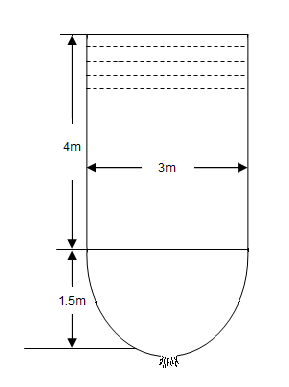
Given,
- Diameter of cylindrical portion,
= 3m
- Height of water above the spherical base = 4m
First of all, let us split up the tank into two portion i.e., cylindrical and hemispherical, and then find out the time required to empty both of them independently.
We know that the initial height of water above the orifice, = 4+1.5 = 5.5m
and surface area of the tank,
We also know that the time required to empty the cylindrical portion (from = 5.5m to
= 1.5m)
and the time required to empty the hemispherical portion when it is completely filled with water,
Total time,
=
= 721 + 368 = 1089 s = 18 min 9 sec
Time taken to empty the tank = 18 min 9 sec