
FUNCTION
airy
Calculates the Airy functions Ai and Bi and their derivatives.
Interface
#include <codecogs/maths/special/airy/airy.h>
using namespace Maths::Special::Airy;
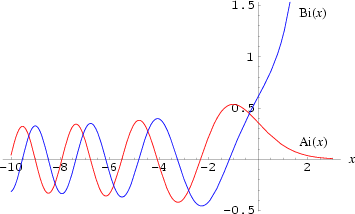
There are four varieties of Airy functions: <em>Ai(x)</em>, <em>Bi(x)</em>, <em>Gi(x)</em>, and <em>Hi(x)</em>. Of these, <em>Ai(x)</em> and <em>Bi(x)</em> are by far the most common, with <em>Gi(x)</em> and <em>Hi(x)</em> being encountered much less frequently. Airy functions commonly appear in physics, especially in optics, quantum mechanics, electromagnetics, and radiative transfer.
<em>Ai(x)</em> and <em>Bi(x)</em> are defined as the two linearly independent solutions to
in the form
where
The function returns the two independent solutions <em>Ai(x)</em>, <em>Bi(x)</em> and their first derivatives <em>Ai'(x)</em>, <em>Bi'(x)</em>.
Evaluation is by power series summation for small x, by rational minimax approximations for large x.
Accuracy:
Error criterion is absolute when function <= 1, relative when function > 1, except * denotes relative error criterion. For large negative x, the absolute error increases as x^1.5. For large positive x, the relative error increases as x^1.5.
<pre> Arithmetic domain function # trials peak rms IEEE -10, 0 Ai 10000 1.6e-15 2.7e-16 IEEE 0, 10 Ai 10000 2.3e-14* 1.8e-15* IEEE -10, 0 Ai' 10000 4.6e-15 7.6e-16 IEEE 0, 10 Ai' 10000 1.8e-14* 1.5e-15* IEEE -10, 10 Bi 30000 4.2e-15 5.3e-16 IEEE -10, 10 Bi' 30000 4.9e-15 7.3e-16 </pre>
References
Cephes Math Library Release 2.8: June, 2000; http://mathworld.wolfram.com/AiryFunctions.html
Example 1
#include <stdio.h>
#include <codecogs/maths/special/airy/airy.h>

int main()
{
  double Ai, Bi, Aip, Bip;
  for(double x=-10; x<2;x++)
  {
    Maths::Special::Airy::airy(x, Ai, Aip, Bi, Bip);
    printf("\n Airy(%.0lf) -> Ai=%lf Bi=%lf Ai'=%lf Bi'=%lf",x,Ai, Bi, Aip, Bip);
  }
  return 0;
}
Output:
Airy(-10) -> Ai=0.040241 Bi=-0.314680 Ai'=0.996265 Bi'=0.119414
Airy(-9) -> Ai=-0.022134 Bi=0.324947 Ai'=-0.975664 Bi'=-0.057401
Airy(-8) -> Ai=-0.052705 Bi=-0.331252 Ai'=0.935561 Bi'=-0.159450
Airy(-7) -> Ai=0.184281 Bi=0.293762 Ai'=-0.771008 Bi'=0.498245
Airy(-6) -> Ai=-0.329145 Bi=-0.146698 Ai'=0.345935 Bi'=-0.812899
Airy(-5) -> Ai=0.350761 Bi=-0.138369 Ai'=0.327193 Bi'=0.778412
Airy(-4) -> Ai=-0.070266 Bi=0.392235 Ai'=-0.790629 Bi'=-0.116671
Airy(-3) -> Ai=-0.378814 Bi=-0.198290 Ai'=0.314584 Bi'=-0.675611
Airy(-2) -> Ai=0.227407 Bi=-0.412303 Ai'=0.618259 Bi'=0.278795
Airy(-1) -> Ai=0.535561 Bi=0.103997 Ai'=-0.010161 Bi'=0.592376
Airy(0) -> Ai=0.355028 Bi=0.614927 Ai'=-0.258819 Bi'=0.448288
Airy(1) -> Ai=0.135292 Bi=1.207424 Ai'=-0.159147 Bi'=0.932436
Parameters
Returns
Interactive Calculator
Computing…
Set a range above first to export a graph.