
Convergent Mouthpiece
Discharge and Pressure in a Convergent Mouthpiece
Discharge through a Convergent Mouthpiece
Generally a jet of liquid gets contracted at the entrance of a mouthpiece. There is always some loss of head due to this contraction of the jet. To counteract the loss of head, due to contraction of the jet up to vena contract, the mouthpiece is given the same slope as that of the jet of liquid as shown in fig-1.
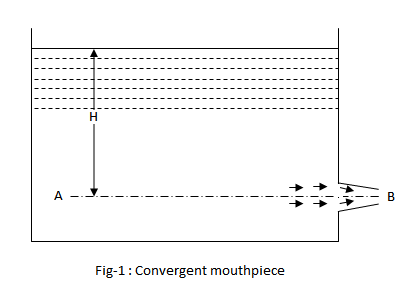
In such a mouthpiece, there will be no loss of head due to expansions. If such a mouthpiece terminates at the vena contracta of the jet, then the mouthpiece is called convergent mouthpiece.
Let,
= Height of the liquid above the mouthpiece
= Area of the orifice at point B, and
= Velocity of the jet
Applying Bernoulli's equation to points A and B,
We know that the actual discharge,
Equating equation (#1) and (#2)
Coefficient of discharge,
= 1
and discharge,
Example 1 [metric]
A convergent mouthpiece is discharging water under a constant head of 5m. Find the discharge, if diameter of the mouthpiece is 75 mm.
Given,
= 75mm = 0.075m
The area of the mouthpiece,
and discharge through the mouthpiece,
Discharge through the mouthpiece = 43.8 liters/s
Pressure in a Convergent Mouthpiece
Consider a vessel, open to atmosphere at its top, having an orifice fitted with a convergent mouthpiece as shown in fig-2. We know that the slope of the mouthpiece is the same as that of the jet up to vena contracta.
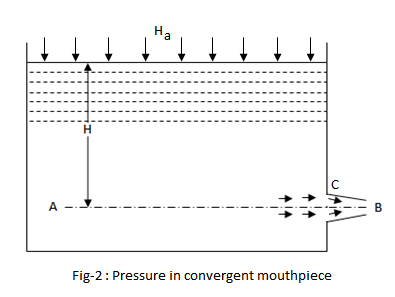
Let,
= Atmospheric pressure head
= Absolute pressure head at vena contracta, and
Applying Bernoulli's Equation to points A and C,
If there is no loss of head, then
Now substituting this value of H in equation (#1)
This shows that the absolute pressure head at the vena contracta is the same as that of the atmosphere. But in actual practice, the flow is no longer a steady one.