
Convergent_Divergent Mouthpiece
Discharge and Pressure in a Convergent - Divergent Mouthpiece
In this type of mouthpiece, the mouthpiece is first made convergent up to the vena contracta of the jet and beyond that it is made divergent. Such a mouthpiece, which is first convergent is known as convergent-divergent mouthpiece as shown in figure.
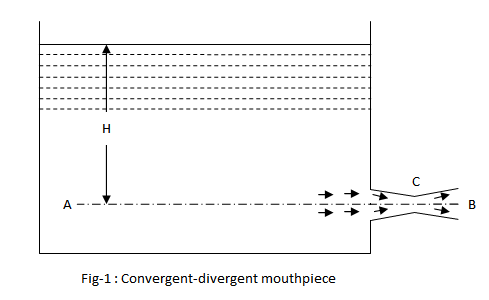
Discharge through a convergent-divergent mouthpiece
The discharge through a convergent-divergent mouthpiece is same as http://www.codecogs.com/reference/engineering/fluid_mechanics/pipes/mouthpiece/convergent_mouthpiece.php "convergent mouthpiece." In such a mouthpiece, there will be no loss of head due to sudden expansion. The coefficient of discharge C\_d in the case of convergent-divergent mouthpiece is also 1.
The diameter of the mouthpiece, for the purpose of calculating the discharge, is taken at the vena-contracta i.e., at C (or in other words where the convergent and divergent pieces meet). It is also known as throat diameter of the mouthpiece.
Example 1 [metric]
A convergent-divergent mouthpiece having 80mm throat diameter is discharging water under a constant head of 4.5m. Find the discharge through the mouthpiece.
Given,
= 4.5m
= 80mm = 0.08m
The area of the mouthpiece,
and discharge through the mouthpiece,
Discharge through the mouthpiece = 47.2 liters/s
Pressure in a Convergent-divergent mouthpiece
Consider a vessel open to atmosphere at its top, having an orifice fitted with a convergent-divergent mouthpiece as shown in fig-2. We know that the slope of the mouthpiece is the same as that of the jet up to vena contracta, and beyond that is it made divergent. The theoretical absolute pressure head at vena contracta is the same as that of atmospheric pressure head.
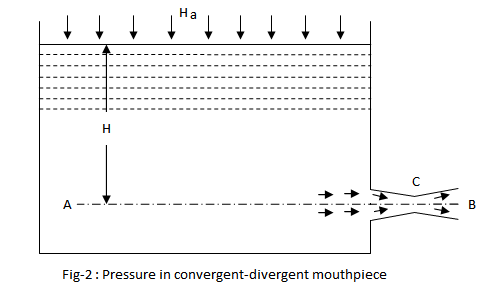
The pressure at the outlet of the mouthpiece is atmosphere. We know that the jet will expand from vena contracta (i.e., C) to outlet of the tube (i.e., B). For a steady flow, through the outlet of the mouthpiece, the shape of the divergent portion is made according to the profile of the expanding jet. However, if the divergence is made too large, the jet will not touch the walls of the mouthpiece.
Let,
= Atmospheric pressure head
= Absolute pressure head at vena contracta
= Velocity of liquid at outlet
= Velocity of liquid at vena contracta
= Area of mouthpiece at vena contracta
= Area of mouthpiece at outlet
We know that, if there is no loss of head,
Now applying Bernoulli's equation to points C and B,
Substituting the value of in (#1)
Since the flow of the liquid is continuous, therefore
The above expression gives the ratio of areas of divergence to the convergence of the mouthpiece. If d and d\_c be the diameters of the mouthpiece at outlet and vena contracta (i.e., convergence), then this expression can also be expressed as :
Example 1 [metric]
Water flows through a convergent-divergent mouthpiece of diameter at convergence 40mm, under a head of 4m. Determine the maximum diameter of divergence to avoid separation of the flow, if the maximum vacuum pressure is 8m of water.
Given,
= 40mm = 0.04m
- Maximum vacuum pressure head
= 8m
Let, = Maximum diameter of the divergence in meters
We know that,
Maximum diameter of the divergence, d = 52.6mm
Example 2 [metric]
A convergent-divergent mouthpiece is fitted to the side of a tank. If the diameters at the outlet and vena contracta be 30mm and 20mm respectively, find the maximum head of water for steady flow. take atmospheric pressure as 10m and separation as 2.5m of water.
Given,
Let, = Maximum head of water in meters
We know that,
Squaring both sides of the above equation,
Maximum head of water, = 1.85 m