
Stepped Notch
Discharge over a Stepped Notch
A stepped notch is a combination of rectangular notches as shown in figure. It is thus obvious that the discharge over such a notch will be the sum of the discharges over the different rectangular notches.
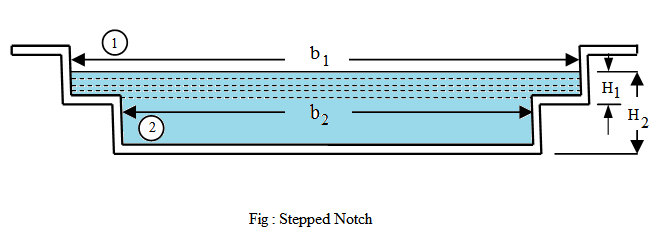
Consider a stepped notch as shown in figure. For the purpose of analysis, let us split up the notch into two rectangular notches 1 and 2. The total discharge over the notch will be the sum of the discharges over the two rectangular notches.
Let,
- H\_1 = Height of the liquid above the sill of notch 1
- b\_1 = Breadth of notch 1
- H\_2, b\_2 = Corresponding values for notch 2, and
- C\_d = Coefficient of discharge for both the notches
From the geometry of the notch, we get,
and the discharge over the notch 2,
Now the total discharge over the notch,
Example 1 [metric]
Find the discharge in m\^3 /s over a stepped notch shown in figure.
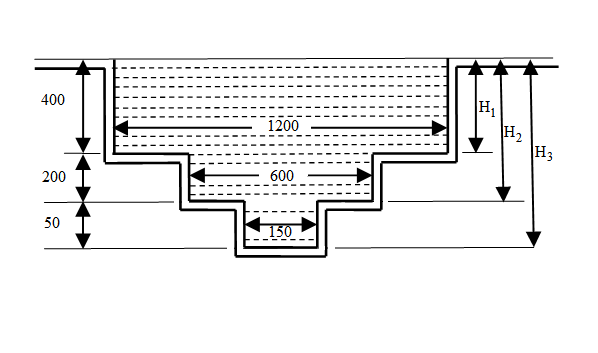
The level of water coincides with the top of the notch. Take C\_d for all sections 0.6. All dimensions are in mm.
Given,
- C\_d = 0.6
We know that the total discharge over the stepped notch,
Discharge over the notch = 0.779 m\^3 /s