
Masonry Walls
Water pressure on masonry walls
Consider a vertical masonry wall having water on one of its sides as shown in figure. Now consider a unit length of the wall. We know that the water pressure will act perpendicular to the wall. A little consideration will show, that the intensity of pressure, at the water level, will be zero, and will increase by a straight line law to at the bottom as shown in figure. Thus the pressure diagram will be a triangle.
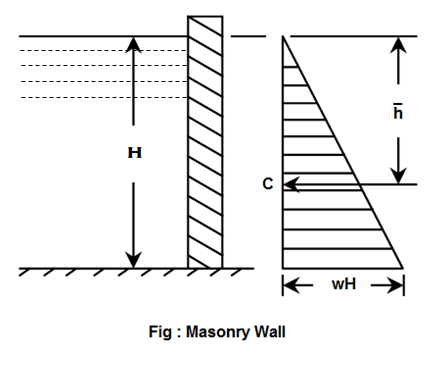
The total pressure on the wall will be the area of the triangle, i.e.,
This pressure will act through the center of gravity of the pressure diagram.
Let, = Depth of the center of pressure from the water surface.
We know that the c.g. of triangle is at a height of from the base, where
is the height of the triangle. Therefore depth of center of pressure from the water surface,
Thus the pressure of water on a vertical wall will act through a point at a distance from the bottom, where
is the depth of water.
Example 1 [metric]
One of the walls of a swimming pool contains 4m deep water. Determine the total pressure on the wall, if it is 10m wide.
Given,
- Depth of water, H = 4m
- Width of wall = 10m
We know that pressure on the wall per meter length
and total pressure on the wall,
Total pressure on the wall = 784.8 KN
Example 2 [metric]
A rectangular container 2.5m wide has a vertical partition in the middle. It is filled with petrol of specific gravity 0.8 to a height of 1m on one side and oil of specific gravity 0.9 to a height of 0.8m on the other. Find the resultant thrust per meter length of the partition wall and its point of application.
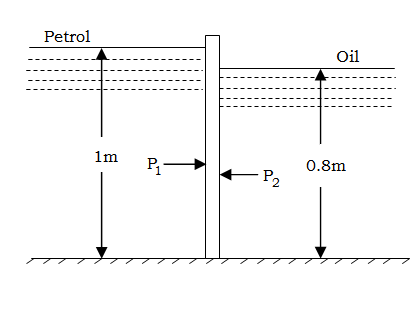
Given,
- Width of partition wall = 2.5m
- Specific gravity of petrol = 0.7
- Depth of petrol, H\_1 = 1m
- Specific gravity of oil = 0.9
- Depth of oil, H\_2 = 0.8m
Resultant thrust on the partition wall
We know that pressure of petrol per meter length of the partition wall,
and pressure of oil per meter length of the partition wall,
Resultant thrust per meter length of the partition wall,
Point of application of the thrust
Let, = Height of the center of the resultant pressure from the base.
We know that the pressure P\_1 and P\_2 will act at a height of from the base, where
is the respective height of petrol and oil from the base. Taking moments of the pressures about the base and equating the same,
Resultant thrust on the partition wall = 0.609 KN
Point of application of the thrust = 0.644 m