
Masonry Dams
Water Pressure on Masonry Dams
The dams are constructed in order to store large quantities of water, for the purpose of irrigation and power generation. A dam may be of any cross-section, but the following are important from the subject point of view:
- Rectangular dams
- Trapezoidal dams
Water Pressure on Rectangular Dams
Consider a rectangular dam retaining water on one of its sides as shown in fig-1. Now consider a unit length of the dam.
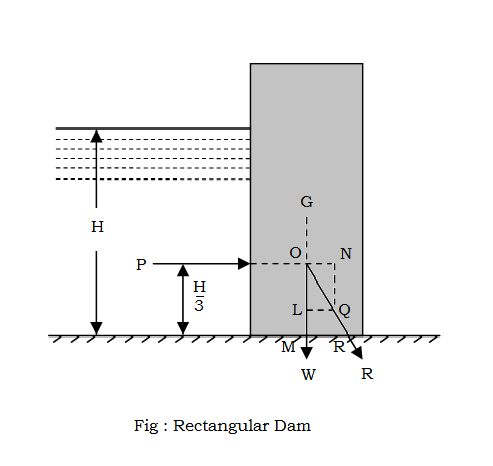
Let, H = Height of water retained by the dam
We know that the total pressure on the dam due to water,
and this pressure will act as height of H/3 above the base of the dam. Let, W be the weight of the dam masonry per unit length of the dam. We know that W will act downwards through the center of gravity of the dam section.
Now the resultant pressure of the force P and weight W will be given by the relation,
be given by the relation:
and the inclination of the resultant with the vertical will
Now with OL and ON or LQ (equal to W and P to some scale) complete the rectangle OLQN. We know that the diagonal OQ will give the resultant R to scale. Now extend OL and OQ to meet the base line at M and R as shown in fig-1.
Let x be the horizontal distance between the center of gravity of the dam and the point through which the resultant cuts the base (i.e., MR). The distance x may be found out from the similar triangles OLQ and OMR. i.e,
Example 1 [metric]
A retaining wall 6m high and 2.5m wide retains water up to its top. Find the total pressure per meter length of the wall and the point at which the resultant cuts the base. Also find the resultant thrust on the base of the wall per meter length. Assume weight of masonry as 23 KN/m\^3.
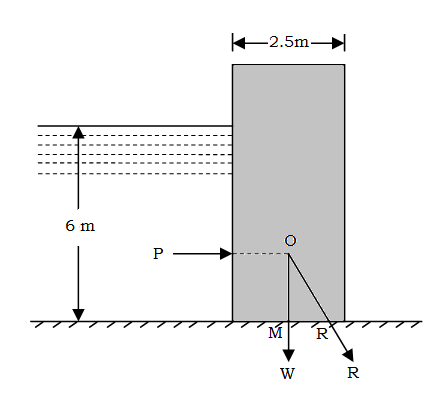
Given,
- Height of retaining wall, H = 6 m
- Width of retaining wall, b = 2.5 m
- Weight of masonry = 23 KN/m\^3
Total Pressure per meter length of the wall
We know that total pressure per meter length of the wall,
Points at which the resultant cuts the base
We also know that weight of masonry per meter length of the wall,
and distance between the mid-point (M) of the wall and the point where resultant cuts the base (R).
Resultant thrust on the base of the wall per meter length
We know that resultant thrust on the base of the wall per meter length,
Total Pressure per meter length of the wall = 176.6 KN
Points at which the resultant cuts the base (from the mid-point of the wall) = 1.02 m
Resultant thrust on the base of the wall per meter length = 387.6 m
Example 2 [metric]
A concrete dam of rectangular section, 15m high and 4m wide has water standing 3m below its top. Find :
(a) Water pressure on one meter length of dam,
(b) Height of the center of of pressure above base, and
(c) The point at which the resultant cuts the base.
Assume the weight of concrete as 24KN per cubic meter.
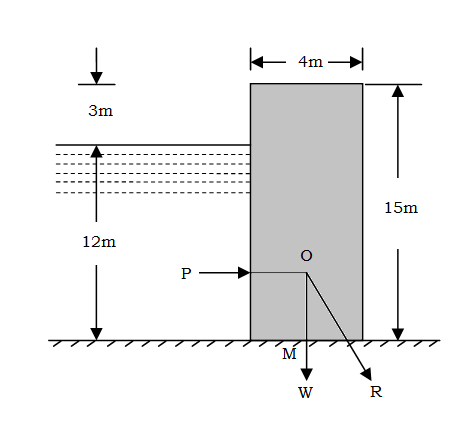
Given,
- Total height of the dam = 15 m
- Width of dam, b = 4 m
- Height of water, H = 15 - 3 = 12 m
- Weight of concrete = 24 KN/m\^3
(a) Water pressure on one meter length of dam
The total water pressure on one meter length of the dam,
(b) Height of the center of of pressure above base
The center of pressure is at a height of above the base.
The center of pressure =
above the base.
(c) The point at which the resultant cuts the base
The weight of concrete per meter length of the dam,
Distance between the mid-point of the dam and the point where resultant cuts the base, R
Water pressure on one meter length of dam = 706.3 KN
Height of the center of of pressure above base = 1440 KN
The point at which the resultant cuts the base = 1.96 m
Water Pressure on Trapezoidal Dams
A trapezoidal dam is more economical and also easier to construct than a rectangular dam. That is why, these days trapezoidal dams are preferred over the rectangular ones.
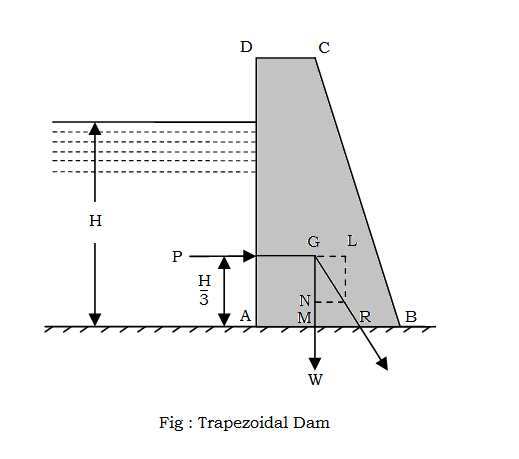
Consider a trapezoidal dam ABCD retaining water on one of its sides (say vertical side) as shown in fig-2. Now consider a unit length of the dam.
Let, = Height of water retained by the dam
Like the rectangular dam, the total pressure on a trapezoidal dam per meter length will also be given by the relation.
and the horizontal horizontal distance between the center of gravity of the dam and the point, at which the resultant cuts the base will also be given by the relation:
Example 1 [metric]
A concrete dam having water on vertical face is 16m high. The base of the dam is 8m wide and top 3m wide. Find the resultant thrust on the base per meter length of the dam and the point of where it intersects the base, where i contains water 16m deep. Take weight of the concrete as 23 KN/m\^3.
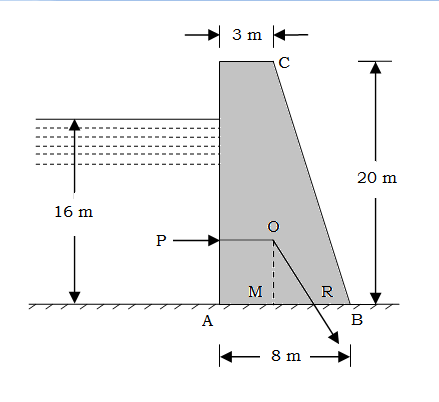
Given,
- Height of dam = 20 m
- Base width = 8 m
- Top width = 3 m
- Depth of water = 16 m
- Weight of concrete = 24 KN/m\^3
Resultant thrust on the base per meter length of the dam
We know that total water pressure per meter length of the dam,
and weight per meter length of the dam,
Resultant thrust on the base per meter length of the dam,
The point where the resultant thrust intersects the base
First of all, let us find out the point (M) at the base of the dam, through which center gravity (G) passes. Taking moments of the area of trapezoidal section about A and equating the same.
We know that distance between the mid-point (M) of the dam point where the resultant cuts the base (R).
Resultant thrust on the base per meter length of the dam = 2923.4 KN
The point where the resultant thrust intersects the base = 5.48 m