
Accelerated along inclined plane
Fluid masses subjected to acceleration along inclined plane
Consider a tank open at top, containing a liquid and moving upwards along inclined plane with a uniform acceleration as shown in fig-1(a).
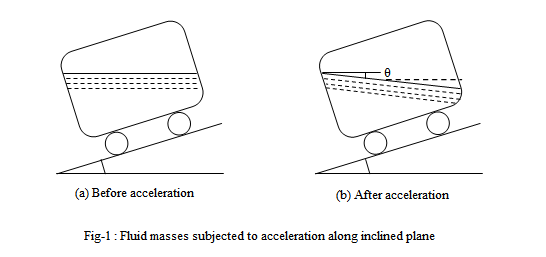
We know that when the tank starts moving, the liquid surface falls down on the front side and rises up on the back side of the tank as shown in fig-1(b).
Let,
= Inclination of the plane with the horizontal
= Angle, which the liquid surface makes with the horizontal, and
= Acceleration of the tank
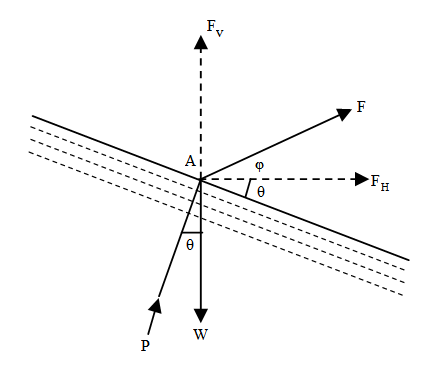
Now consider any particle A on the liquid surface. We know that the forces acting on the liquid particle are :
1. Weight of the particle (W) acting vertically down.
2. Accelerating force (F) on an angle with the horizontal.
3. Pressure (P) exerted by the liquid particles normal to the free surface.
Now resolving the accelerating force (F) horizontally and vertically, we get
and
We know that the weight of the particle,
Similarly, the accelerating force,
Now resolving all the forces horizontally at A,
And resolving all the forces vertically at A,
Dividing equation (#1) by (#2)
where,
- a\_H = horizontal component of the acceleration
- a\_V = vertical component of the acceleration
Example 1 [metric]
A rectangular box containing water is accelerated at 3m/s\^2 upwards on an inclined plane 30 degree to the horizontal. Find the slope of the free liquid surface.
Given,
Let, = Angle which the water surface will make with the horizontal.
Horizontal component of the acceleration,
vertical component of the acceleration,
Slope of the free liquid surface =