
FUNCTION
hm_cylinder
Computes the temperature inside a thin homogeneous cylindrical wall.
Interface
#include <codecogs/engineering/thermodynamics/conduction/hm_cylinder.h>
using namespace Engineering::Thermodynamics::Conduction;
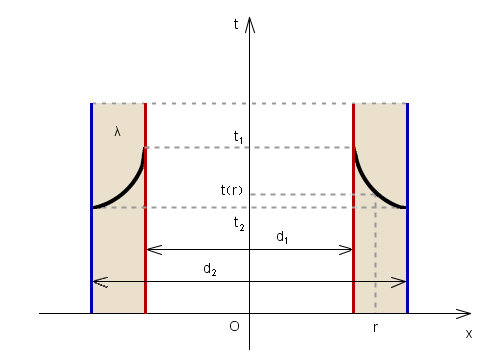
Consider the case of a thin homogeneous cylindrical wall with internal diameter , external diameter
, length
, satisfying the inequalities:
and having constant thermal conductivity at any of its points.
The conductive heat flow may be thought of as radial, thus by the law of conduction we have the following equation using cylindrical coordinates:
where a is the thermal diffusivity and r, z, are cylindrical coordinates.
For a radial heat flow and considering the x-axis along the length of the wall, the next equalities hold:
Hence it is true that:
which by integration and considering appropriate limit conditions, gives the formula for the temperature inside the cylindrical wall at a radius of r:
In the diagram below the value of the function is shown for a particular value of
.
Example 1
#include <codecogs/engineering/heat_transfer/conduction/hm_cylinder.h>
#include <stdio.h>

int main()
{
  // input data
  double r = 0.28, d1 = 0.5, d2 = 0.6,
        t1 = 45.7, t2 = 20.8;

  // display the various input data
  printf("Input data:\n\n");
  printf(" r = %.2lf\n", r);
  printf("d1 = %.2lf\nd2 = %.2lf\n", d1, d2);
  printf("t1 = %.2lf\nt2 = %.2lf\n\n", t1, t2);

  // compute the temperature inside the cylindrical wall
  double t = Engineering::Heat_Transfer::Conduction::hm_cylinder
  (r, d1, d2, t1, t2);

  // display the result
  printf("The temperature inside the cylindrical wall is:\n\n");
  printf("%.10lf\n\n", t);

  return 0;
}
Output:
Input data:

 r = 0.28
d1 = 0.50
d2 = 0.60
t1 = 45.70
t2 = 20.80

The temperature inside the cylindrical wall is:

30.2224870072
Parameters
Returns
The following inequalities must always hold when passing various values to the function:
References
Dan Stefanescu, Mircea Marinescu - "Termotehnica"
Interactive Calculator
Computing…
Set a range above first to export a graph.