
FUNCTION
nhm_sphere
Computes the temperatures at contact surfaces between the layers of a spherical non-homogeneous wall.
Interface
#include <codecogs/engineering/thermodynamics/conduction/nhm_sphere.h>
using namespace Engineering::Thermodynamics::Conduction;
For a spherical non-homogeneous wall, formed by n layers of various diameters and thermal conductivities
the total conductive heat flow is unidirectional and is given by the following formula:
where is the internal diameter of the spherical wall.
It is assumed that the <i>i</i>-th layer has constant thermal conductivity at any of its points.
The temperature at the contact surface between layer and layer
will be denoted by
, for any value of
between 1 and
. The value of these temperatures are obtained by considering the following equality relation between the total conductive heat flows which pass through each layer and the value of
given above:
where:
Hence we obtain the following formula:
In the diagram below you may notice the temperatures which decrease while the heat flow passes through layers of increasing diameters and various thermal conductivities.
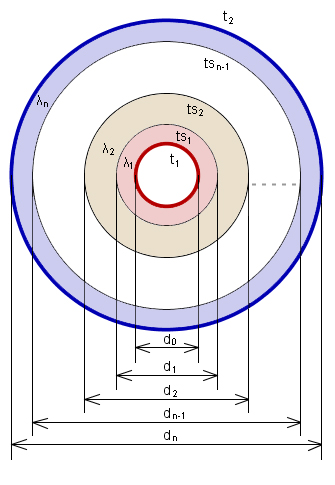
Example 1
#include <codecogs/engineering/heat_transfer/conduction/nhm_sphere.h>
#include <stdio.h>

int main()
{
  // input data
  int n = 4;
  double t1 = 75.0, t2 = 20.0,
  d[5] = {0.1, 0.15, 0.2,  0.25, 0.35},
  lambda[4] = {0.75, 0.95, 1.2,  1.0};

  // display the various input data
  printf("Input values:\n\n");
  printf(" n = %d\nt1 = %.2lf\nt2 = %.2lf\n\n", n, t1, t2);
  printf("diameters:\n(");
  int i;
  for (i = 0; i < n; i++)
    printf("%.2lf, ", d[i]);
  printf("%.2lf)\n\n", d[n]);
  printf("lambda:\n(");
  for (i = 0; i < n - 1; i++)
    printf("%.2lf, ", lambda[i]);
  printf("%.2lf)\n\n", lambda[n - 1]);

  // compute the temperatures at the contact surfaces between all layers
  std::vector<double> result =
  Engineering::Heat_Transfer::Conduction::nhm_sphere
  (4, t1, t2, d, lambda);

  // display the results
  printf("\nThe temperatures at contact surfaces between layers are:\n\n");
  printf("(");
  for (i = 0; i < result.size() - 1; i++)
    printf("%.5lf, ", result[i]);
  printf("%.5lf)\n\n", result[result.size() - 1]);

  return 0;
}
Output
Input values:

 n = 4
t1 = 75.00
t2 = 20.00

diameters:
(0.10, 0.15, 0.20, 0.25, 0.35)

lambda:
(0.75, 0.95, 1.20, 1.00)


The temperatures at contact surfaces between layers are:

(45.09862, 33.29544, 27.68893)
Parameters
Returns
The inequality must always hold when passing values to the function. Also the diameters array must be given in increasing order, thus:
References
Dan Stefanescu, Mircea Marinescu - "Termotehnica"