
FUNCTION
Covariance
Calculates the covariance of a given set of data
Interface
#include <codecogs/statistics/moments/covariance.h>
using namespace Statistics::Moments;
The covariance of two random variables and
with mean
and
respectively is defined as
The covariance of a random variable with itself is simply the variance
Covariance captures a measure of the correlation of two variables.
Positive covariance indicates that as increases, so does
. Negative covariance indicates
decreases as
increases and vice versa. Zero covariance can indicate that
and
are uncorrelated. Covariance is defined as:
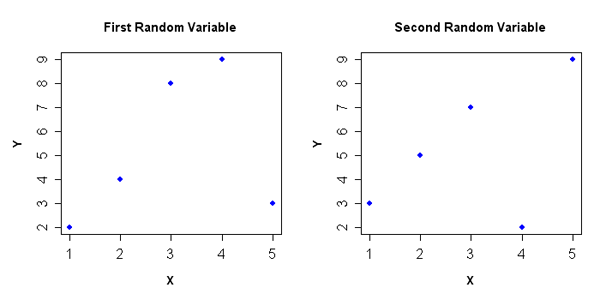
In the example below the covariance of two random variables is calculated, yielding the result: <em> -1.64 </em>. These two variables are also displayed in the following graphs.
Example 1
#include <codecogs/statistics/moments/covariance.h>
#include <iostream>
int main()
 {
  int x[5] = {2 , 4 , 8 , 9 , 3};
  int y[5] = {3 , 5 , 7 , 2 , 9};
  double cov = Stats::Moments::covariance<int>(5, x , y);
  std::cout << "The covariance of x and y is: " << cov << std::endl;
  return 0;
}
Output:
The covariance of x and y is: -1.64