
Vector
Dynamically allocates a 1D block (vector) of data.
Interface
#include <codecogs/computing/array/vector.h>
using namespace Computing::Array;
Overview
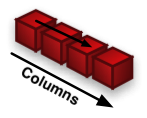
Dynamically allocates a zero-based 1D block of memory. This memory block is continuous.
The more traditional equivalent of this function is simply <tt>new</tt>, for example:
char* a=vector<char>(11);is nearly (see code) identical to:
char* a=new char[11];You may use <em> free_vector </em> with default argment to deallocate memory allocated to this structure, alternatively you can use the more traditional C++ approach: <tt>delete[](..)</tt>
Parameters
FUNCTION
vector
Dynamically allocates a 1D block of memory, to contain components within the specifed range (inclusive). This memory block is continuous.
Example 1
#include <codecogs/array/vector.h>

int main()
{
double *a = Array::vector<double>(1,10);
a[1]=23.4;
a[10]=56.7;
Array::free_vector(a, 1);
int *b = Array::vector<int>(20,30);
b[20]=4;
b[30]=5;
Array::free_vector(b, 20);
return 0;
}
You must use <em> free_vector </em> to deallocate memory allocated to this structure.
Parameters
FUNCTION
free_vector
Removes any dynamically allocated memory from the stack. Can be used on virtually any 1D array. This function is provided for completeness, but is identical to <tt>delete[](...)</tt>. We recomend you use delete is most situations.
The opposite of this function is <em> vector </em>