
Recover Password

Or login with:

  • Facebookhttp://facebook.com/
  • Googlehttps://www.google.com/accounts/o8/id
  • Yahoohttp://yahoo.com/

Rotating Discs and Cylinders

The Stresses and Strains generated in a rotating disc or cylinder
+ View other versions (4)

Discs Of Uniform Thickness.

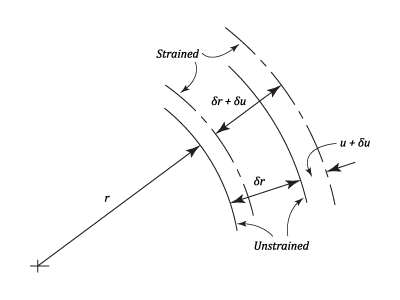
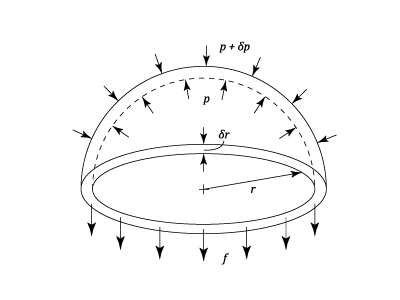
For a "thin" disc it can be assumed that the Stress in the Axial direction is zero. Due to the rotation of the disc, Circumferential \displaystyle f (Hoop) and radial \displaystyle p Stresses will occur. Both these Stresses are Tensile. If the radial shift at a radius r is u, then the Strain Equations are:

Differentiating equation (2) and equating it to equation (1) gives:

23287/Rotating-Discs-and-Cylinders-3-0001.png
+

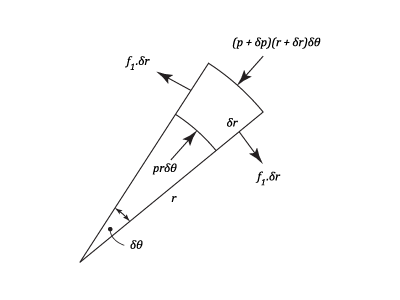
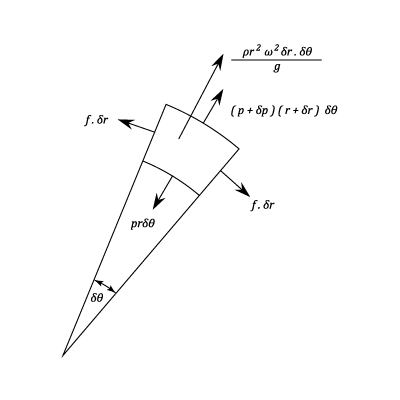
If the angular velocity of rotation is \displaystyle \omega and the density of the disc material is \displaystyle \rho then the element shown in the diagram is subjected to a centrifugal force which:

Which for unit thickness:

The equilibrium equation in the radial direction is:

In the limit this equation reduces to:

From equation (8) obtain \displaystyle f - p and substitute into equation (3)

Rearranging

Integrating:

Subtracting equation (8)

Integrating:

Substituting from equation (11)

A Solid Disc

Since the Stresses can no be infinite at the centre of a solid Disc B must be zero.

If R is the outside radius of the disc then rewriting equations (14) and (15) then:

From Which:

At the centre r = 0 and so:

This is the Maximum Stress.

At the outside :

23287/Rotating-Discs-and-Cylinders-3-0002.png
+

For a value of \displaystyle \frac{1}{m} = 0.3

And at the outside:

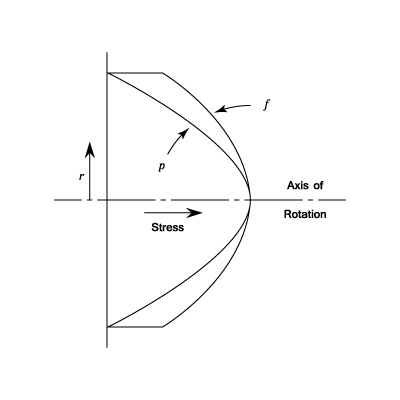
The variations of the Hoop and Radial Stresses with Radius are shown on the diagram.

A Disc With A Central Hole

The Radial Stress is Zero at both the inner and outer radii. If the value of these is \displaystyle R_1\;\;and\;\;R_2 then using equation (14)

Solving the above two equations for A and B:

Substituting from equation(15)

p is a maximum when \displaystyle r = \sqrt{R_1\,R_2}

Note that if \displaystyle R_1 is very small \displaystyle \hat{f}\rightarrow \left(3 + \frac{1 } {m} \right)\left(\frac{\rho \;\omega ^2\;R_2^2}{4g} \right) which is tweiew the value which would be found in a solid disc.

At the outside

23287/Rotating-Discs-and-Cylinders-4-0003.png
+

As in the case of a thin rotating cylinder. The variations in Stress are shown on the diagram.

Example:
[imperial]
Example - Stress in a hollow uniform disc
Problem
A thin uniform disc of 10 in. diameter with a central hole of 2 in. , runs at 10,000 r.p.m. Calculate the maximum Principal Stress and the maximum Shear Stress in the disc. Take \frac{1}{m}\;\;\;=\;\;0.3\; and Density = 0.28 lb.in.-3
Workings
The maximum Principal Stress will be at the inside and is given by equation (31)

The maximum Shearing Stress at any radius is given by:

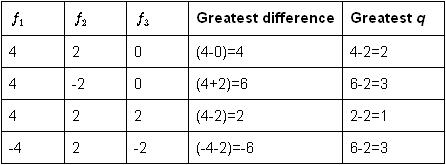
It can be seen from the diagram that the greatest Stress difference occurs at and the Maximum Shearing Stress is:

Solution
The maximum Principal Stress = 16,500 lb.in-2

The maximum Shear Stress = 8250 lb.in.-2

Long Cylinders

Assume that the Longitudinal Stress is \displaystyle f_1 and that the Longitudinal Strain e is constant. i.e. the cross sections remain plane which must be true away from the ends. The analysis is similar that used for a rotating disc and the Strain Equations are:

Using Equations (40) and (41) eliminate \displaystyle \frac{du}{dr}

From Equation (41)

From Equation (40)

Substituting \displaystyle \frac{df_1}{dr} = \left(\frac{1}{m} \right)\left(\frac{df}{dr} + \frac{dp}{dr} \right) which was obtained from equation (39)

The equilibrium equation is as equation (8) and subtracting equation (46) we get.

Integrating:

This can be compared to equation (11) which is for a thin disc. It can be seen that the result for a long cylinder can be obtained from those for a thin disc by writing \displaystyle \frac{1}{1 - \frac{1}{m}}\;instead\;of\;1 + \frac{1}{m}

Solid Cylinder

The maximum Stress occcurs at the centre where p and f are equal

( This compares with \displaystyle 0.41\times\frac{\rho \times \omega ^2\times R^2}{8g} for a solid disc)

Hollow Cylinder

\displaystyle \hat{p} = \left(\frac{3 - \frac{2}{m}}{1 - \frac{1}{m}} \right)\times \frac{\rho \times \omega ^2}{8g}\times\left(R_2 - R_1 \right)^2

\displaystyle \hat{f} = \frac{\rho \times \omega ^2}{4g\left(1 - \frac{1}{m} \right)}\left[\left(1 - \frac{2}{m}\right)R_1^2 + \left(3 - \frac{2}{m} \right) R_2^2 \right]

These values do not differ greatly from those for a thin disc.

A Disc Of Uniform Strength

Consider the condition of equal stress at all radii. i.e. \displaystyle p = f = Constant

23287/Rotating-Discs-and-Cylinders-5.png
+

Le \displaystyle t be the thickness of the disc at a radius \displaystyle r and

assume that the thickness will be \displaystyle t + \delta t at radius \displaystyle r + \delta r

The mass of the element will be approximately

And the centrifugal Force will:

Hence the equilibrium Equation is:

Which in the limit is:

Integrating:

Example:
Example - A Disc Of Uniform Strength
Problem
A Turbine rotor Disc is 24 in. Diameter at the blade ring and is keyed to a 2 in diameter shaft. If the minimum thickness is 3/8 in. what should be the thickness at the shaft for a uniform stress of 30,000 lb./in2. aqt 10,000 r.p.m.? Density of material = 0.28 lb./in3.
Workings
Solution
The required thickness = 2.5 inches
 

Page Comments


     Format Excel Equations

      You must login to leave a messge