
Submerged Orifice
Discharge through a submerged orifice
Discharge through a wholly drowned orifice
When the outlet side of an orifice is beneath the surface of liquid it is known as a wholly submerged orifice as shown in fig.1. In such orifices, the coefficient of contraction is equal to one.
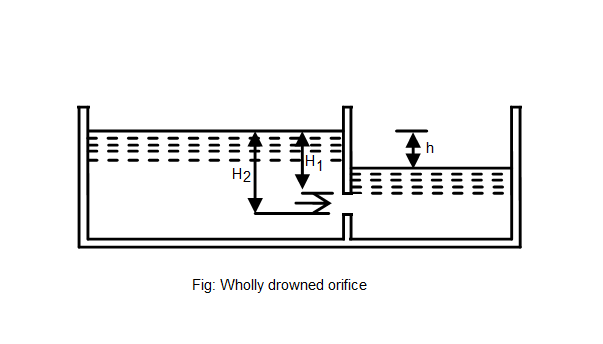
Consider a wholly drowned orifice discharging water as shown in fig.1.
Let,
- $H_{1}$ = Height of water (on the upstream side) above the top of the orifice
- $H_{2}$ = Height of water (on the upstream side) above the bottom of the orifice
- $h$ = Difference between the two water levels on either side of the orifice
- $C_{d}$ = Coefficient of discharge
- $C_{v}$ = Coefficient of velocity
- $C_{c}$ = Coefficient of contraction
$\therefore$ Area of orifice = $b(H_{2}-H_{1})$
We know that the theoretical velocity of water through the strip = $\sqrt {2gh}$
$\therefore$ Actual velocity of water = $C_{v}\sqrt {2gh}$
From the relation of hydraulic coefficients we know that, $C_{d} = C_{v}\times C_{c}$
Since coefficient of contraction is 1 in this case, therefore $C_{d} = C_{v}$
$\therefore$ Actual velocity of water = $C_{d}\sqrt {2gh}$
Now the discharge through the orifice,
$Q$ = Area of orifice $\times$ Actual velocity
$\Rightarrow Q = b(H_{2}-H_{1}) \times C_{d}\sqrt {2gh}$
$\therefore Q = C_{d}.b(H_{2}-H_{1}) \times \sqrt {2gh}$
If depth of the drowned orifice (d) is given instead of $H_{1}$ and $H_{2}$, then in such cases the discharge through the wholly drowned orifice is:
Example 1 [metric]
A drowned orifice 1.5m wide and 0.5m deep is provided in one side of a tank. Find the discharge in liters/s through the orifice, if the difference of water levels on both the sides of the orifice be 4m. Take $C_{d}$ = 0.64.
Given,
- $b$ = 1.5m
- $d$ = 0.5m
- $h$ = 4m
- $C_{d}$ = 0.64
$\therefore$ Q = C_{d}.b.d \sqrt {2gh}$ $= 0.64 \times 1.5 \times 0.5 \times \sqrt {2\times 9.84 \times 4}$ $= 0.48 \times 8.859$ $= 4.25m^3 /s = 4250 liters/s$
Discharge = 4250 liters/s