
Submerged Orifice
Discharge through a submerged orifice
You're viewing an older version of this page (#4196). View the current version.
Discharge through a wholly drowned orifice
When the outlet side of an orifice is beneath the surface of liquid it is known as a wholly submerged orifice as shown in fig.1. In such orifices, the coefficient of contraction is equal to one.
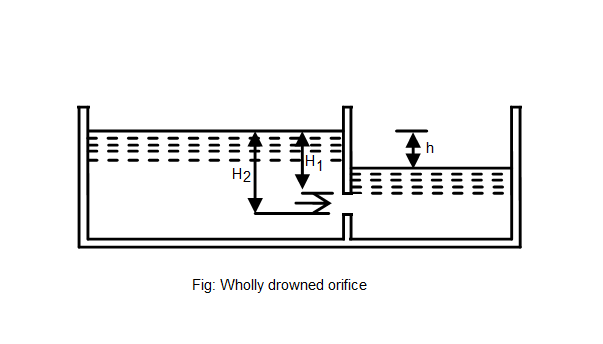
Consider a wholly drowned orifice discharging water as shown in fig.1.
Let,
= Height of water (on the upstream side) above the top of the orifice
= Height of water (on the upstream side) above the bottom of the orifice
= Difference between the two water levels on either side of the orifice
= Coefficient of discharge
= Coefficient of velocity
= Coefficient of contraction
Area of orifice =
We know that the theoretical velocity of water through the strip =
Actual velocity of water =
From the relation of hydraulic coefficients we know that,
Since coefficient of contraction is 1 in this case, therefore
Actual velocity of water =
Now the discharge through the orifice,
= Area of orifice
Actual velocity
If depth of the drowned orifice (d) is given instead of and
, then in such cases the discharge through the wholly drowned orifice is:
Example 1 [metric]
A drowned orifice 1.5m wide and 0.5m deep is provided in one side of a tank. Find the discharge in liters/s through the orifice, if the difference of water levels on both the sides of the orifice be 4m. Take = 0.64.
Given,
= 1.5m
= 0.5m
Discharge = 4250 liters/s