
Pipe Head Loss
The pressure head lost due to flow through pipes and other losses.
In general the flow of liquid along a pipe can be determined by the use of The Bernoulli Equation and the Continuity Equation. The former represents the conservation of energy, which in Newtonian fluids is either potential or kinetic energy, and the latter ensures that what goes into one end of a pipe must comes out at the other end. However as the flow moves down the pipe, losses due to friction between the moving liquid and the walls of pipe cause the pressure within the pipe to reduce with distance - this is known as head loss.
Note: Only Incompressible liquids are being considered.
Head Lost due to Friction in the Pipe
Two equations can be used when the flow is either Laminar or Turbulent. These are:
Darcy's Equation for Round Pipes
For Round Pipes:
where
- $h_f$ is the head loss due to friction [m]
- $l$ is the length of the pipe [m],
- $d$ is the hydraulic diameter of the pipe. For circular sections this equals the internal diameter of the pipe [m].
- $v$ is the velocity within the pipe [$m/s$]
- $g$ is the acceleration due to gravity
- $f$ is the coefficient of friction.
This equation can be expressed in terms of the quantity flowing per second. $h_f=\frac{4flv^2}{2g\;d}=\frac{4fl}{2g\;d}\times \left ( \frac{4Q}{\pi d^2} \right )^2$
Darcy's Equation for Non Circular Pipes
where $m=$ wetted area / wetted perimeter (the hydraulic mean depth)
The Chezy Equation
where
- $i$ is $\frac{h_f}{l}$
- $m$ is $\frac{A}{P}$, i.e. the wetted area divided by the wetted perimeter (the hydraulic mean depth)
and $C=\sqrt{\frac{2g}{f}}$
Reynolds number
$R_N=\frac{Density \times\,Velocity\times\,Diam. \,of\,pipe}{Viscosity}$
Which equals 2,300 at the point where the flow changes from Laminar to Turbulent. This is known as the Critical Velocity
If $Ln$ $hf$ is plotted against $Ln$ $v$
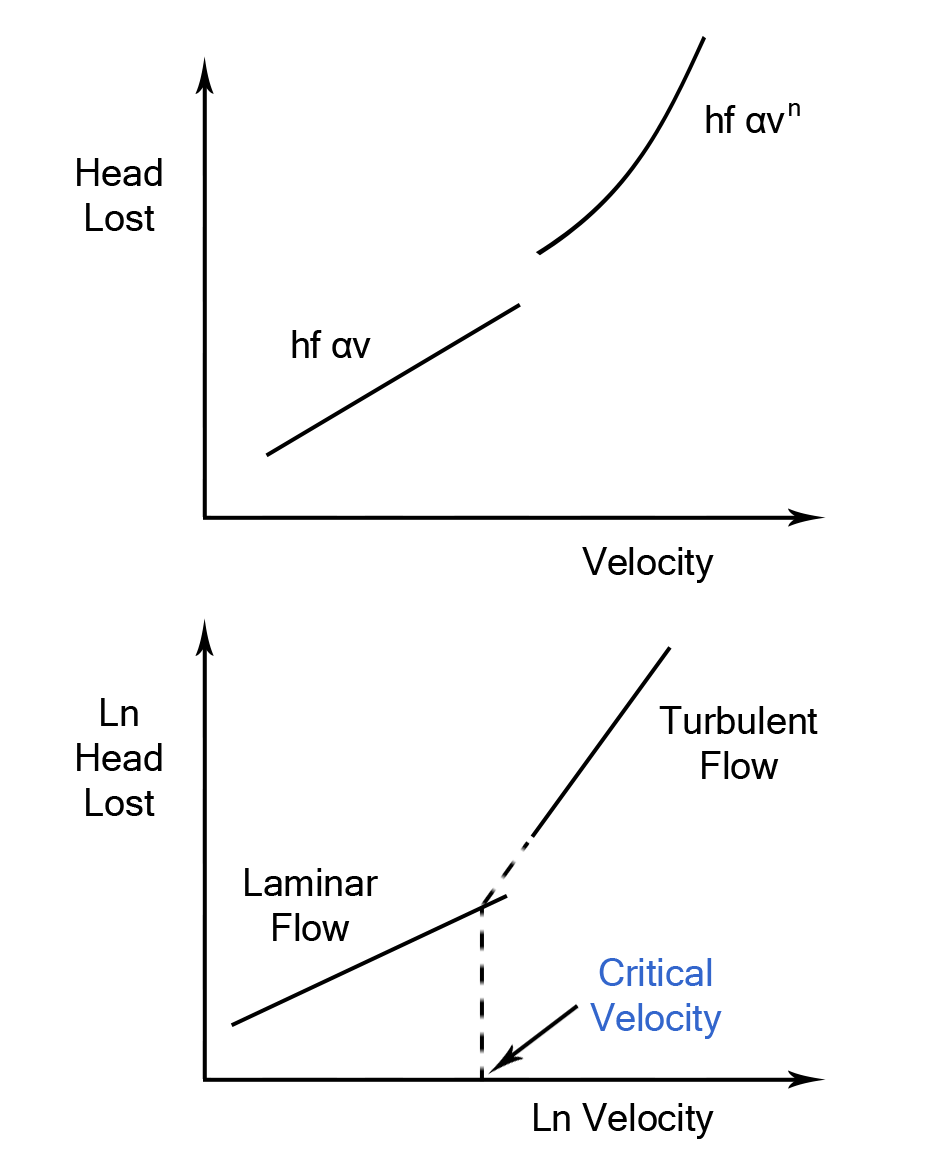
The critical velocity is the velocity at which the change over from laminar to turbulent flow takes place.
Consider a circular pipe running full
$V = C\:\sqrt[]{m\:i}$ $\therefore\;\;\;V^2\;=\:\frac{2g}{f}\:\:\frac{A}{P}\:\;\frac{h}{l}$ $\therefore\;\;\;h\:= f\;\frac{P\:L}{A}\:.\:\frac{V^2}{2g}$ $\therefore\;\;\;h = f\;\frac{\pi\,d\,l}{\pi\,\displaystyle\frac{d^2}{4}}\;.\;\frac{V^2}{2g}$
Which can be written as The DARCY EQUATION
i.e. Head lost $= 4\:f\frac{l\:V^2}{2\:d\,g}$
Note: $f$ in the Darcy formula is not an empirical coefficient
For Laminar flow $f\:=\:\frac{16}{R}$ The change over from laminar flow to turbulent flow occurs when $R$ = 2300 and is independent of whether the pipe walls are smooth or rough.
Laminar Flow
When the flow is laminar it is possible to use the following equation to find the head lost.
The Poiseuille equation states that for a round pipe the head lost due to friction is given by:
$h_F=\frac{32\times \mu\;l\;v}{\rho\;g\;d^2}$
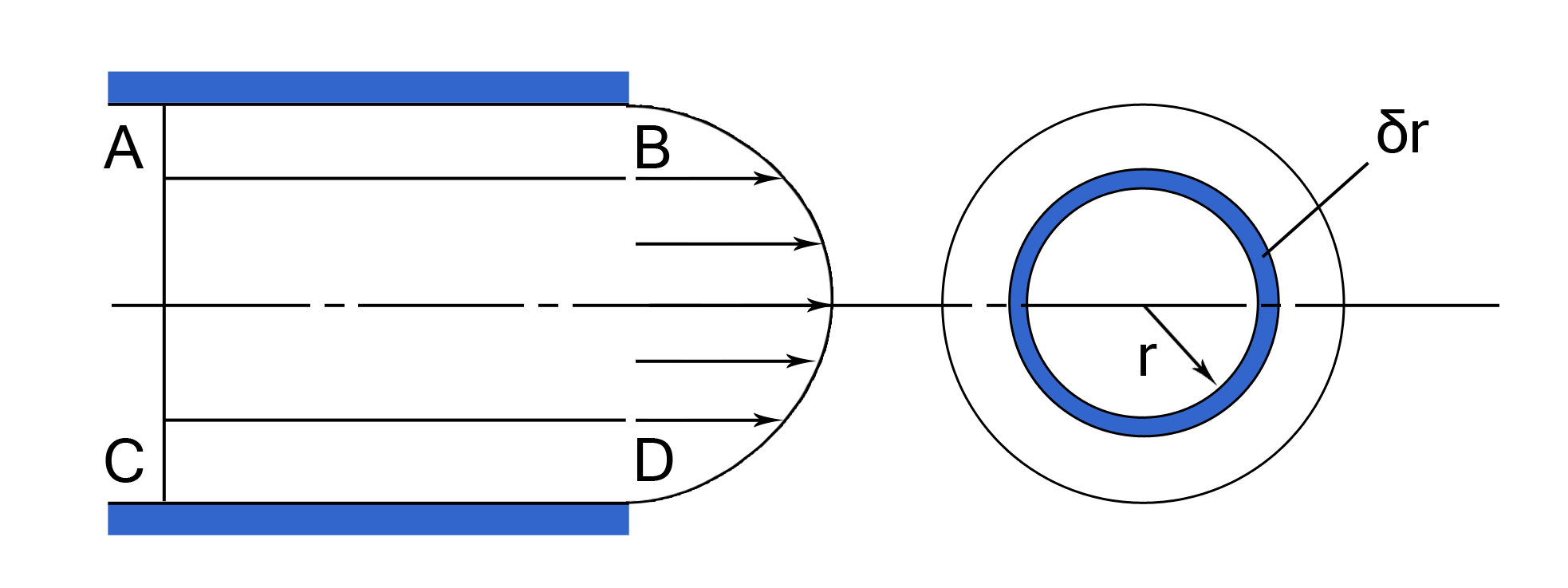
Flow occurs because the force across $AB$ is more than that on $AB$ and hence it is possible to write down the following equation.
$(P_1-P_2)\times \pi\; r^2=-\mu\;\frac{dv}{dr}\times 2\pi r l$
Integrating $-\left [ v \right ]_{v_r}^{v_0}=\left ( \frac{P_1-P_2}{l} \right )\left [ \frac{r^2}{4\mu} \right ]_{r_0}^{r_1}$ $\therefore \;\;\;\;\;v_r=v_0-\left ( \frac{P_1-P_2}{l} \right )\frac{r^2}{4\mu}$
But when $r=\frac{d}{2}\;\;v=0$
$\therefore \;\;\;\;\;v_0=\left ( \frac{P_1-P_2}{l} \right )\frac{d^2}{16\mu}$ $\therefore \;\;\;\;\;v_r=\left ( \frac{P_1-P_2}{l} \right )\frac{d^2}{16\mu}-\left ( \frac{p_1-p_2}{l} \right )\frac{r^2}{4\mu}$ Thus: $v_r=\frac{p_1-p_2}{l}\times \left ( \frac{d^2}{16\mu}-\frac{r^2}{4\mu} \right )$
But: $Q=\int_{0}^{\frac{d}{2}}v_r\times 2\pi\; r\;dr$
$\therefore \;\;\;\;\;\;Q=\int_{0}^{\frac{d}{2}}\frac{P_1-P_2}{l}\times \left ( \frac{d^2}{16\mu}-\frac{r^2}{4\mu} \right )\times 2\pi\; r\; dr$
$=\frac{p_1-p_2}{l}\times \frac{2\pi}{4\mu}\int_{0}^{\frac{d}{2}}\left ( \frac{d^2}{4}-r^2 \right )r\;dr$ $=\frac{p_1-p_2}{l}\times \frac{2\pi}{4\mu}\left [ \frac{d^2}{4}.\frac{r^2}{2}-\frac{r^4}{4} \right ] _{0}^{\frac{d}{2}}$ $=\frac{p_1-p_2}{l}\times \frac{2\pi}{4\mu}\times \frac{1}{4}\left [ \frac{d^4}{8}-\frac{d^4}{16} \right ]$ $=\frac{p_1-p_2}{l}\times \frac{2\pi}{4\mu}\times \frac{1}{4}\times \frac{d^4}{16}$
Now the mean velocity is given by:- $v_m=\frac{Q}{\pi\;d^2/4}$ $=\frac{p_1-p_2}{l}\times \frac{\pi\;d^4}{128\mu}\times \frac{4}{\pi\;d^2}$
From equation (4)
The head lost due to friction is given by:
$h_f=\left ( \frac{p_1-p_2}{\omega} \right )=\frac{p_1-p_2}{\rho\;g}$
Substituting from equation (6) for $P_1-P_2$
$h_f=\frac{32\;\mu\;l\;v}{\rho\;g\;d^2}$
Example 1 [imperial]
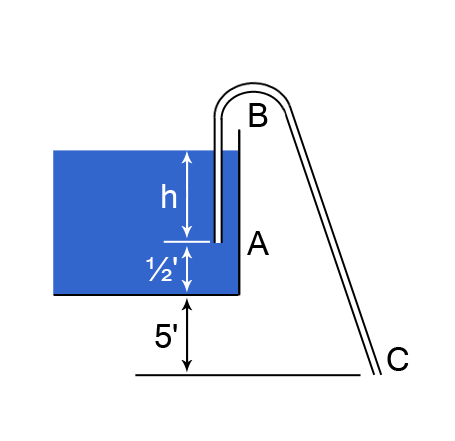
Water is siphoned out of a tank by means of a bent pipe $ABC$, 80 ft. long and 1 in. in diameter. $A$ is below the water surface and 6 in . above the base sof the tank. $AB$ is vertical and 30 ft long; $BS$ is 50 ft. long with the discharge end $C$ 5ft. below the base of the tank.
If the barometer is 34 ft. of water and the siphon action at $B$ ceases when the absolute pressure is 6 ft. of water, find the depth of water in the tank when the siphon action ceases. $F$ is 0.008 and the loss of head at entry to the pipe is:
$=0.5\frac{v^2}{2g}$
Where $v$ is the velocity of water in the pipe.
Bernoulli'\b{s Equation} is:
$\frac{p_1}{w}+\frac{v_1^2}{2g}+Z_1=\frac{p_2}{w}+\frac{v_2^2}{2g}+Z_2+L$ where $L=$Losses
Applying Bernoulli for the pipe length $AB$. Note that the pressures quoted in the question have been expressed in ft. of water and therefore:
Applying Bernoulli for the whole pipe length:
$41\displaystyle\frac{1}{2}-34=\frac{4\times 0.008\times 50\times v^2}{2g\times 1/12}$
From which: $v=5.02\;ft./sec.$ Substituting in equation (7)
$39\displaystyle\frac{1}{2}+h=41\displaystyle\frac{1}{2}+\frac{5.02^2}{2\times 32.2}\left ( 1.5+\frac{120\times 0.008}{1/12} \right )$ $\therefore \;\;\;\;\;\;h=7.6\;ft.$
The depth of water is $h=7.6\;ft.$
Example 2 [imperial]
A pipe 6 in. in diameter and 200 ft. long connects two reservoirs who's constant difference in water level is 20 ft. A horizontal venturi meter having an inlet diameter of 6 in. is halfway along thee pipe and is 9 ft. below the level of the upper reservoir. The discharge coefficient for the venturi is unity and the loss of head in its divergent portion is $\displaystyle\frac{v^2}{2g}$ where $v$ is the velocity of flow through the pipe. The frictional coefficient for the pipe is 0.005.
Flow is controlled by a valve at the outlet end of the pipe and when full open, the loss across the valve is $\displaystyle\frac{9v^2}{2g}$. If under these conditions, the pressure head at the venturi throat must not be less than 8 ft. below atmospheric pressure.
Find:
- a) The minimum allowable throat diameter.
- b) The maximum rate of flow in cusec. ($ft.^3/sec.$)
Neglect loss of head at the pipe entry.
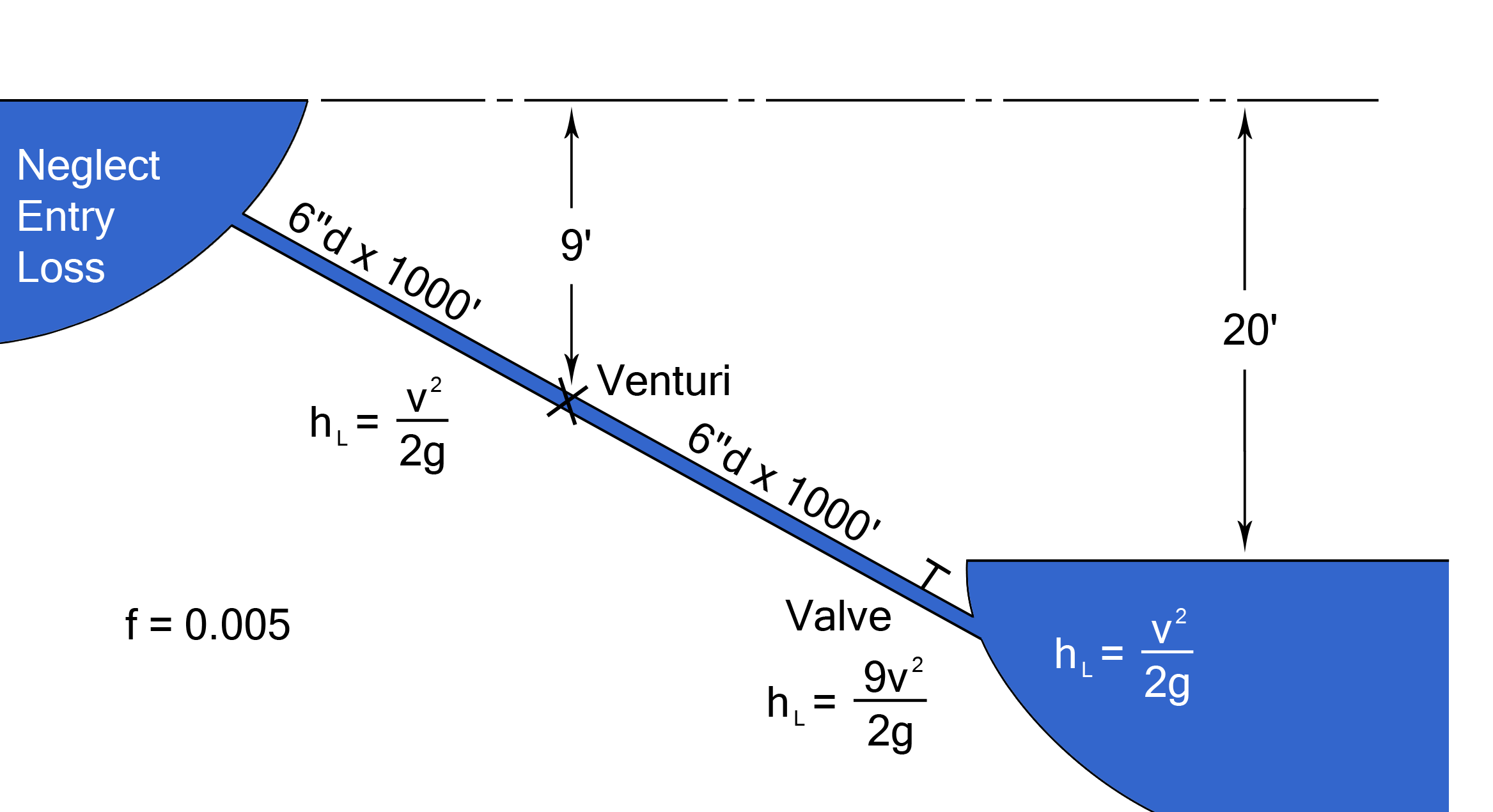
Applying Bernoulli at positions 1 and the venturi throat.
Note. The head lost due to pipe friction is obtained from the Darcy Equation (3)
$9=-8+\frac{V{_{T}}^{2}}{2g}+0+\frac{4\times 0.005\times 1000\times V^2}{2\times \displaystyle\frac{6}{12}\times g}$
Applying Bernoulli between 1 and 2
The total head lost between the two reservoirs is 20 ft.
Applying Bernoulli between 1 and 2
The total head lost must equal the frictional loss in the pipe + the loss in the venturi meter + the loss in the valve + the exit loss from the pipe.
Thus: $20=\frac{4\times 0.005\times 2000\times V^2}{2\times \displaystyle\frac{6}{12}\times g}+\frac{V^2}{2g}+\frac{9V^2}{2g}+\frac{V^2}{2g}$ $\therefore \;\;\;\;\;20=\frac{91\times V^2}{2g}$
Substituting equation (10) in (9)
$V_T=23\;ft./sec$
Using the continuity equation:
$V\times \frac{\pi}{4}\times \left ( \frac{6}{12} \right )^2=V_T\times \frac{\pi}{4}\times\left ( \frac{d_T}{12} \right )^2$
Substituting in the value for $d_T$ the diameter of the venturi throat of 2.43 in.
The volume of water flowing down the pipe $Q$, is given by:
$Q=\frac{\pi}{4}\times \left ( \frac{6}{12} \right )^2\times 3.76=0.74\;ft.^3/sec.$
- The diameter is $2.43 in.$
- The maximum rate of flow is $0.74\;ft.^3/sec.$
Example 3 [imperial]
Two tanks $A$ and $B$ are connected by a pipe 100 ft. long. The first 70 ft. has a diameter of 3 in. and then it is suddenly reduced to 2 in. for the next 30 ft. The distance of levels between the tanks is constant at 8 ft. $f$ for both pipes is 0.005 and the contraction coefficient at the sudden change in area is 0.58.
Find all the losses of head, including that at the sharp edged pipe entry from $A$ in terms of the velocity $V_2$ and at the exit of the 2 in. pipe and hence find the flow in gallons per min.
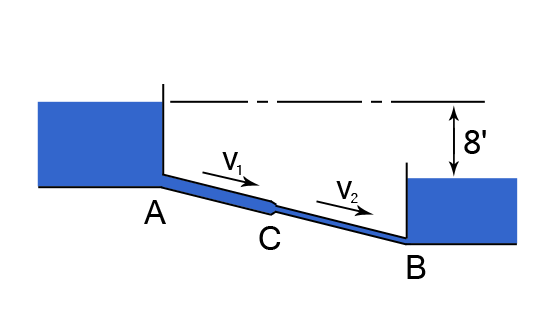
Using the rule on continuity:
$a_1v_1=a_2v_2$ $\therefore \;\;\;\;\;v_1=\frac{2^2}{3^2}v^2$ Or: $v_1^2=0.197v_2^2$
Using Darcy'\b{s Equation} for the friction loss along the pipe $AC$: $h_l=\frac{4\times 0.005\times 70}{\displaystyle\frac{3}{12}}\times\frac{ v{_{1}}^{2}}{2\times g}=\frac{1.4}{0.25}\times \frac{{v_{1}}^{2}}{2g}$
Expressing the above in terms of $v_2$ :
$h_l=\frac{1.4}{0.25}\times 0.197\times \frac{{v_{2}}^{2}}{2g}\;ft.$
Thus head lost $=\frac{1.4}{0.25}\times 0.197\times \frac{{v_{2}}^{2}}{2g}=1.103\frac{{v_{2}}^{2}}{2g}\;ft.$
Using Darcy'\b{s Equation} for the friction loss along the pipe $CB$:
$h_l=\frac{4\times 0.005\times 30}{\displaystyle\frac{2}{12}}\times\frac{ v{_{2}}^{2}}{2\times g}$
$h_l=3.6\times \frac{{v_{2}}^{2}}{2g}\;ft.$
Using equation (7) the head loss at the entry to pipe $A$:
$h_l=\left ( \frac{1}{C_C}-1 \right )^2\;\;\frac{v_{1}^{2}}{2g}=\left ( \frac{1}{0.58}-1 \right )^2\;\;\frac{{v_{1}}^{2}}{2g}$ $=0.52\times\frac{{v_{1}}^{2}}{2g}=0.52\times 0.197\frac{{v_{2}}^{2}}{2g}=0.103\;\frac{{v_{2}}^{2}}{2g}\;ft.$
Similarly the loss at the sudden contraction at $C$ :
$=0.52\;\frac{{v_{2}}^{2}}{2g}\;ft.$
The loss at the end of the pipe at $B$ can be found from equation (6) :
$h_L=\frac{(v_2-0)^2}{2g}\;ft.$
Hence the total loss, which must equal 8 ft (From Bernoulli) equals the total losses i.e.
$8=(1.103+3.6+0.103+0.52+1.0)\;\frac{{v_{2}}^{2}}{2g}$
From which:
$V_2=9.02\;ft./sec.$
The flow through the pipe is given by:
$\frac{\pi}{4}\times \left ( \frac{2}{12} \right )^2\times 9.02=0.197\;ft.^3/sec.$ $=0.197\times 62.4\;lb./sec.=0.197\times 62.4\times 60\;lb.\min=73.8\;gallons/min.$ Note: 1 cubic foot of water weighs 62.4 lbs and 1 UK gallon weighs 10 lbs.
- The total loss is $8=(1.103+3.6+0.103+0.52+1.0)\;\frac{{v_{2}}^{2}}{2g}$
- The flow is $73.8\;gallons/min.$
Please note that further worked examples on this topic will be found in the paper on "Hydraulic Gradients"