
Macaulay Method
A beam is a horizontal structural element that is capable of withstanding load primarily by resisting bending. The bending force induced into the material of the beam as a result of the external loads, own weight, span and external reactions to these loads is called a bending moment.
Describes the Macaulay Method for calculating the deflection of Beams.
Macaulay's Method - Introduction
Definition
Macaulay'\b{s method} (The double integration method) is a technique used in structural analysis to determine the deflection of Euler-Bernoulli beams. Use of Macaulay's technique is very convenient for cases of discontinuous and/or discrete loading.
Using Calculus to find expressions for the deflection of loaded beams (See Deflection of Beams Part 1), it is normally necessary to have a separate expression for the Bending Moment for each section of the beam between adjacent concentrated loads or reactions. Each section will produce its own equation with its own constants of integration. It will be appreciated that in all but the simplest cases the work involved will be laborious; the separate equations being linked together by equating slopes and deflections given by the expressions on either side of each "junction point".
However, a method devised by Macaulay enables one continuous expression for bending moment to be obtained, and provided that certain rules are followed the constants of integration will be the same for all sections of the beam.
It is advisable to deal with each different type of load separately.
Concentrated Loads
Measuring $x$ from one end write down an expression for the Bending Moment in the last section of the beam enclosing all less than $x$ in square brackets, i.e.
$E\,I\,\frac{d^2y}{dx^2} = M = -\,W_1x + R[x - a] - W_2[x - b] - W_3[x - c]$
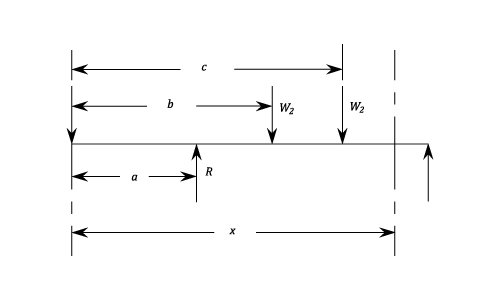
Subject to the condition that all terms for which the quantities in the square brackets are negative are omitted ( i.e. given a value of zero), this equation may be said to represent the bending moment for all values of $x$. If $x$ is less than $b$ then both the last two terms are omitted and so on.
The brackets are integrated as a whole, i.e.
$E\,I\,\frac{dy}{dx} = -\,W_1\frac{x^2}{2} + \frac{R}{2}[x - a]^2 - \frac{W_2}{2}[x - b]^2 - \frac{W_3}{2}[x - c]^2 + A$
And, $E\,I\,y = -\,W_1\frac{x^3}{6} + \frac{R}{6}[x - a]^3 - \frac{W_2}{6}[x - b]^3 - \frac{W_3}{6}[x - c]^3\;+Ax + B$
By doing so it can be shown that the constants of integration are common to all sections of the beam, e.g. if $\displaystyle x = b - \Delta$
$E\,I\;\frac{dy}{dx} = -\left(\frac{W_1}{2} \right)(b - \Delta )^2 + \left(\frac{R}{2} \right)(b - \Delta - a)^2 + A$
And, $E\,I\;y = -\left(\frac{W_1}{6} \right)(b - \Delta )^3 + \left(\frac{R}{6} \right)(b - \Delta - a)^3 + A(b - \Delta ) + B$
$E\,I\;\frac{dy}{dx} = -\left(\frac{W_1}{2} \right)(b + \Delta )^2 + \left(\frac{R}{2} \right)(b + \Delta - a)^2\;-\left(\frac{W_2}{2} \right)\Delta ^2+\;A'$
And, $E\,I\;y = -\left(\frac{W_1}{6} \right)(b - \Delta )^3 + \left(\frac{R}{6} \right)(b + \Delta - a)^3\;-\left(\frac{W_2}{6} \right)\Delta ^3+\;A'(b + \Delta ) + B'$
Now as $\displaystyle \Delta \rightarrow 0$ the slope and deflection values must correspond (i.e.) at $x = b$ from which it can be seen that $A = A$' and $B = B$'. The values of $A$ and $B$ are found as before ( Part 1).
Uniformly Distributed Loads.
Supposing that a uniformly distributed load is applied from a distance $a$ to a distance $b$ measured from one end $A$. Then in order to obtain an expression for the Bending Moment at a distance $x$ from the end, which will apply for all values of $x$, it is necessary to continue the loading up to the section at $x$, compensating this with an equal negative load from $b$ to $x$ (see diagram)
Hence, $M = Rx - \displaystyle\frac{w}{2}[x - a]^2 + \displaystyle\frac{w}{2}[x - b]^2$
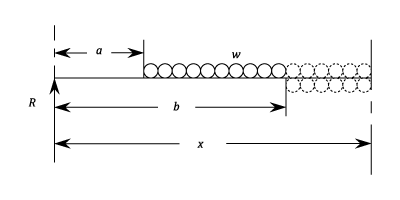
Each length of the loading acts at its centre of gravity. The square brackets are interpreted as before.
For $x>a$ but $<b$, omit $[x - b]$ and:
Hence, $M = Rx - \displaystyle\frac{w}{2}(x - a)^2$
This is clearly correct. The remaining steps of integration are the evaluation of the Constants, and proceeds as before.
Concentrated Bending Moment
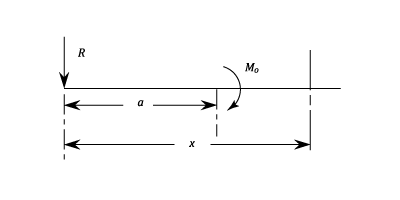
It is possible to write:
$E\,I\,\frac{d^2y}{dx^2} = M = -\,Rx + M_0[x - a]^0$
$E\,I\,\frac{dy}{dx} = -\,R\frac{x^2}{2} + M_0[x - a] + A\;\;\;\;\;\;etc.$
Example 1 [imperial]
A simply supported beam of length $L$ carries a load $W$ at a distance $a$ from one end and $b$ from the one $( a > b)$.
Find the position and magnitude of the maximum deflection and show that the position is always approximately within $\displaystyle\frac{L}{13}$ of the centre.
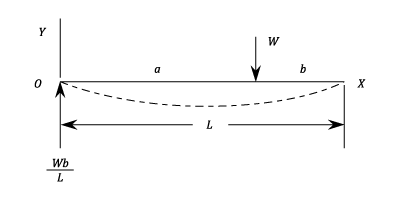
The maximum deflection (i.e.) zero slope will occur on the length a since $a>b$
Taking the axes as shown in the diagram.
$E\,I\,\frac{d^2y}{dx^2} = M = \left(\frac{Wb}{L} \right)\,x - W[x - a]$
Integrating
And Integrating again gives:-
At $x = 0$ and $y = 0$ and therefore $B = 0$.
At $x = 0$, $y = L$
$\therefore\;\;\;\;\;A\,L\;= - \left(\frac{Wb}{L} \right)\left(\frac{L^3}{6} \right) + \left(\frac{W}{6} \right)b^3$
From which: $A\;= - \left(\displaystyle\frac{Wb}{6L} \right)\left(L^2 - b^2 \right)$
We need to find the value of $x$ when $\displaystyle \frac{dy}{dx}$ is zero. Using equation (1) and omitting $[x - a]$ ( We can do this because at zero slope $x < a$ when $a > b$ )
Hence, $\;\;\;\;\;\;x = \sqrt{\left[\displaystyle\frac{L^2 - b^2}{3} \right]}$
At the point of maximum deflection. To find the value of this deflection substitute into equation (2)
$E\,I\,y = \frac{W\,b}{L}\times \frac{(L^2 - b^2)^\frac{3}{2}}{6\times3\;\sqrt{3}} - \frac{W\,b}{6L}\times\frac{(L^2 - b^2)^\frac{3}{2}}{\sqrt{3}}$
$y = -\,\frac{W\,b}{L}\times \frac{(L^2 - b^2)^\frac{3}{2}}{9\;\sqrt{3}\times E\,I\,L}$
Re-writing Equation (3) to obtain the value of $x$ when $\displaystyle\frac{dy}{dx} = 0$ gives:
$x = \sqrt{\left(\frac{L^2 - b^2}{3} \right)}$
This gives the distance from the centre of the beam to be :
Distance from Centre = $\sqrt{\left(\displaystyle\frac{L^2 - b^2}{3} \right)} - \displaystyle\frac{L}{2}$
Which has a maximum value of $\displaystyle\frac{L}{\sqrt{3}} - \displaystyle\frac{L}{2}\;\approx \displaystyle\frac{L}{13}$
- The distance from the centre of the beam is $\displaystyle\frac{L}{\sqrt{3}} - \displaystyle\frac{L}{2}\;\approx \displaystyle\frac{L}{13}$
Example 2 [imperial]
A simply supported beam of 20 ft. span carries two concentrated loads of 4 tons at 8ft. and 10 tons at 12 ft. measured from one end.
Calculate:
- a) The deflection under each load.
- b) The maximum deflection.
$E = 13,200\; tons/in^2$ and $I = 1200\;in^4$
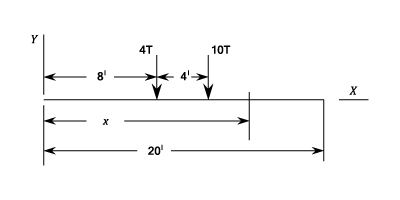
Reaction at $O$ is $\displaystyle\frac{4\times 12 + 10\times 8}{20} = 6.4\;tons$
$E\,I\,\frac{d^2y}{dx^2} = M = 6.4\,x - 4[x - 9] - 10[x - 12]$
Integrating,
Integrating again, $E\,I\,y = \frac{3.2}{3}\,x^3 - \frac{2}{3}[x - 8]^3 - \frac{5}{3}[x - 12]^3 + A\,x + B$
When $x = 0$ and $y = 0$ and therefore $B = 0$
When $x = 20$, $y = 0$
Giving $A = -326.5 tons-ft.sq.$
- a) Under the $4 tons$ load $x = 8 ft$
$\therefore\;\;\;\;\;\;\;E\,I\,y= \frac{3.2}{3}\,8^3\;-326.5\times 8 = -\,2066\;tons-ft^3$
Thus the deflection $y$ is given by:
$y\;= - \displaystyle\frac{2066\times 12^3}{13200\times 1200} = 0.225\;in.$ downwards
Under the $10 tons$ load $x = 12 ft.$
$E\,I\,y = \left(\frac{3.2}{3} \right)\times 12 - \frac{2}{3}\times 4^3 - 326.5\times12 = -\,2118\;tons-ft.$
$y = \displaystyle\frac{2118\times12^3}{13200\times1200} = 0.231\;in.$ downwards
Note. For those not used to the fps system the $\displaystyle 12^3$ is needed to convert from $\displaystyle ft.^3$ to $in.^3$
- b) The maximum deflection can be judged to occur between the loads and we can therefore omit the term in $[x - 12]$ as it will be negative. At the maximum deflection the slope of the beam will be zero and hence using equation (4) and the result from equation (5) we can write
$3.2\,x^2 - 2(x - 8)^2 - 326.5 = 0$
$\therefore\;\;\;\;\;1.2\,x^2 = 32\,x - 454.5 = 0$
Hence, $x = \frac{-32 + \sqrt{32^2 - 4\times 1,2\times 454.5}}{2\times 1.2} = 10.3\;ft.$
Note: This comes between the $4 ton$ and $12 ton$ loads as assumed
Thus the maximum deflection is given by:
$\hat{y} = \frac{\left\{(3.2/3)\times 10.3^3 - (2/3)\times6.3^3 - 326.5\times10.3^3 \right\}12^3}{13200\times 1200}\;=0.258\;in.$
- a) $y= 0.225\;in.$ downwards ; $y= 0.231\;in.$ downwards
- b) The maximum deflection is $0.258\;in.$
Example 3 [imperial]
A cantilever 12 ft. long is supported at its free end by a prop at the same level as at the fixed end. A uniform distributed load of 2 tons/ft. is carried along the middle half of the beam, together with a central load of 5 tons.
Determine the load at the prop and the maximum Bending Moment.
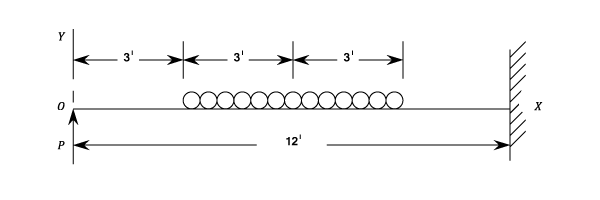
Let $P$ be the load on the prop.
Taking the Prop as the origin:
$E\,I\,\;\frac{d^2y}{dx^2} = Px - \frac{2}{2}[x - 3]^2 + \frac{2}{2}[x - 9]^2 - 5[x - 6]$
$E\,I\,\;\frac{dy}{dx} = P\frac{x^2}{2} - \frac{[x - 3]^3}{3} + \frac{[x - 9]^3}{3} - \frac{5[x - 6]^2}{2} + A$
When $x = 12\;ft.\;\;\;\displaystyle\frac{dy}{dx} = 0$ and $y = 0$
$\therefore\;\;\;\;\;\frac{dy}{dx} = 72P - 243 + 9 - 90 + A = 0$
$y = 0 = 288\,P - 720 + 12\,A + B$
Substituting in the value for $A$
$B = -\,288\,P + 720 - 12\times324 + 12\times 72\,P:=;576\,P - 3168$
But when $x = 0$, $y = 0$ and therefore $B = 0$
$\therefore\;\;\;\;\;\;P = \frac{3168}{576} = 5.5\;tons$
A point of maximum Bending Moment occurs at a value of $x$ giving Zero Shear Force and this will be in the distributed load such that the downwards load equals the load on the prop. ( See " The relations between $w$, $F$ and $M$" in the pages on Shearing Force and Bending Moments)
$x = 3 + \displaystyle\frac{5.5}{2} = 5.75\;ft.$ from the Prop
Where $\;\;\;\;\;M = 5.5\times5.75 - 4\displaystyle\frac{2}{2}(5.75 - 3)^2 = 24.1\;tons-ft.$
Note the fraction $\displaystyle\frac{2}{2}$ is $\displaystyle\frac{w}{2}$ where $w$ is the uniform loading.
Check this result against the value at the built in end.
$M = 5.5\times12 - 1\times(12 - 3)^2 + 1\times (12 - 9)^2\;-5(12 - 6)$
$\therefore\;\;\;\;\;M = 36\;tons-ft$
- The load is $5.75\;ft.$
- The maximum Bending Moment is $M = 36\;tons-ft$