
Belt and Rope Drives Brakes
Power is the rate at which work is done or energy is transferred in relation to time. In calculus terms, power is the derivative of work with respect to time.
An engine or motor is a machine designed to convert energy into useful mechanical motion.
Centrifugal force represents the effects of inertia that arise in connection with rotation and which are experienced as an outward force away from the center of rotation.
A band brake is a brake in which the frictional force is applied by increasing the tension in a flexible band to tighten it around the drum.
The Theory behind Belt and Rope drives using both Flat and Grooved pulleys. Included in this section are drum brakes.
Introduction
Where power has to be transmitted between two shafts which are a distance apart, a belt or rope drive is frequently used. In most cases the power transmitted relies upon the friction between the rope or belt and the rim of the pulley.
However, in the case of toothed belts and chains, friction does not play a beneficial part, no slip is allowable, and a precise relationship between the movement of the pulleys is obtained. Examples of this type of drive are the cam belt used on many modern engines and the simple bicycle chain.
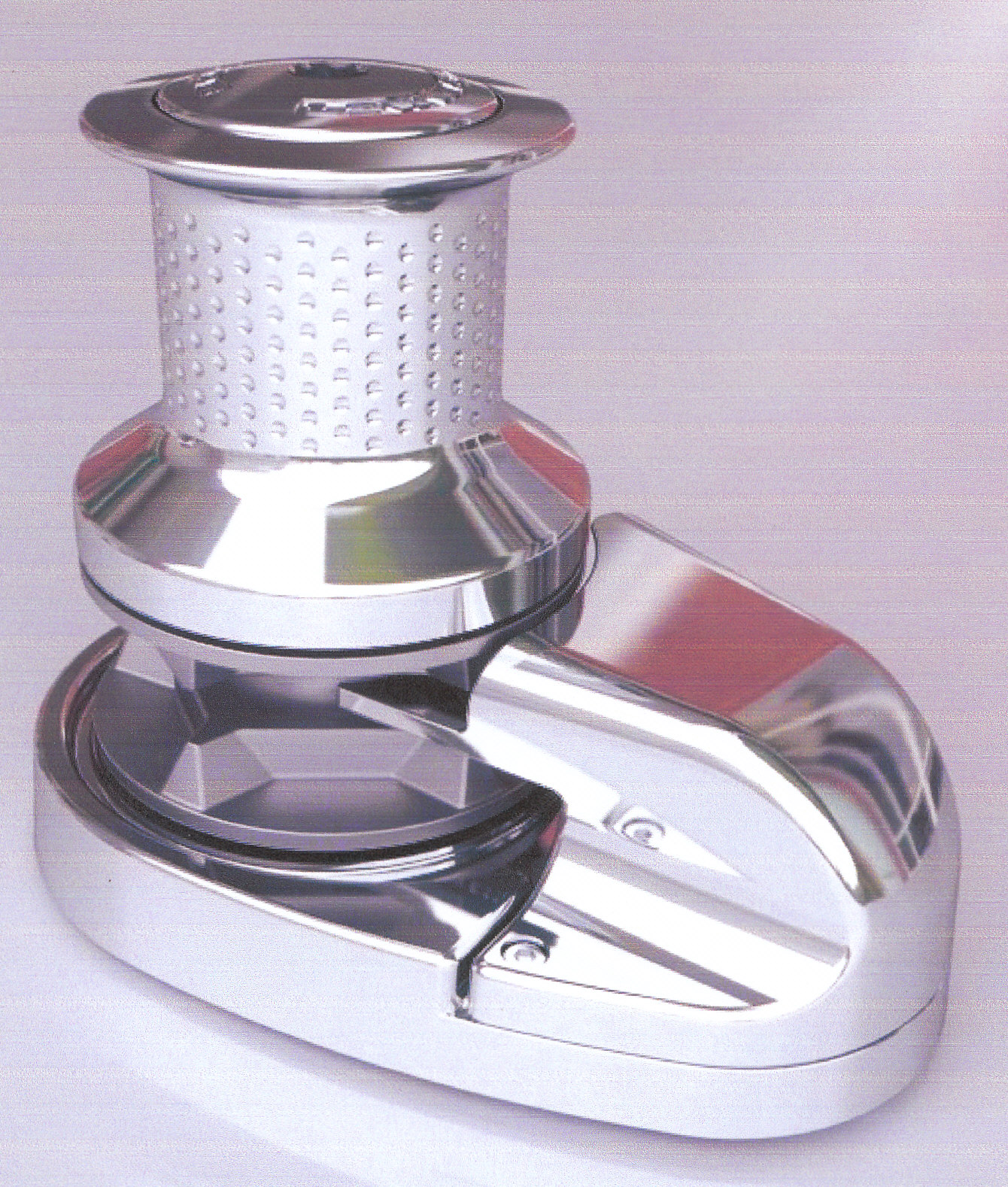
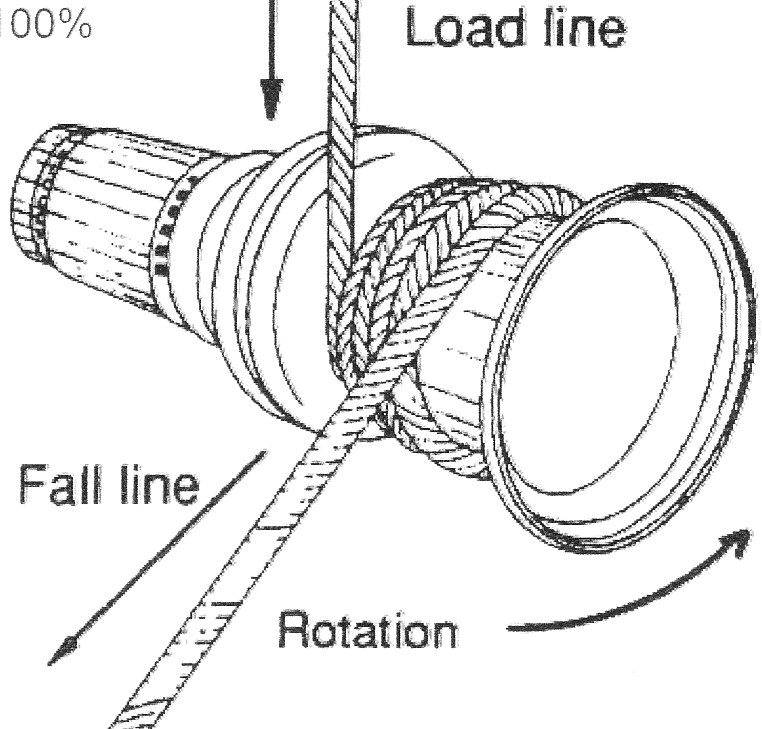
Rope drives, as such, are not much in use now. But, the principle is alive and well in shipping, where capstans and windlasses are used to tighten ropes and chains.
Flat belts were used extensively in both agriculture (to connect both steam and early tractors to static machinery) and also in early factories - where all the machinery in a building was powered by one engine driving a series of shafts, pulley wheels and belts. These belts could be long enough to transmit power from one floor of a building to the one above. A selection of arrangements of belt drives is shown in the diagram below.
Today the majority of belts in use are of Vee cross section, often used in sets of three - side by side. A modern development seen on some cars, is a flat belt with a series of mini Vee's on the inner surface.
Flat Pulley Drives
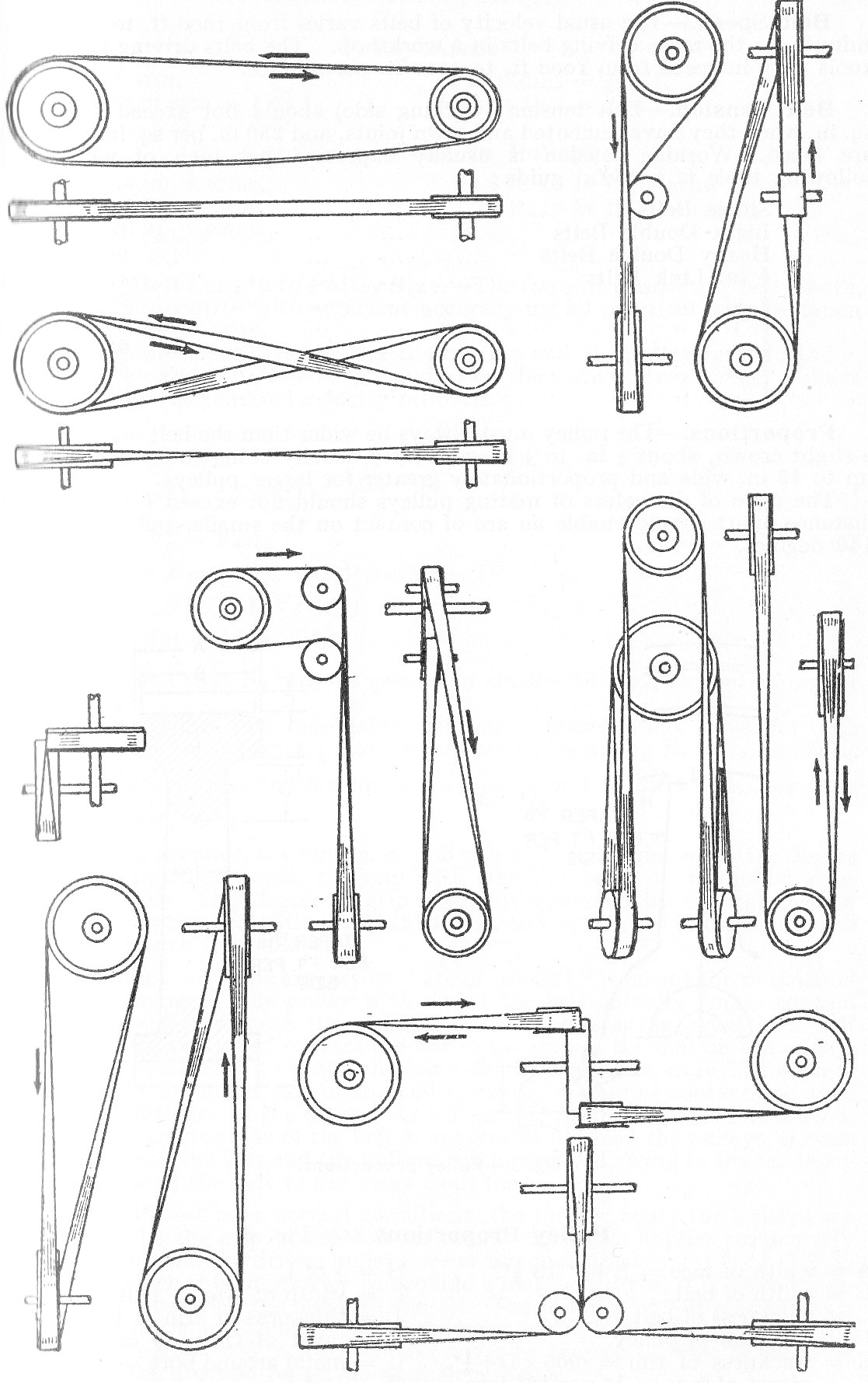
Although described as Flat, many pulleys used with flat belts are actually slightly curved so that the diameter at the middle is slightly larger than that at the ends.
This helps to keep the belt on the pulley.
It is also normal on long belts to twist them as shown in the diagram. This can be seen in the above diagram and increases the angle of contact between the belt and the pulley. Another technique to increase the angle is the use of idlers which are small pulley wheels that help to control slack in the belt.
At Low Speed
The maximum torque that can be transmitted between the belt and the pulley occurs when limiting friction is developed around the arc of contact.
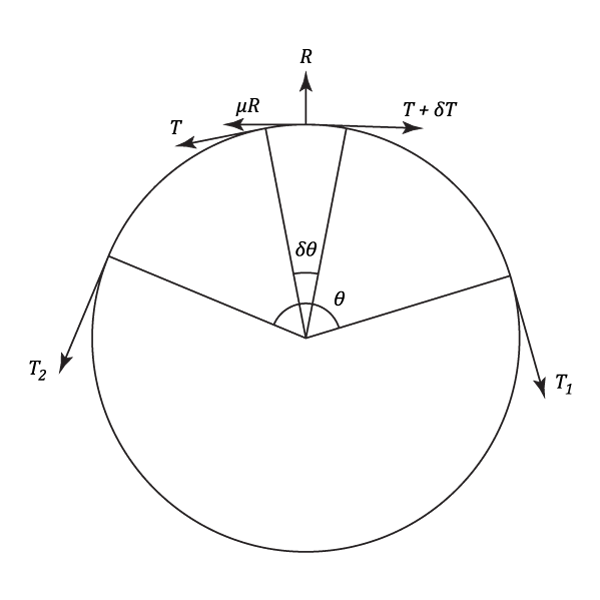
The forces acting on a short length of the belt which subtends an angle of $\delta \theta$ at the centre of the pulley, are shown on the above diagram.
Resolving Tangentially:- $\mu R=(T+\delta T)\cos\frac{1}{2}\delta \theta -T\cos\frac{1}{2}\delta \theta$
Thus in the limit,
Resolving Radially:-
Referring to the diagram showing the tensions and their radial components: $T_r'=T\sin\displaystyle\frac{1}{2}\delta \theta$ therefore, $T_r''=(T+\delta T)\sin\displaystyle\frac{1}{2}\delta \theta$
Adding, $R=(T+\delta T)\sin\frac{1}{2}\delta \theta +T\sin\frac{1}{2}\delta \theta$ $\text{As}\;\;\delta \theta \rightarrow 0\;\;\;\sin\frac{1}{2}\delta \theta \rightarrow \frac{\delta \theta}{2} \;\;\text{and}\;\;\delta T\rightarrow 0$
Hence in the limit,
Combining equations (1) and (2) and eliminating $R$, $\frac{\delta T}{T}=\mu\, \delta \theta$
This equation can now be integrated over the whole arc $\theta$ . $\therefore \;\;\;\;\;\;\ln\left ( \frac{T_1}{T_2} \right )=\mu \,\theta$ Or,
This is the maximum possible ratio of tensions between the "tight" and "slack" sides of the belt and consequently for a drive between pulleys of unequal diameter, the smaller angle of lap should be used.
It should be noted that in some applications such as Capstans and Windlasses, the rope is passed completely round the pulley, sometimes more than once.
Allowance for Centrifugal Force
The analysis above assumes, in effect, that the belt and pulley is at rest. In practice this is not often the case when the belt is subjected to a centrifugal force as if passes round the pulley.
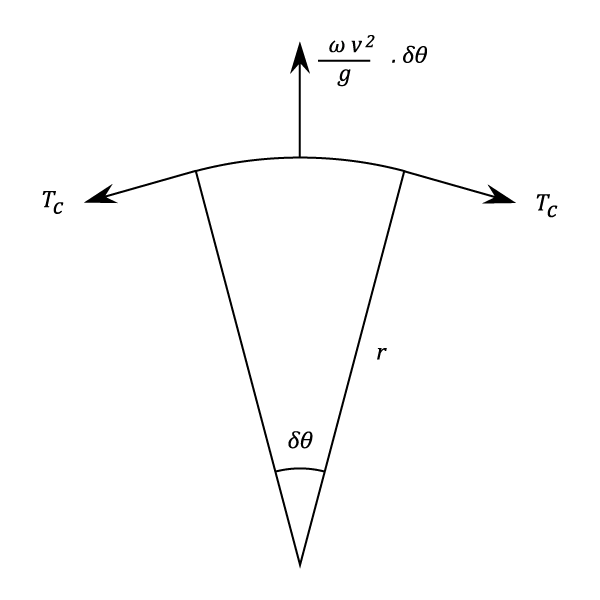
If $w$ is the weight of a unit length of belt and $v$ is the linear belt speed, then the force on an element
$=\left ( \frac{w\,r\,\delta \theta }{g} \right )\times \frac{v^2}{r}=\frac{w\,v^2}{g}\times\delta \theta$
This force has to be balanced by a tension $T_C$ in the belt. The value of this tension is obtained by resolving radially.
Hence, $2\,T_c\times \sin\displaystyle\frac{1}{2}\delta \theta =\left ( \displaystyle\frac{wv^2}{g} \right )\delta \theta$
$\text{As}\;\;\;\;\;\delta \theta \rightarrow 0\;\;\;\sin\frac{1}{2}\delta \theta \rightarrow \frac{\delta \theta }{2}$
The Total Tensions on the two sides are then,
where $T_1$ and $T_2$ are the tensions transmitting the power and are calculated from equation (2).
Equation (3) can now be written as: $\displaystyle\frac{T_T-T_C}{T_S-T_C}=e^{\mu \;\theta }$
Grooved Pulley Drives
Although rope can be used for such drives, the vast majority rely on V-belts. In many applications the pulley has more than one groove and there are obviously an appropriate number of belts.
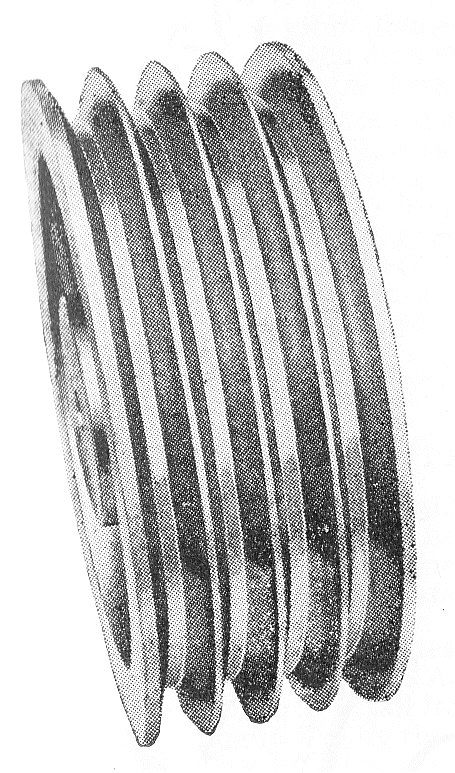
Assuming that the included angle of the groove is $2\beta$ , the Normal Reaction $R$ is given by,
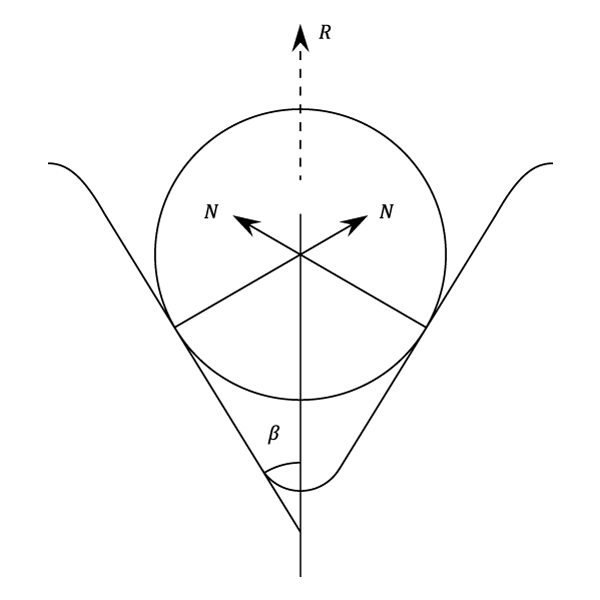
$R=2N\sin\beta$ But Friction
(using the above equation)
Where $\mu '=\displaystyle\frac{\mu }{\sin\beta }$
The analysis now becomes similar to a flat pulley where $\mu '$ is the equivalent coefficient of friction.
The Power Transmitted
Two sets of equations are given below to cater for both measurement systems:
Imperial
The horse-power transmitted
Using equation (3) this can be rewritten to give the maximum power transmitted i.e.
And using equation (5)
S.I.Units
Power transmitted in Kilo Watts $=(T_1-T_2)\times \displaystyle\frac{v}{1,000}$
Combining with equation (3) $=T_1\left ( 1-e^{-\mu \,\theta } \right )\times\displaystyle\frac{v}{1,000}$
And using equation (5) $=\left ( T_T-T_C \right )\left ( 1-e^{-\mu \,\theta } \right )\times\displaystyle\frac{v}{1,000}$
For a limiting value of $T_T$, it can be shown that the above equations for the power transmitted have a maximum value when,
$v=\sqrt{\left ( \displaystyle\frac{g\,T_T}{3w} \right )}$ i.e. $T_C=\displaystyle\frac{1}{3}T_T$
It is usual to assume that the mean tension $\displaystyle\frac{1}{2}(T_T+T_S)$ is constant at all speeds, and is therefore equal to the initial tension $T_0$.
If $T_C$ is neglected it then follows from equation (3) that: $T_1=\displaystyle\frac{2\,T_0}{1+e^{-\mu \,\theta }}$
And hence the power transmitted at a given speed is proportional to the initial tension.
The principles of Band Brakes are similar to those of the preceding paragraphs, giving in this case the braking torque which can be applied to a rotating drum.
There has been a slow but steady movement away from the use of Shoe and Drum Brakes by the automotive industry. The method of tackling problems associated with this type of brake can be seen in Example (15)
Example 2 [imperial]
A flexible elastic band passes over a pulley 20 in. in diameter which is supported in fixed horizontal bearings.
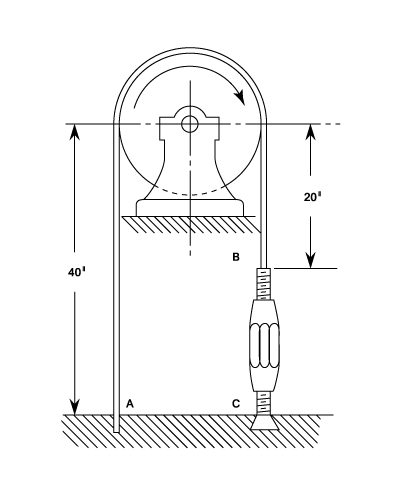
The end $A$ is anchored to the ground and the end $B$ is held by a turnbuckle whose lower end is also anchored to the ground at $C$.
The turnbuckle, which has right-hand left-hand square-threaded screws of $1\displaystyle\frac{1}{4}\;in.$ external diameter and $\displaystyle\frac{1}{4}\;in.$ pitch is used to tighten the band on the pulley until the couple on the turnbuckle is 100 lb.in.,the tension on the band being then assumed to be uniform.
The pulley is now rotated clockwise against the frictional resistance of the band. Assuming that the total length of the band now remains unchanged, find the couple required to produce this rotation.
The coefficient of friction between the screws and nuts = 0.15 and between the band and the pulley = 0.25. Neglect friction at the bearings and any extension between $B$ and $C$.
For the first part of this question it may be necessary to look the pages on "Screw threads "and in particular equation (14)
The Couple on the turnbuckle is:
where $W$ is the initial tension in the band. $\alpha =\tan^{-1}\left ( \frac{0.25}{\pi\times 1.25 } \right )=3^0\;39'$ and $\phi =\tan^{-1}0.15=8^0\;32'$
Substituting into equation (10)
When the pulley is rotated, $A$ becomes the "tight" side (tension $T_1$) and $B$ the "slack" side (tension $T_2$).
Equation (3) states that:
The stretch in the band is proportional to the product of the tension and the length and for a constant total length: $T_1\times 40 +\int_{0}^{\pi }T_2\times e^{0.25\,\pi }\times 10d\theta +T_2\times20=W(40+10\,\pi +20))$
Using the results of equations (11) and (12) this can be integrated and re-written as: $87.6T_2+\left ( \frac{10T_2}{0.25} \right )\left ( e^{0.25\,\pi }-1 \right )+T_2\times 20=371\times91.4$
Simplifying, $T_2=\frac{371\times91.4}{87.6+47.6+20}=219\;lb.$
And from equation (12), $T_1=479\;lb.$
Hence the couple on the pulley $=(T_1-T_2)\times10=2600\;lb.in.$
The couple on the pulley $=(T_1-T_2)\times10=2600\;lb.in.$
Example 3 [imperial]
In the torque amplifier shown in the diagram, the input and output shafts rotate at the same speed and in the same direction. They are connected by a flexible band, attached to radius arms, which make 1.25 turns around a coaxial drum. The drum is driven at high speed by an electric motor.
If the coefficient of friction between the drum and the band is 0.21, find the torque required at the input shaft to overcome a torque of 1.5 lb.ft. at the output shaft. If the drum speed is 5 r.p.s. and the shaft speeds are 2 r.p.s. find for the above conditions, the energy lost in drum friction expressed in ft.lb./sec.
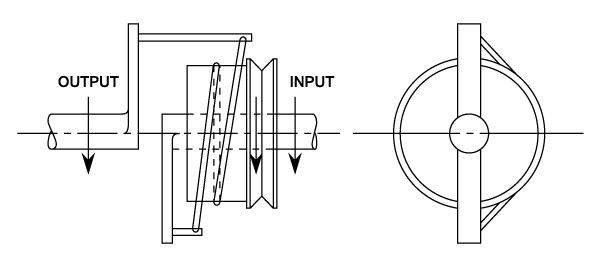
Let both the input and output arms be of length $l$ and note that the "tight" side of the band is connected to the output side.
The tension at input is given by: $T_1=\displaystyle\frac{1.5}{l}$
Using equation (3) the tension at input is given by: $T_2=\displaystyle\frac{T_1}{e^{0.21\times 1.25\times 2\,\pi }}$
From the above equation the input torque, $T_2\,l$ is given by: $T_2\,l=\displaystyle\frac{T_1\,l}{e^{1.645}}$
Substituting from equation (1 in the above example), $=\displaystyle\frac{1.5}{5.19}=0.289\;lb.ft.$
The torque on the drum is the difference between the input and output torques of which the output value is given as 1.5 lb.ft. $=1.5-0.289 =1.211\;lb.ft.$
The energy lost = the torque on the drum $X$ the speed of slip $=1.211\times (5-2)2\,\pi =22.8 ft.lb.\;sec^{-1}$
- The torque is $1.211\;lb.ft.$
- The energy lost is $22.8 ft.lb.\;sec^{-1}$
Example 6 [imperial]
A leather belt $\displaystyle\frac{1}{4}$ in. thick connects two pulleys of 3 ft. 2 in. and 1 ft. 9 in. diameters, carried on parallel shafts at 11 ft. 6 in. centres; the speed of the larger pulley is 240 r.p.m.. The coefficient of friction is 0.25 and the maximum permissible load on the belt is 260 lb.
Find the maximum horse-power and the necessary initial tension.
Plot on a base of initial mean tension, curves showing the horse-power which can be transmitted
- Maximum loading but neglecting the possibility of slip.
- Limitations due to slip but neglecting the possibility of overloading the belt.
Hence determine the permissible range of initial tension if $7\displaystyle\frac{1}{2}$ is to be transmitted.
The difference in pulley diameters is 38 in. - 21 in.= 8.5 in. and therefore the smallest angle of lap, $\theta$ is given by:
$\theta =\pi -2\sin^{-1}\left ( \frac{8.5}{11.5\times 12} \right )=3.018\; rad.$
Therefore, $e^{-\mu \,\theta }=\displaystyle\frac{1}{e^{0.25\times 3.018}}=0.471$
Allowing for the thickness of the belt, the velocity of the belt is:
$v=240\times \pi \times (3+2.25)\times \frac{1}{60}=40.1\;ft.\;sec^{-1}$
From equations (3) and (7), Horse-power $=T_1\left ( 1-e^{-\mu \;\theta } \right )\times \frac{v}{550} =260\left ( 1-0.471 \right )\times \frac{40.1}{550}=10$
Using equation (3) again, $Y_0=\frac{1}{2}\left ( T_1+T_2 \right )=\frac{1}{2}T_1\left ( 1+e^{-\mu \;\theta } \right ) =\frac{1}{2}\times 260\left ( 1+0.471 \right )=191\;lb.$
- Allowing for maximum loading $T_1$ = 260 lb. and hence:
$T_2=2T_0-T_1=2T_0-260$
From equation (7), Horse-power $=(T_1-T_2)\times \displaystyle\frac{v}{550}$
Substituting in values from above:
Horse-power $=(520-2T_0)\times \displaystyle\frac{40.1}{550}=0.146(260-T_0)$
- Allowing for limitations due to slip
From equation (3), $T_2=T_1\times e^{-\mu \;\theta }$
Since $T_1+T_2 =2T_0$ it can be shown that: $T_1=\displaystyle\frac{2T_0}{1+e^{-\mu \;\theta }}$
Substituting in equation (8) gives, Horse-power $=2T_0\left ( \frac{1-e^{-\mu \;\theta }}{1+e^{-\mu \;\theta }} \right )\times \frac{v}{550}=2T_0\left ( \frac{1-0.471}{1+0.471} \right )\times\frac{40.1}{550} =0.0524\;T_0$
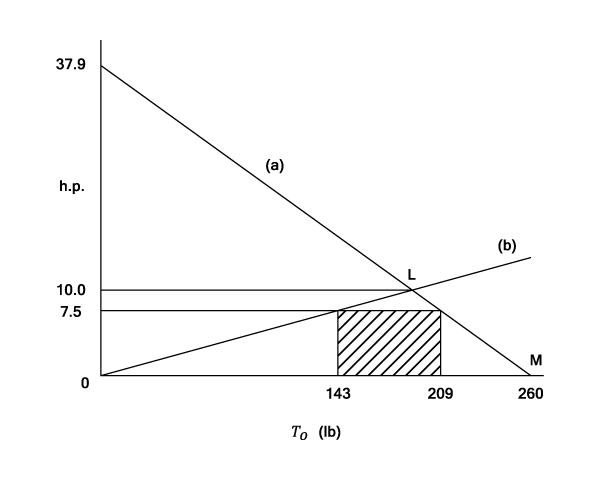
The only operating parts of the lines given by the two conditions given in the question are below OLM and the range of $T_0$ for 7.5 h.p. is from 143 lb. to 209.lb.
Example 7 [imperial]
A small pulley of radius $r_1$ on a line shaft drives a large pulley of radius $r_2$ on a machine vertically below it, the centre distance being a distance $d$.
Show that slipping will be equally likely to occur at either pulley, if the tension in the belt where it runs over the larger pulley is given by:
$T=\frac{e^{\mu (\pi -2\theta )}-1}{e^{\pi +2\theta }-e^{\mu -2\theta }}\times w\;d$
Where $w$ is the weigth of a unit length of belt and $\sin\theta=\displaystyle\frac{r_2-r_1}{d}$
The length of belt between the pulleys is $d \cos\theta$ and resolving vertically for each side of the belt.
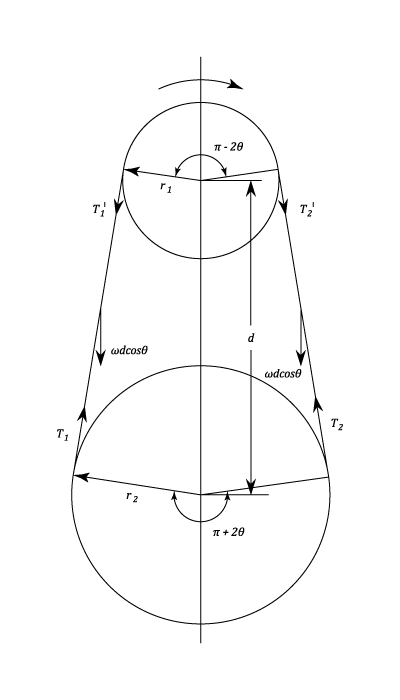
$\left ( T_1'-T_1 \right )=wd\cos\theta$
Similarly:
And,
From Equation (3)
And $T_1=T_2\;e^{\mu (\pi +2\theta )}$
Substituting from equations (14) and (16) in equation (17)
$T_1+wd=(T_2+wd)\times e^{\mu (\pi -2\theta)}$
Eliminating $T_1$ from the above equation by using equation (15)
$T_2\;e^{\mu (\pi +2\theta )}+wd=(T_2+wd)\times e^{\mu (\pi -2\theta)}$
$T_2=\frac{e^{\mu (\pi -2\theta )}-1}{e^{\mu (\pi +2\theta )}-e^{\mu (\pi -2\theta )}}\times wd$