The following methods of Integration cover all the Normal Requirements of A.P.; A Level; The International Baccalaureate as well as Engineering Degree Courses.
It does not cover approximate methods such as The Trapezoidal Rule or Simpson's Rule.
Simple Algebraic equations
$\int x^n\:dx = \frac{1}{n+1}\:x^{n+1} + C$
Except when n = -1 Then $\int \frac{dx}{x} = \ln\,x + C$
but $\frac{d\:\sqrt[]{x^2\:+\:2x\:+\:3}}{dx} = \frac{1}{2}(x^2\:+\:2x\:+\:3)^{-\frac{1}{2}}\:X\:(2x\:+\:3)$ $=\:\frac{\frac{1}{2}(2x\:+\:2)}{\sqrt[]{x^2\:+\:2x\:+\:3}}$
Solution
From which it can be seen that $\frac{d\int_{}^{}f\:x}{dx} = \frac{\frac{1}{2}f^{'}x}{\sqrt[]{fx}}$
In general the answer to this type are in the form $\sqrt[]{} + (\sinh\:or\:\cosh\:or\:\sin)^{-1}$ The integral of $\sqrt[]{\frac{x\:-\:1}{2x\:+\:1}}\;dx$ can be found by multiplying top and bottom by $\sqrt[]{x\:-\:1}$
$\text{let}\;\;\;U = \ln\:x$
$\therefore\;\:\;\frac{dU}{dx} = \frac{1}{x}$
and
$dx = x\:dU$
thus the original equation can now be rewritten as :-
$\int \frac{\ln\:x}{x}\:dx = \int \frac{U}{x}\:.\:x\:dU$
Find the integral of $\frac{\sqrt[]{x^3\:+\:a^2}}{x}\:dx$
Workings
let U = $\sqrt[]{x^3\:+\:a^2}$ $\therefore\:\:\;U^2\:=\:x^3\:+\:a^2\;\;\;and\:\;\;2U\:\frac{dU}{dx}\:=\:3x^2$ $\therefore\;\;\;\frac{2}{3}\,U\:dU = x^2\:dx$
The integral can now be written as :- $\int \frac{U}{U^2\:-\:a^2}\:dU$ $= \frac{2}{3}\int\frac{U^2}{U^2\:-\:a^2}\;dU$ $= \frac{2}{3}\int \left(1\:+\:\frac{a^2}{(U\:-\:a)(U\:+\:a)} \right)dU$ $= \frac{2}{3}\int \left(1\:+\:\frac{\frac{1}{2}a}{U\:-\:a}\:-\:\frac{\frac{1}{2}a}{U\:+\:a} \right)\:dU$ $= \frac{2}{3}\left[U\:+\:\frac{1}{2}\: a\:Ln\:\frac{U\:-\:a}{U\:+\:a}\right]\;+\:C$
substitute $U = \sqrt[n]{ax\:+\:b}\;\;\;i.e.\;\;\;U^n\:=\:ax\:+\:b$
$\therefore\;\;\;\frac{n}{a}\:\;U^{(n\:-\:1)}\:dU = dx$
So the integral is now rational in $U\:dU$
Example 1
Problem
Find the integral of $\int \frac{1}{x+\sqrt{2x - 1}}\;dx$
Workings
Substitute $U=\sqrt{2x - 1}$ i.e. $x=\frac{U^2+1}{2}$
Therefore $U\:dU = dx$ \todo Review the following workings
thus the integral can be written as:- $\int \frac{1}{\frac{U^2+1}{2}+U}\:dU$$= 2\,\int \frac{U}{(U^2+1)}dU$ $= 2\int\left(\frac{1}{U+1}-\frac{1}{(U+1)^2} \right)$ $= 2\ln (U+1)+\frac{2}{U+1}+C$
To find the integral of $(\cos \:5x\:\cos\:2x)\;dx$
Workings
But $\cos\:A\:+\:B = 2\:\cos\frac{A\:+\:B}{2}\:\cos\frac{A\,-\:B}{2}$ from which it can be shown that $\int\cos\,5x\:\cos\,2x\:dx = \frac{1}{2}\int (\cos\,7x\:+\:\cos\,3x)\:dx$
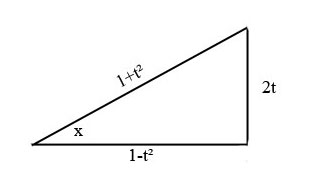
using the same substitution as above $=\:\int \frac{1\:+\:t^2}{1\:-\:t^2}\;.\;\frac{2}{1\:+\:t^2}\:dt$ $=\:\int \left(\frac{1}{1\:-\:t}\:+\:\frac{1}{1\:-\:t} \right)\:dt$ $=\:-\:\Ln\,(1\:-\:t)\:+\:\Ln\,(1\:+\:t)\:+\:C$ $=\:Ln\:\frac{1\:+\:t}{1\:-\:t}\;+\:C$
Let $x = a sinh u$ $\therefore\;\;\;\frac{dy}{dx}\:=\:a\:cosh\,u$ $\frac{dy}{du}\:=\:\frac{dy}{dx}\:X\:\frac{dx}{du}\:=\sqrt[]{(x^2\:+\:a^2)}\:X\:a\:cosh\,u$ $but\;\;\;\sqrt[]{(x^2\:+\:a^2}\:=\:\sqrt[]{a^2\,\sinh^2\,u\:+\:a^2)}=\:\sqrt[]{a^2\:\cosh^2\,u}$ $thus\;\;\;\frac{dy}{du}\:=\:a^2\:\cosh^2\,u\:=\:\frac{1}{2}\,a^2(1\:+\:\cosh\,2u)$ $\therefore\;\;\;y\:=\:\frac{1}{2}\:a^2\int (1\:+\:\cosh\:2u)\:du$ $=\:\frac{1}{2}\:a^2\:(u\:+\:\frac{1}{2}\,\sinh\,2u)\:=\frac{1}{2}\:a^2\,u\:+\:\frac{1}\:(sinh\,u\:\cosh\,u)$