
Examples showing how various functions can be integrated

You're viewing an older version of this page (#3353). View the current version.

View versions (4)

Introduction

The following methods of Integration cover all the Normal Requirements of A.P.; A. level; The International Baccalaureate as well as Engineering Degree Courses.

It does not cover approximate methods such as The Trapezoidal Rule or Simpson's Rule. These will be covered in another paper.

Simple Algebraic equations

\int x^n\:dx = \frac{1}{n\:+\:1}\:x^{n\:+\:1} + C
(1)

Except when n = -1 Then

\int \frac{1}{x\:dx} = Ln\,x + C
(2)

Example 1

\int \frac{1}{\sqrt[]{{2x\:+\:3}}}\:dx
(3)
=\:\int (2x\:+\:3)^{-\frac{1}{2}}\:dx\:
(4)
= \frac{1}{2}\times\;2(2x\:+\:3)^\frac{1}{2} + C
(5)

Rational Algebraic Functions whose Denominator Factorizes.

\int \frac{x}{(x\:-\:1)(x\:-\:2}\:dx
(6)
= \int \left( \frac{-\,1}{x\:-\:1}\:+\:\frac{2}{x\:-\:2} \right)\:dx
(7)
=\:-\:\Ln(x\:-\:1)\:+\:2\,\Ln(x\:-\:2) + C
(8)
= \Ln\left[K\frac{(x\:-\:2)^2}{(x\:-\:1)} \right] + C
(9)

Rational Algebraic Functions whose Denominators do not Factorize

\int\frac{f^{'}(x)}{f(x)} = \Ln\:f(x) + C
(10)
\int \frac{2\,x\:+\:3}{x^2\:+\:3\,x\:+\:7}\;dx = \Ln(x^2\:+\:3x\:+\:7) + C
(11)
Blank
\int \frac{a}{x^2\:+\:a^2}\:dx = tan^{-1}\left (\frac{x}{a}\right ) + C
(12)

Example 2

\int \frac{1}{x^2\:+\:8x\:+\:25}\,dx
(13)
= \frac{1}{3}\int \frac{3}{(x\:+\:4)^2\:+\:3^2}}\:dx
(14)
= \frac{1}{3}\:tan^{-1}\left (\frac{x\:+\:4}{3}\right ) + C
(15)

Example 3

\int \frac{4x\:+\:5}{x^2\:+\:2x\:+\:2}\:dx
(16)
= \int \left(\frac{2(2x\:+\:2)}{x^2\:+\:2x\:+\:2} \:+\:\frac{1}{(x\:+\:1)^2\:+\:1}\right)
(17)
2\:\Ln(x^2\:+\:2x\:+\:2)\:+\:\tan^{-1}(x\:+\:1) + C
(18)

Note The general answer to this method will be in the form of \Ln(f(x)) and \tan^{-1}(f(x))

Irrational Algebraic Fraction of the following kind

\frac{ax\:+\:b}{\sqrt[]{px^2\:+\:qx\:+\:s}}\;\:\:\;where\;p\:\neq\:0
(19)

Example 4

\int \frac{1}{\sqrt[]{x^2\:+\:2x\:-\:3}}
(20)
= \int \frac{1}{\sqrt[]{(x\:+\:1)^2\:-\:4}}}
(21)
=\:cosh^{-1}(\frac{x\:+\:1}{2}) + C
(22)

Other forms

\int \frac{b}{(x\:+\:a)^2\:-\:d^2}\:dx = b\:\cosh^{-1}\:\frac{x\:+\:a}{d}
(23)
\int \frac{b}{\sqrt[]{(x\:+\:a)^2\:+\:d^2}} = b\:\sinh^{-1}\:\frac{x\:+\:a}{d}
(24)
\int \frac{b}{\sqrt[]{d^2\:-\:(x\:+\:a)^2}} = b\:\sin^{-1}\:\frac{x\:+\:c}{d}
(25)

Example 5

\int \frac{x\:+\:1}{\sqrt[]{x^2\:+\:2x\:+\:3}}\:dx\:= \sqrt[]{x^2\:+\:2x\:+\:3} + C
(26)

but

\frac{d\:\sqrt[]{x^2\:+\:2x\:+\:3}}{dx} = \frac{1}{2}(x^2\:+\:2x\:+\:3)^{-\frac{1}{2}}\:X\:(2x\:+\:3)
(27)
=\:\frac{\frac{1}{2}(2x\:+\:2)}{\sqrt[]{x^2\:+\:2x\:+\:3}}
(28)

From which it can be seen that

\frac{d\int_{}^{}f\:x}{dx} = \frac{\frac{1}{2}f^{'}x}{\sqrt[]{fx}}
(29)

Example 6

\int \frac{3x\:-\:5}{x^2\:+\:4x\:+\:7}\;dx
(30)
\int \left(\frac{3\:.\:\frac{1}{2}(2x\:+\:4)}{\sqrt[]{x^2\:+\:4x\:+\:7}} \,-\:\frac{11}{\sqrt[]{(x^2\:+\:2)^2}\:+\:3}}\right)\:dx
(31)
= 3\:\sqrt[]{x^2\:+\:4x\:+\:7}\:-\:11\:sinh^{-1}\frac{x\:+\:2}{\sqrt[]{3}} + C
(32)

In general the answer to this type are in the form

\sqrt[]{} + (\sinh\:or\:\cosh\:or\:\sin)^{-1}
(33)

The integral of

\sqrt[]{\frac{x\:-\:1}{2x\:+\:1}}\;dx
(34)

can be found by multiplying top and bottom by

\sqrt[]{x\:-\:1}
(35)

thus

\int \sqrt[]{\frac{x\:-\:1}{2x\:+\:3}} = \int\frac{x\:-\:1}{\sqrt[]{2x^2\:+\:x\:-\:3}}
(36)
=\:\frac{1}{2}\sqrt[]{2x^2\:+\:x\:-\:3} - \frac{5}{4\;\sqrt[]{2}}\cosh^{-1}\frac{4x\:+\:1}{5} + C
(37)

An Irrational Function of the following type

\int \frac{Ln\:x}{x}\;dx
(38)
\text{let}\;\;\;U = Ln\:x
(39)
\therefore\;\:\;\frac{dU}{dx} = \frac{1}{x}
(40)
\text{and}\;\;\;dU = \frac{1}{x}\:dx
(41)

thus the original equation can now be rewritten as :-

\int \frac{Ln\:x}{x}\:dx = \int \frac{U}{x}\:.\:x\:dU
(42)
\text{And}\;\;\;\int U\:dU = \frac{1}{2}U^2 + C
(43)
\therefore\:\;\;\int \frac{Ln\:x}{x}\:dx = \frac{1}{2}(\Ln\:x)^2 + C
(44)

Example 7

To find the integral of

\frac{\sqrt[]{x^3\:+\:a^2}}{x}\:dx
(45)

let U =

\sqrt[]{x^3\:+\:a^2}
(46)
\therefore\:\:\;U^2\:=\:x^3\:+\:a^2\;\;\;and\:\;\;2U\:\frac{dU}{dx}\:=\:3x^2
(47)
\therefore\;\;\;\frac{2}{3}\,U\:dU = x^2\:dx
(48)

The integral can now be written as :-

\int \frac{U}{U^2\:-\:a^2}\:dU
(49)
= \frac{2}{3}\int\frac{U^2}{U^2\:-\:a^2}\;dU
(50)
= \frac{2}{3}\int \left(1\:+\:\frac{a^2}{(U\:-\:a)(U\:+\:a)} \right)dU
(51)
= \frac{2}{3}\int \left(1\:+\:\frac{\frac{1}{2}a}{U\:-\:a}\:-\:\frac{\frac{1}{2}a}{U\:+\:a} \right)\:dU
(52)
= \frac{2}{3}\left[U\:+\:\frac{1}{2}\: a\:Ln\:\frac{U\:-\:a}{U\:+\:a}\right]\;+\:C
(53)
=\:\frac{2}{3}\left[\sqrt[]{x^3\:+\:a^2}\:+\:\frac{1}{2}\:a\:Ln\:\frac{\sqrt[]{x^3\,+\:a^2}\:-\:a}{\sqrt[]{x^3\:+\:a^2}\:+\:a} \right]
(54)

An Irrational Function Containing

\sqrt[n]{ax\:+\:b}
(55)

substitute

U = \sqrt[n]{ax\:+\:b}\;\;\;i.e.\;\;\;U^n\:=\:ax\:+\:b
(56)
\therefore\;\;\;\frac{n}{a}\:\;U^{(n\:-\:1)}\:dU = dx
(57)

So the integral is now rational in U\:dU

Example 8

Find the integral of

\int \frac{1}{x\:+\:\sqrt[]{2x\:-\:1}}\;dx
(58)

substitute

U\:=\:\sqrt[]{2x\:-\:1}\;\;\;i.e.\;\;\;x\:=\:\frac{U^2\:+\:1}{2}
(59)
\therefore\:\;\;U\:dU = dx
(60)

thus the integral can be written as:-

\[\int \frac{1}{\frac{U^2\:+\:1}{2}\:+\:a}\:U\:dU
(61)
= 2\,\int \frac{U}{(U^2\:+\:1)}\:dU
(62)
= 2\:\int_{}^{}\left(\frac{1}{U\:+\:1}\:-\:\frac{1}{(U\:+\:1)^2} \right)
(63)
= 2\:Ln\:(U\:+\:1)\:+\:\frac{2}{U\:+\:1}\:+\:C
(64)
\therefore\;\;\;\int \frac{1}{x\,+\:\sqrt[]{2x\:-\:1}}\:dx = 2\,\Ln\,(\sqrt[]{2x\,-\:1}\:+\:1\:+\:\frac{2}{\sqrt[]{2x\:-\:1}}\:+\:1}\;+\:C
(65)

Simple Trigonometrical Functions

Blank
\int \cos\:x\:dx = sin\:x\:+\:C
(66)
\int \sin\:x\:dx\:= -\:\cos\:x + C
(67)
\int \tan\:x\:dx = Ln\:\sec\:x + C
(68)
\int \sec^2\:x\,dx\:= \tan\:x + C
(69)
\int \sin^4\:\cos\:x\:dx = \frac{1}{5}\:\sin^5\,x + C
(70)

Using Trigonometrical formula

Example 9

To find the integral of

(\cos \:5x\:\cos\:2x)\;dx
(71)
but\;\;\;\cos\:A\:+\:B = 2\:\cos\frac{A\:+\:B}{2}\:\cos\frac{A\,-\:B}{2}
(72)

from which it can be shown that

\int\cos\,5x\:\cos\,2x\:dx = \frac{1}{2}\int (\cos\,7x\:+\:\cos\,3x)\:dx
(73)
=\:\frac{1}{14}\,\sin\,7x\:+\:\frac{1}{6}\sin\,3x + C
(74)

]

Example 10

\int\ cos^2\:x\:dx = \frac{1}{2}\:\int (2\:\cos\,2x\:+\:1)
(75)
= \frac{\sin\:2x}{4}\:+\:\frac{x}{2}\:+\:C
(76)

Any Trigonometrical formula

To integrate any trigonometrical function such as (\sin\times  \cos x) dx
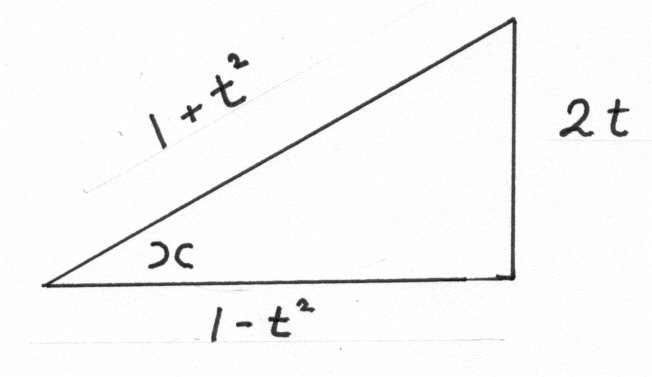
put\;\:\;\;t = tan\:\frac{x}{2}
(77)
but\:\;\:\;tan\:x\:=\:\frac{2\:tan\,\frac{x}{2}}{(1\:+\:tan^2\:\frac{x}{2})}
(78)
= \frac{2t}{1\:-\:t^2}
(79)
13108/img_half_angle.jpg

Example 11

\int \cosec\:x\:dx = \int \frac{1}{sin\,x}\:dx
(80)
= \int \frac{1}{\frac{2t}{1\:+\:t^2}}\;X\;\frac{2}{1\:+\:t^2}\;dt
(81)
= \int \frac{1}{t}\:dt = \Ln\:t + C
(82)
\therefore\;\;\;\int \cosec\:x\:dx = \Ln\,\tan\frac{x}{2} + C
(83)

Example 12

\int \sec\:x\;dx\;=\:\int \frac{1}{\cos\:x}\:dx
(84)

using the same substitution as above

=\:\int \frac{1\:+\:t^2}{1\:-\:t^2}\;.\;\frac{2}{1\:+\:t^2}\:dt
(85)
=\:\int \left(\frac{1}{1\:-\:t}\:+\:\frac{1}{1\:-\:t} \right)\:dt
(86)
=\:-\:\Ln\,(1\:-\:t)\:+\:\Ln\,(1\:+\:t)\:+\:C
(87)
=\:Ln\:\frac{1\:+\:t}{1\:-\:t}\;+\:C
(88)
\therefore\;\;\;\int \sec\:x\;dx\:=
(89)
\:\Ln\frac{1\:+\:tan\,\frac{x}{2}}{1\:-\:tan\frac{x}{2}} + C
(90)

Any Hyperbolic Function

Simple equations

\int \sech^2\:\theta\;d\theta = \tanh\:\theta + C
(91)
\int\:\cosh^2\:\theta\:d\theta
(92)
=\:\frac{1}{2}\int(1\:+\:\cosh\:2\theta)\:d\theta
(93)
=\:\frac{1}{2}\theta\:+\:\frac{1}{4}\:\sinh\:2\,\theta + C
(94)

Any hyperbolic equation

\intf(sinh\,\theta\:\cos\,\theta)\:d\theta
(95)
put\;\:\;\;\;\;U = e^\phi
(96)

Then

\sinh\:\theta = \frac{U\:-\:\frac{1}{U}}{2}\:=\:\frac{U^2\:-\:1}{2U}
(97)
\cosh\:\phi\:=\:\frac{U\:+\:\frac{1}{U}}{2}\:=\:\frac{u^2\:+\:1}{2U}
(98)

Example 13

\int \sech\:\phi\:d\phi\:=\:\int\frac{2U}{1\:+\:U^2}\:.\:\frac{1}{U}\:dU
(99)
=\:2\:\tan{_1}\:U\:+\:C\;\; = \;\;2\:\tan^{-1}\,e^\phi\:+\:C
(100)

Integration of Irrational Equations of the Following Type using Trigonometrical Substitution

\sqrt[]{ax^2\:+\:bx\:+\:C}
(101)

Example 14

\int \frac{1}{x^2\:\sqrt[]{1\:-\:x^2}}\:dx
(102)
put\;\;\;\;x\:=\:\sin\:\theta\;\;\:and\;\therefore\;\;\;dx\:=\:\cos\:\theta\:d\theta
(103)
thus\;\;\;integral\:=\:\int_{}^{}\frac{1}{sin^2\theta\:\cos\,\theta}\:\cos\theta\:d\theta
(104)
=\:\int \cosec^2\:\theta\:d\theta
(105)
=\:\cot\:\theta\:+\:C\;\;=\:-\:\frac{\sqrt[]{1\:-\:x^2}}{x}\:+\:C
(106)

Example 15

Find the integral of

\sqrt[]{(x^2\:+\:a^2)}\;dx
(107)

Let x = a sinh u

\therefore\;\;\;\frac{dy}{dx}\:=\:a\:cosh\,u
(108)
\frac{dy}{du}\:=\:\frac{dy}{dx}\:X\:\frac{dx}{du}\:=\sqrt[]{(x^2\:+\:a^2)}\:X\:a\:cosh\,u
(109)
but\;\;\;\sqrt[]{(x^2\:+\:a^2}\:=\:\sqrt[]{a^2\,\sinh^2\,u\:+\:a^2)}=\:\sqrt[]{a^2\:\cosh^2\,u}
(110)
thus\;\;\;\frac{dy}{du}\:=\:a^2\:\cosh^2\,u\:=\:\frac{1}{2}\,a^2(1\:+\:\cosh\,2u)
(111)
\therefore\;\;\;y\:=\:\frac{1}{2}\:a^2\int (1\:+\:\cosh\:2u)\:du
(112)
=\:\frac{1}{2}\:a^2\:(u\:+\:\frac{1}{2}\,\sinh\,2u)\:=\frac{1}{2}\:a^2\,u\:+\:\frac{1}\:(sinh\,u\:\cosh\,u)
(113)
=\:\frac{1}{2}\:a^2\:\sinh^{-1}\frac{x}{a}\:+\:x\:\sqrt[]{(a^2\:+\:x^2)}
(114)

Integration by Parts

\frac{d\,(uv)}{dx}\:=\:u\:\frac{dv}{dx}\:+\:v\:\frac{du}{dx}
(115)
\therefore\;\;\;uv\:=\:\int u\:\frac{dv}{dx}\:dx\:+\:\int 
v\:\frac{du}{dx}\:dx
(116)
\int u\:\frac{dv}{dx}\:dx\:=\:uv\:-\:\int v\:\frac{du}{dx}\:dx
(117)

this can also be written as:-

\int \:u\:(v)^{'}\:dx\:=\:u\,v\:-\:\int v\:(u)'\:dx
(118)

Example 16

\int \:x\:cos\,x\:dx\:
(119)
=\:\int x\:(\sin\:x)^1}\:dx\:=\:x\:sin\,x\:-\:\int \:\sin\,(x\:.\:1)
(120)
=\:x\:\sin\,x\:+\:\cos\,x\:+\:C
(121)

Example 17

\int x^2\ln x\;dx
(122)

Can be written as:-

\int \ln x\left ( \frac{1}{3}x^3 \right )'\;dx=\frac{1}{3}\ln x-\int \frac{1}{3}x^3\times \frac{1}{x}\;dx
(123)
=\frac{1}{3}x^3\ln x-\frac{1}{9}x^3+C
(124)

Example 18

\int \ln x \;dx
(125)
=\int \ln x\times 1\;dx
(126)

This can now be written as:-

\int \ln x\;\left ( x \right )'\;dx=x\ln x-\int x\times \frac{1}{x}\;dx
(127)
=x\lnxx-x+C
(128)

Example 19

\int \sinh^{-1}x\;dx
(129)
=\int \sinh^{-1}x\times x'\;dx
(130)
=x\sinh^{-1}x-\int x\;\frac{1}{\sqrt{x^2+1}}\;dx
(131)
=x\sinh^{-1}x-\frac{\sqrt{x^2+1}}{2}+C
(132)

The Integration by Parts twice to regain the Original Integral

Example 20

\int e^{3x}\cos2x\;dx=\int e^{3x}\left ( \frac{1}{2}\sin2x \right )'\;dx
(133)
=\frac{1}{2}e^{3x}\sin x- \frac{3}{2}\int\sin2x\;e^{3x}\;dx
(134)
=\frac{1}{2}e^{3x}\sin x- \frac{3}{2}\int e^{3x}-\left ( \frac{1}{2}\cos2x \right )'dx
(135)
=\frac{1}{2}e^{3x}\sin x- \frac{3}{2}\left [ -\frac{1}{2}e^{3x}\cos2x + \frac{1}{2}\int \cos2x\;e^{3x} \right ]dx
(136)
\frac{13}{4}\int e^{3x}\;\cos2x\;dx=\frac{1}{2}e^{3x}\;\sin2x+\frac{3}{4}e^{3x}\cos2x
(137)
\therefore \;\;\;\;\int e^{3x}\;\cos2x\;dx=\frac{2}{13}e^{3x}\;\sin2x+\frac{3}{13}e^{3x}\cos2x+C
(138)

Example 21

\int \sec^3x\;=\int \sec x(\tan x)'\;dx
(139)
= \sec x\tan x\;-\int \tan x\sec x \tan x\;dx
(140)
=\sec x\tan x\;-\int \ \sec x  \left ( \sec^2x-1 \right )\;dx
(141)
=\sec x\tan x\;-\int \ \sec x \;dx-\int \sec^3x\;dx
(142)
2\int \sec^3x\;dx=\frac{1}{2}\sec x\tan x+\frac{1}{2}\ln(\sec x+\tan x)+C
(143)