
Magnetic Pull Force
Key facts
For an electromagnet characterized by the area $A$, the magnetic flux density $B$, and the relative magnetic permeability $\mu_r$, the magnetic pull force is:
where $\mu_0$ is the magnetic permeability of free space.
<br/>
Constants
An analysis of the magnetic pull force which arises between the poles of an electromagnet
Consider an electromagnet of area $A$ and magnetic flux density $B$, and also imagine a displacement of $\delta x$ as highlighted in Figure 1.
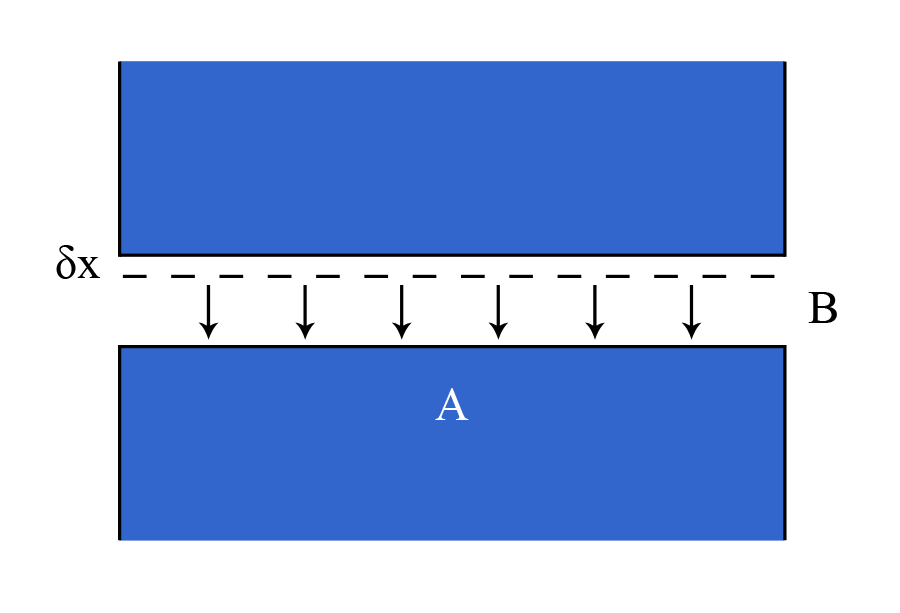
We know that the energy stored in a magnetic field of no magnetic saturation is given by:
where $V$ is the volume, $\mu_0$ the magnetic permeability of free space, and $\mu_r$ the relative magnetic permeability (for a more detailed discussion on the energy stored in a magnetic field see Stored Energy ).
Thus, the change in energy stored following the displacement $\delta x$ will be:
where $\delta V$ ($=A \delta x$) is the change in volume. This leads to:
where $W$ refers to the work done. However, we also know that work can also be defined as:
where $F$ is the force ($Newtons$).
Taking into account equations (5) and (6), we get that:
\calc{A*(B^2/(8*π*10^(-7)*mu_r))} "Instant calculator eq(6)"
from which the magnetic pull force becomes:
Example 1 [metric]
Consider the electromagnet diagramed in Figure E1, characterised by the lengths $l_1 = 20 \; cm$, $l_2 = 15 \; cm$, and $l_g = 0.001 \; cm$, and the area $A = 10 \; cm^2$. Given that a current of $i = 1 A$ passes through a coil with $N = 200$ turns and relative magnetic permeability of $\mu_r = 3000$, find the total magnetic pull force.
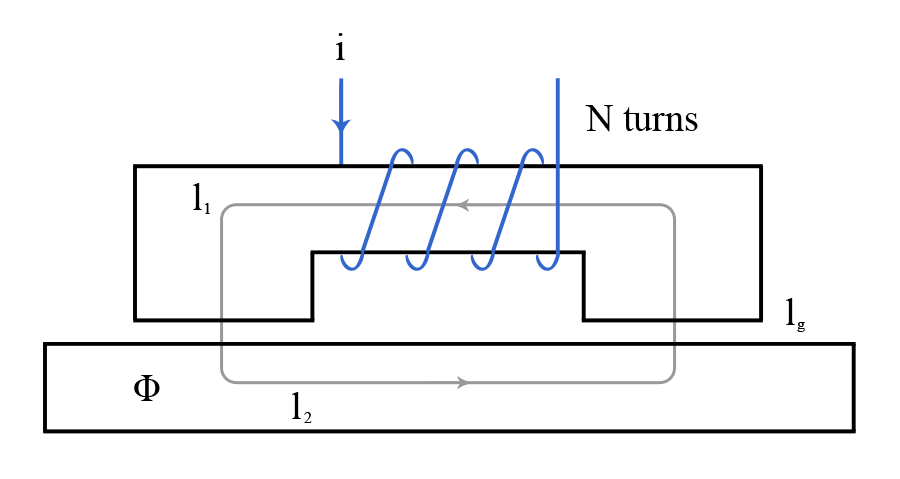
We know that the total magnetic reluctance of a magnetic circuit of length $l$, cross-sectional area $A$, and relative magnetic permeability $\mu_r$, with an air gap of length $l_g$, is given by:
As, in our case, $l=l_1+l_2=20+15 \; cm$ ($=(20+15)\cdot 10^{-2} \; m$), $A=10\; cm^2$ ($=10\cdot 10^{-4} \; m^2$), $\mu_r = 3000$, and $l_g=0.001 \; cm$ ($=0.001 \cdot 10^{-2} \; m$), we obtain the total magnetic reluctance:
which gives:
The total magnetic flux is given by:
where $\mathcal{F}$ is the magnetomotive force:
As, in our case, $N=200$, $i=1\; A$, and $\mathcal{R}=10.88 \cdot 10^4 \; At/Wb$ (from equation 11), we obtain from (12) and (13) that the total magnetic flux is:
Taking into account that the magnetic flux density $B$ is given by:
and also considering (14) and that $A=10\; cm^2$ ($=10\cdot 10^{-4} \; m^2$), we obtain the magnetic flux density in the air gap:
As the magnetic pull force is given by:
and also considering (16), and that $A=10\; cm^2$ ($=10\cdot 10^{-4} \; m^2$), and the relative magnetic permeability of air is $\mu_r = 1$, the magnetic pull per pole becomes:
Thus, we obtain the total magnetic pull force: