
Angle and Cone of friction
The relationship between the Angle and Cone of Friction.
You're viewing an older version of this page (#3944). View the current version.
Description
Engineers often refer to either the coefficient of friction or the angle of friction. This section describes their relationship and goes on to explain the Cone of friction.
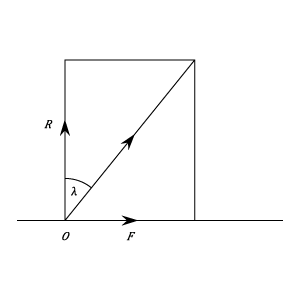
Let R be the normal reaction at a point of contact O and F the frictional force acting in a direction perpendicular to R. Then the total force at O is given by:
acting in a direction making an angle
with the normal reaction.
If friction is limiting, and the action at O makes an angle of
with the normal reaction. This angle is denoted by
.
Thus,
and the magnitude of the limiting friction can be found if either or
is known.
If the direction in which the body tends to move is varied, then the force of limiting friction will always lie in the plane through O, perpendicular to the normal reaction. The direction of the total action at O will always lie on a cone with it's vertex at O and axis along the line of the normal reaction. The semi vertical angle will be .
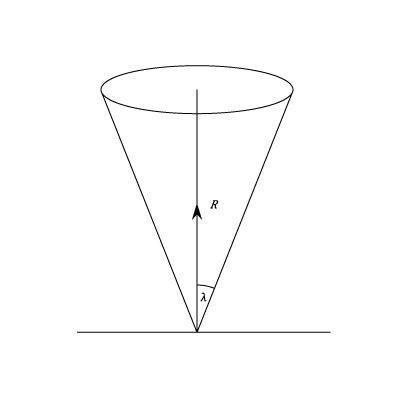
This cone is called the cone of friction. If friction is not limiting, the angle made by the total action at O will be less than . Hence whether the friction be limiting or not, the direction of the total action at O must be inside or on the cone of friction. It follows that if P is the resultant of the other forces acting on the body which is in equilibrium, the direction of P must lie inside or on the cone o friction, since P must balance the total action at O